Department of Respiratory and Critical Care Medicine, Affiliated Jinling Hospital, Medical School, Nanjing University, Nanjing, China.
Department of Respiratory and Critical Care Medicine, Jinling Hospital, Jinling Clinical College of Nanjing Medical University, Nanjing, China.
Thorac Cancer. 2023 May;14(15):1327-1338. doi: 10.1111/1759-7714.14874. Epub 2023 Apr 2.
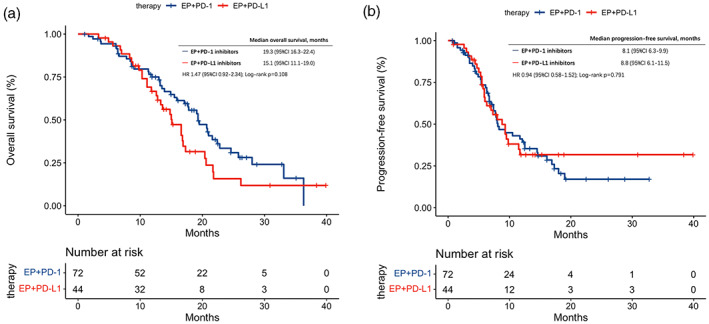
Our research aimed to evaluate the effectiveness of first-line immune checkpoint inhibitors (ICIs) with etoposide and platinum (EP) for extensive-stage small cell lung cancer (ES-SCLC) and identify prognostic factors, as real-world outcomes and the inconsistency of PD-1 and PD-L1 inhibitors are uncertain.
We selected ES-SCLC patients in three centers and conducted a propensity score-matched analysis. The Kaplan-Meier method and Cox proportional hazards regression were conducted to compare the survival outcomes. We also performed univariate and multivariate Cox regression analyses to investigate predictors.
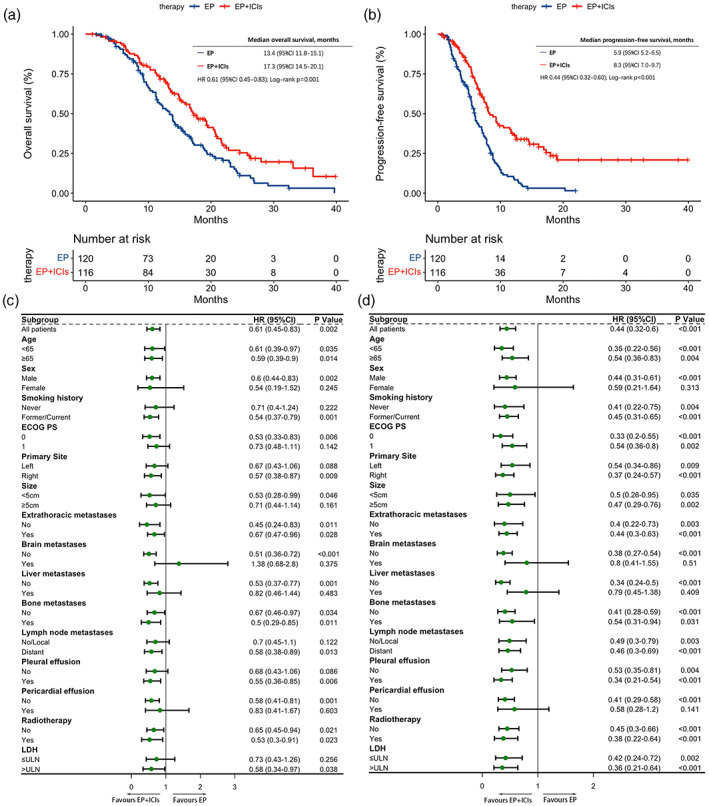
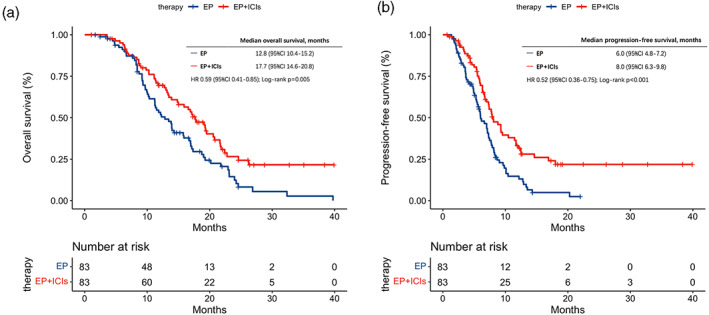
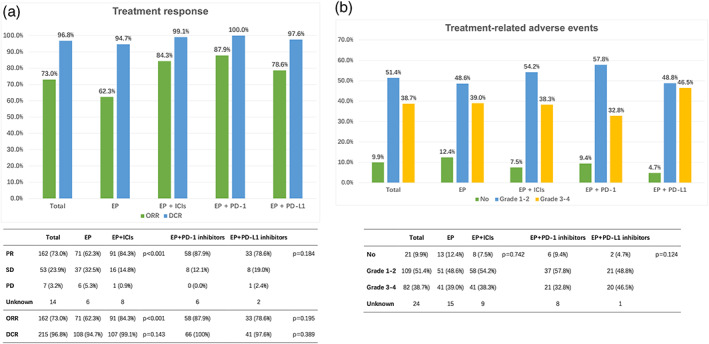
Among 236 patients included, 83 pairs of cases were matched. The EP plus ICIs cohort had a longer median overall survival (OS) (17.3 months) than the EP cohort (13.4 months) (hazard ratio [HR], 0.61 [0.45, 0.83]; p = 0.001). The median progression-free survival (PFS) was also longer in the EP plus ICIs cohort (8.3 months) than in the EP cohort (5.9 months) (HR, 0.44 [0.32, 0.60]; p < 0.001). The EP plus ICIs group had a higher objective response rate (ORR) (EP: 62.3%, EP + ICIs: 84.3%, p < 0.001). Multivariate analysis presented that liver metastases (HR, 2.08; p = 0.018) and lymphocyte-monocyte ratio (LMR) (HR, 0.54; p = 0.049) were independent prognostic factors for OS, and performance status (PS) (HR, 2.11; p = 0.015), liver metastases (HR, 2.64; p = 0.002), and neutrophil-lymphocyte ratio (NLR) (HR, 0.45; p = 0.028) were for PFS in patients with chemo-immunotherapy.
Our real-world data demonstrated that ICIs with chemotherapy as the first-line setting for ES-SCLC are effective and safe. PS, liver metastases, and inflammatory markers could serve as valuable risk factors.
我们的研究旨在评估广泛期小细胞肺癌(ES-SCLC)一线免疫检查点抑制剂(ICI)联合依托泊苷和铂类(EP)的疗效,并确定预后因素,因为真实世界的数据和 PD-1/PD-L1 抑制剂的不一致性尚不确定。
我们选择了三个中心的 ES-SCLC 患者,并进行了倾向评分匹配分析。采用 Kaplan-Meier 方法和 Cox 比例风险回归比较生存结果。我们还进行了单因素和多因素 Cox 回归分析以探讨预测因素。
在纳入的 236 例患者中,有 83 对病例匹配。与 EP 组相比,EP 联合 ICI 组的中位总生存期(OS)(17.3 个月)更长(风险比 [HR],0.61 [0.45,0.83];p=0.001)。EP 联合 ICI 组的中位无进展生存期(PFS)(8.3 个月)也长于 EP 组(5.9 个月)(HR,0.44 [0.32,0.60];p<0.001)。EP 联合 ICI 组客观缓解率(ORR)更高(EP:62.3%,EP+ICI:84.3%,p<0.001)。多因素分析显示,肝转移(HR,2.08;p=0.018)和淋巴细胞-单核细胞比值(LMR)(HR,0.54;p=0.049)是 OS 的独立预后因素,而体能状态(PS)(HR,2.11;p=0.015)、肝转移(HR,2.64;p=0.002)和中性粒细胞-淋巴细胞比值(NLR)(HR,0.45;p=0.028)是化疗免疫治疗患者的 PFS 预后因素。
我们的真实世界数据表明,ICI 联合化疗作为 ES-SCLC 的一线治疗方案是有效且安全的。PS、肝转移和炎症标志物可以作为有价值的风险因素。