Tanaka Anna, Teranishi Shuhei, Kajita Yukihito, Hirose Tomofumi, Kaneko Ayami, Sairenji Yu, Kawashima Hidetoshi, Yumoto Kentaro, Tsukahara Toshinori, Miura Kenji, Kobayashi Nobuaki, Yamamoto Masaki, Nishihira Ryuichi, Kudo Makoto, Miyazawa Naoki, Nishikawa Masanori, Kaneko Takeshi
Respiratory Disease Center, Yokohama City University Medical Center, Yokohama, Japan.
Department of Pulmonology, Yokohama City University Graduate School of Medicine, Yokohama, Japan.
Front Oncol. 2024 Nov 4;14:1400277. doi: 10.3389/fonc.2024.1400277. eCollection 2024.
Total baseline tumor size (BTS) is a prognostic factor for programmed death 1 and programmed death-ligand 1 (PD-L1) inhibitor treatments. However, the prognostic value of total BTS for patients with small-cell lung cancer (SCLC) who receive chemotherapy plus PD-L1 inhibitor remains unknown. Thus, in this study, we aimed to determine whether total BTS is associated with prognosis in patients with SCLC who receive chemotherapy plus PD-L1 inhibitor as first-line therapy.
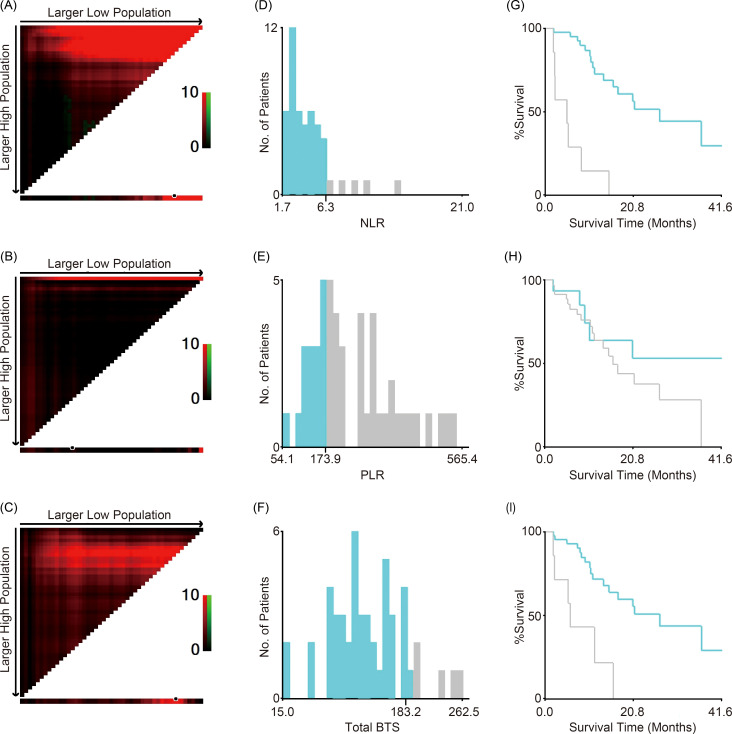
This study included patients with extensive-stage SCLC or post-chemoradiotherapy recurrence of limited-stage SCLC who received chemotherapy plus PD-L1 inhibitor as first-line therapy from August 2019 to December 2022. The two lesions with the largest diameter among the measurable lesions in each organ were selected from up to five organs (maximum of 10 lesions), and the sum of all diameters was defined as total BTS. The patients were divided into two groups, large or small, with total BTS using X-tile software. Median survival was analyzed using the Kaplan-Meier method, and the groups were compared using the log-rank test. Univariate and multivariate analyses examined the association between total BTS and prognosis.
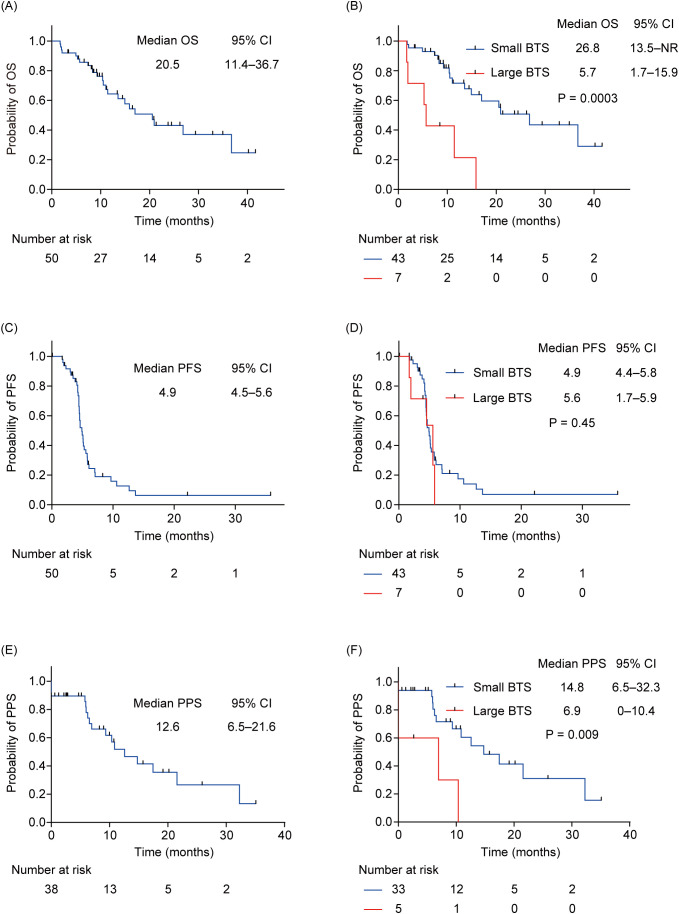
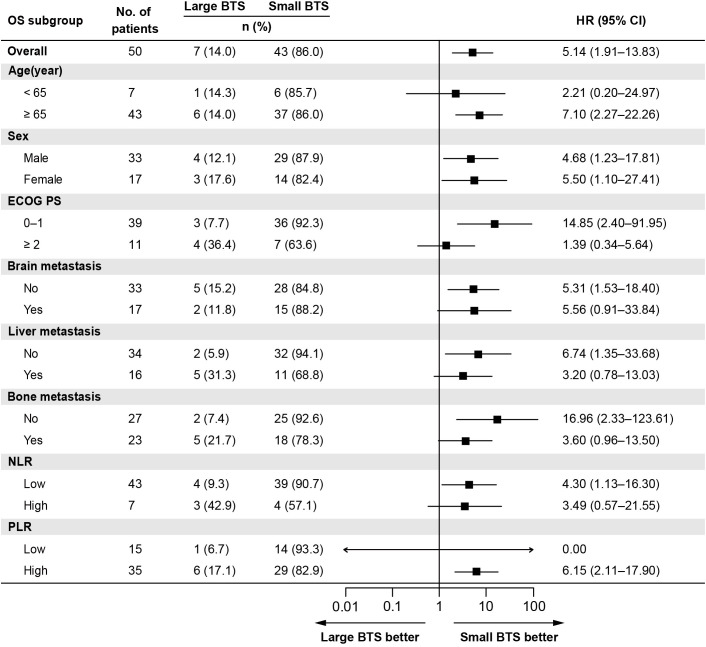
Fifty patients were included; 14% had large total BTS (>183.2 mm) and 86% had small total BTS (≤183.2 mm). The median observation period was 10.5 months. The large total BTS group showed significantly worse overall survival than the small total BTS group (median: 26.8 months vs. 5.7 months, = 0.0003). The multivariate analysis indicated that large total BTS was an independent negative predictor of overall survival (hazard ratio: 7.14, 95% confidence interval: 1.89-26.96).
Total BTS is a potentially useful prognostic factor for patients with advanced SCLC who receive chemotherapy plus PD-L1 inhibitor as first-line therapy.
基线肿瘤总大小(BTS)是程序性死亡1和程序性死亡配体1(PD-L1)抑制剂治疗的一个预后因素。然而,对于接受化疗加PD-L1抑制剂治疗的小细胞肺癌(SCLC)患者,BTS的预后价值尚不清楚。因此,在本研究中,我们旨在确定BTS是否与接受化疗加PD-L1抑制剂作为一线治疗的SCLC患者的预后相关。
本研究纳入了2019年8月至2022年12月期间接受化疗加PD-L1抑制剂作为一线治疗的广泛期SCLC患者或放化疗后复发的局限期SCLC患者。从最多五个器官(最多10个病灶)的可测量病灶中选择每个器官中直径最大的两个病灶,所有直径之和定义为BTS。使用X-tile软件根据BTS将患者分为两组,大或小。采用Kaplan-Meier法分析中位生存期,并使用对数秩检验比较两组。单因素和多因素分析检验了BTS与预后之间的关联。
纳入50例患者;14%的患者BTS较大(>183.2mm),86%的患者BTS较小(≤183.2mm)。中位观察期为10.5个月。BTS较大组的总生存期明显差于BTS较小组(中位生存期:26.8个月对5.7个月,P=0.0003)。多因素分析表明,BTS较大是总生存期的独立负性预测因素(风险比:7.14,95%置信区间:1.89-26.96)。
对于接受化疗加PD-L1抑制剂作为一线治疗的晚期SCLC患者,BTS是一个潜在有用的预后因素。