Nicolson Philippa J A, Holden Melanie A, Marian Ioana R, Williamson Esther, Dutton Susan J, Garrett Angela, Hopewell Sally, Lamb Sarah E
Centre for Rehabilitation Research, Nuffield Department of Orthopaedics, Rheumatology and Musculoskeletal Sciences (NDORMS), , University of Oxford, Oxford, UK.
Primary Care Centre Versus Arthritis, School of Medicine, Keele University, Keele, UK.
Pilot Feasibility Stud. 2023 Apr 1;9(1):56. doi: 10.1186/s40814-023-01275-5.
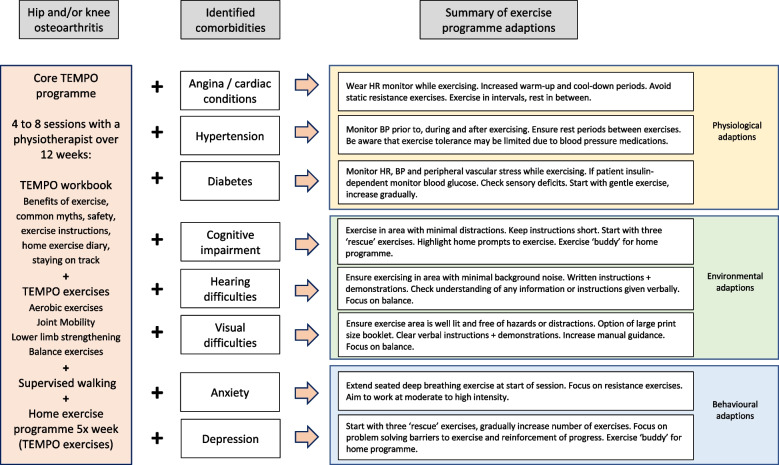
Exercise is recommended for all people with osteoarthritis. However, these recommendations are based on randomised clinical trials including people with an average age between 60 and 70 years, and these findings cannot reliably be generalised to people aged 80 years or older. Rapid loss of muscle occurs after 70 years of age, and older people are more likely to also have other health conditions that contribute to difficulties with daily activities and impact on their response to exercise. To improve care for people aged 80 or older with osteoarthritis, it is thought that a tailored exercise intervention targeting both osteoarthritis and any other health conditions they have, may be needed. The aim of this study will be to test if it is possible to conduct a randomised controlled trial (RCT) for people over 80 years of age with hip/knee osteoarthritis of a tailored exercise intervention.
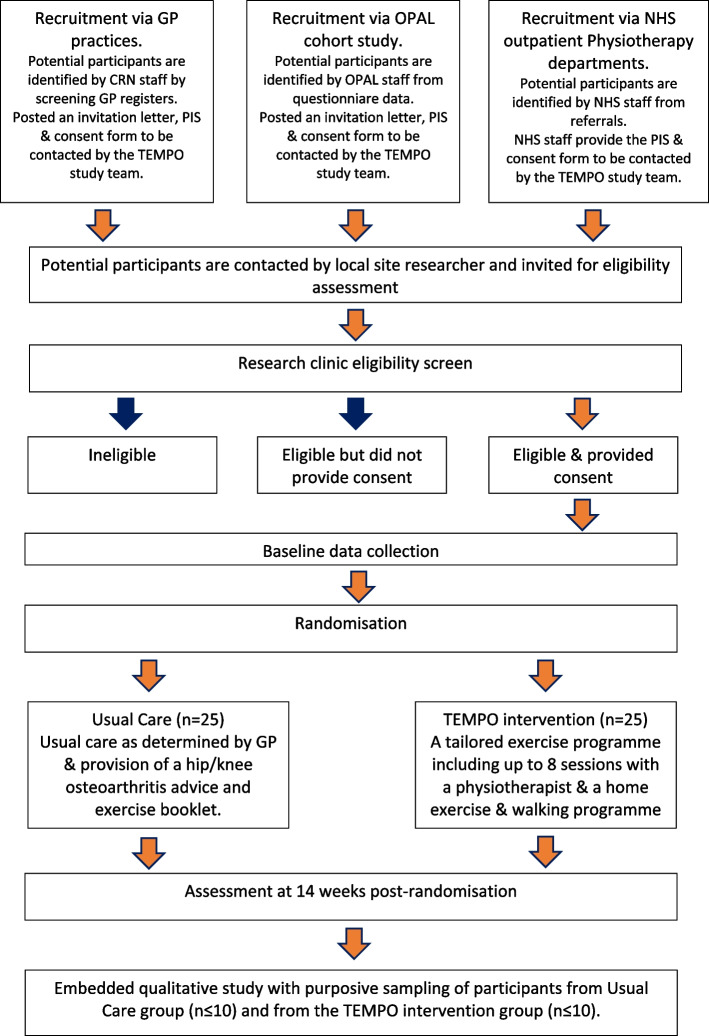
A multicentre, parallel, 2-group, feasibility RCT with embedded qualitative study, conducted in ≥ 3 UK NHS physiotherapy outpatient services. Participants (n ≥ 50) with clinical knee and/or hip osteoarthritis and ≥ 1 comorbidity will be recruited by screening referrals to participating NHS physiotherapy outpatient services, via screening of general practice records and via identification of eligible individuals from a cohort study run by our research group. Participants will be randomised (computer-generated: 1:1) to receive either: a 12-week education and tailored exercise intervention (TEMPO); or usual care and written information. The primary feasibility objectives are to estimate: (1) ability to screen and recruit eligible participants; (2) retention of participants, measured by the proportion of participants who provide outcome data at 14-week follow-up. Secondary quantitative objectives are to estimate: (1) participant engagement assessed by physiotherapy session attendance and home exercise adherence; (2) sample size calculation for a definitive RCT. One-to-one semi-structured interviews will explore the experiences of trial participants and physiotherapists delivering the TEMPO programme.
Progression criteria will be used to determine whether a definitive trial to evaluate the clinical and cost-effectiveness of the TEMPO programme is considered feasible with or without modifications to the intervention or trial design.
ISRCTN75983430. Registered 3/12/2021. https://www.isrctn.com/ISRCTN75983430.
建议所有骨关节炎患者进行锻炼。然而,这些建议是基于随机临床试验得出的,试验对象的平均年龄在60至70岁之间,这些研究结果无法可靠地推广到80岁及以上的人群。70岁以后肌肉会迅速流失,而且老年人更有可能同时患有其他健康问题,这些问题会导致日常活动困难,并影响他们对运动的反应。为了改善对80岁及以上骨关节炎患者的护理,人们认为可能需要一种针对骨关节炎及其所患的任何其他健康问题的量身定制的运动干预措施。本研究的目的是测试是否有可能对80岁及以上患有髋/膝骨关节炎的人群进行一项关于量身定制运动干预措施的随机对照试验(RCT)。
在英国≥3家国民保健服务(NHS)物理治疗门诊服务机构进行一项多中心、平行、两组、具有可行性的随机对照试验,并嵌入定性研究。通过筛选转介至参与试验的NHS物理治疗门诊服务机构、筛查全科医疗记录以及从我们研究小组开展的队列研究中识别符合条件的个体,招募患有临床膝和/或髋骨关节炎且合并症≥1种的参与者(n≥50)。参与者将被随机分配(计算机生成:1:1)接受以下两种方案之一:为期12周的教育和量身定制运动干预(TEMPO);或常规护理及书面信息。主要可行性目标是评估:(1)筛选和招募符合条件参与者的能力;(2)参与者留存率,通过在14周随访时提供结局数据的参与者比例来衡量。次要定量目标是评估:(1)通过物理治疗课程出勤情况和家庭锻炼依从性来评估参与者的参与度;(2)为确定性随机对照试验计算样本量。一对一的半结构化访谈将探讨试验参与者和提供TEMPO方案的物理治疗师的经历。
将使用进展标准来确定是否认为对TEMPO方案的临床和成本效益进行确定性试验是可行的,无论是否对干预措施或试验设计进行修改。
ISRCTN75983430。于2021年12月3日注册。https://www.isrctn.com/ISRCTN75983430。