Department of Internal Medicine, Beijing Obstetrics and Gynecology Hospital, Capital Medical University, Beijing Maternal and Child Health Care Hospital, Beijing, China.
Department of Central Laboratory, Beijing Obstetrics and Gynecology Hospital, Capital Medical University, Beijing Maternal and Child Health Care Hospital, Beijing, China.
Front Immunol. 2023 Mar 14;14:1153901. doi: 10.3389/fimmu.2023.1153901. eCollection 2023.
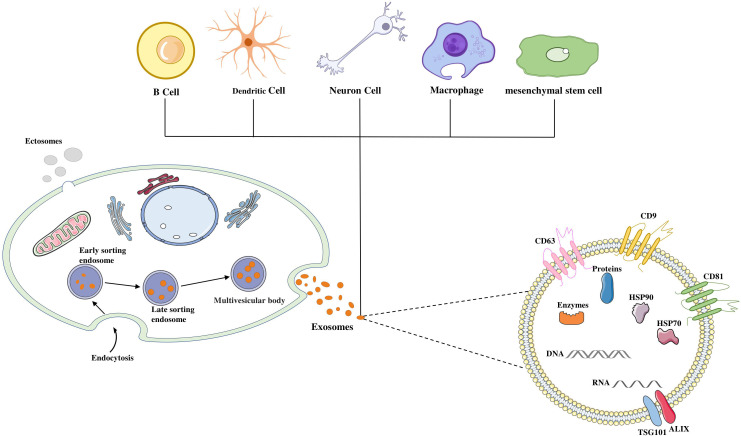
Mesenchymal stem cells (MSCs) are pluripotent stem cells of mesodermal origin with the ability of self-renewal and multidirectional differentiation, which have all the common characteristics of stem cells and the ability to differentiate into adipocytes, osteoblasts, neuron-like cells and other cells. Stem cell derivatives are extracellular vesicles(EVs) released from mesenchymal stem cells that are involved in the process of body's immune response, antigen presentation, cell differentiation, and anti-inflammatory. EVs are further divided into ectosomes and exosomes are widely used in degenerative diseases, cancer, and inflammatory diseases due to their parental cell characteristics. However, most diseases are closely related to inflammation, and exosomes can mitigate the damage caused by inflammation in terms of suppressing the inflammatory response, anti-apoptosis and promoting tissue repair. Stem cell-derived exosomes have become an emerging modality for cell-free therapy because of their high safety and ease of preservation and transportation through intercellular communication. In this review, we highlight the characteristics and functions of MSCs-derived exosomes and discuss the regulatory mechanisms of MSCs-derived exosomes in inflammatory diseases and their potential applications in clinical diagnosis and therapy.
间充质干细胞(MSCs)是中胚层起源的多能干细胞,具有自我更新和多向分化的能力,具有干细胞的所有共同特征和分化为脂肪细胞、成骨细胞、神经元样细胞等细胞的能力。干细胞衍生物是从中胚层干细胞释放的细胞外囊泡(EVs),参与机体免疫反应、抗原呈递、细胞分化和抗炎过程。EVs 进一步分为外泌体和微囊泡,由于其亲本细胞的特性,广泛应用于退行性疾病、癌症和炎症性疾病。然而,大多数疾病都与炎症密切相关,外泌体可以通过抑制炎症反应、抗细胞凋亡和促进组织修复来减轻炎症引起的损伤。由于具有高安全性、易于保存和运输等优点,通过细胞间通讯,干细胞衍生的外泌体已成为一种新兴的无细胞治疗方法。在本文中,我们重点介绍了 MSCs 衍生的外泌体的特征和功能,并讨论了 MSCs 衍生的外泌体在炎症性疾病中的调节机制及其在临床诊断和治疗中的潜在应用。