Mes Lynn, Steffen Ulrike, Chen Hung-Jen, Veth Jennifer, Hoepel Willianne, Griffith Guillermo Romeo, Schett Georg, den Dunnen Jeroen
Center for Experimental and Molecular Medicine, Amsterdam University Medical Centers (UMC), University of Amsterdam, Amsterdam Infection and Immunity Institute, Amsterdam, Netherlands.
Department of Medical Microbiology, Amsterdam University Medical Centers (UMC), University of Amsterdam, Amsterdam Infection and Immunity Institute, Amsterdam, Netherlands.
Front Immunol. 2023 Mar 16;14:1116435. doi: 10.3389/fimmu.2023.1116435. eCollection 2023.
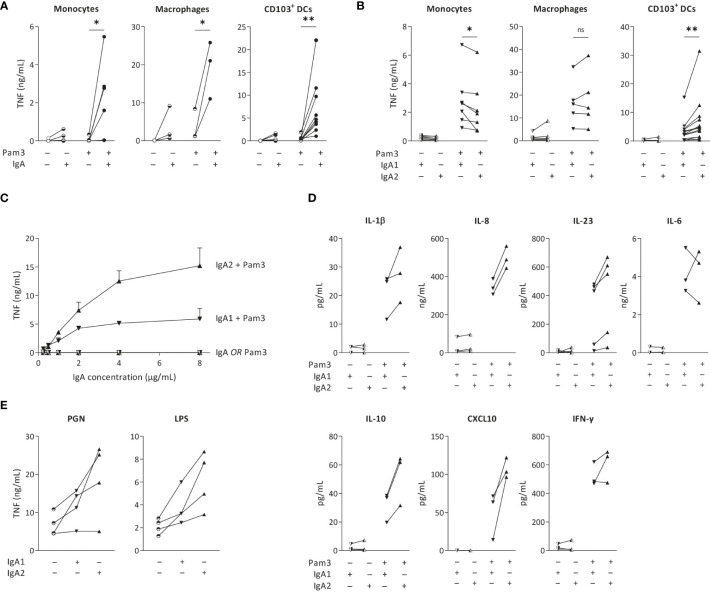
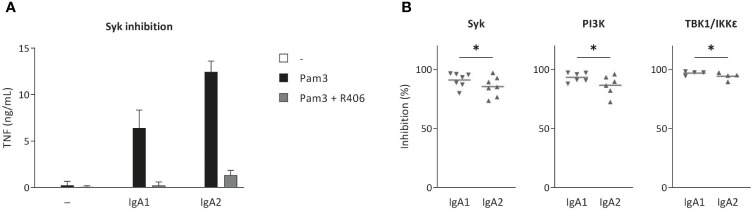
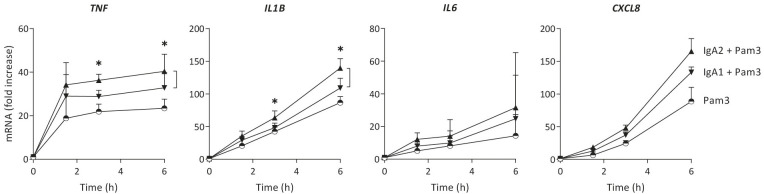
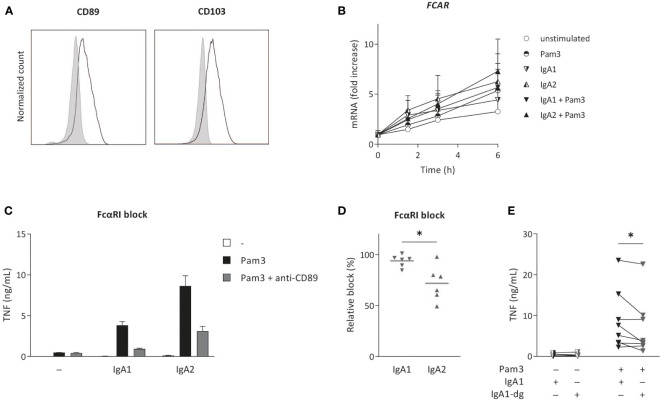
While immunoglobulin A (IgA) is well known for its neutralizing and anti-inflammatory function, it is becoming increasingly clear that IgA can also induce human inflammatory responses by various different immune cells. Yet, little is known about the relative role of induction of inflammation by the two IgA subclasses i.e. IgA1, most prominent subclass in circulation, and IgA2, most prominent subclass in the lower intestine. Here, we set out to study the inflammatory function of IgA subclasses on different human myeloid immune cell subsets, including monocytes, and differentiated macrophages and intestinal CD103 dendritic cells (DCs). While individual stimulation with IgA immune complexes only induced limited inflammatory responses by human immune cells, both IgA subclasses strongly amplified pro-inflammatory cytokine production upon co-stimulation with Toll-like receptor (TLR) ligands such as Pam3CSK4, PGN, and LPS. Strikingly, while IgA1 induced slightly higher or similar levels of pro-inflammatory cytokines by monocytes and macrophages, respectively, IgA2 induced substantially more inflammation than IgA1 by CD103 DCs. In addition to pro-inflammatory cytokine proteins, IgA2 also induced higher mRNA expression levels, indicating that amplification of pro-inflammatory cytokine production is at least partially regulated at the level of gene transcription. Interestingly, cytokine amplification by IgA1 was almost completely dependent on Fc alpha receptor I (FcαRI), whilst blocking this receptor only partially reduced cytokine induction by IgA2. In addition, IgA2-induced amplification of pro-inflammatory cytokines was less dependent on signaling through the kinases Syk, PI3K, and TBK1/IKKϵ. Combined, these findings indicate that IgA2 immune complexes, which are most abundantly expressed in the lower intestine, particularly promote inflammation by human CD103 intestinal DCs. This may serve an important physiological function upon infection, by enabling inflammatory responses by this otherwise tolerogenic DC subset. Since various inflammatory disorders are characterized by disturbances in IgA subclass balance, this may also play a role in the induction or exacerbation of chronic intestinal inflammation.
虽然免疫球蛋白A(IgA)以其中和和抗炎功能而闻名,但越来越清楚的是,IgA也可通过各种不同的免疫细胞诱导人类炎症反应。然而,关于两种IgA亚类即循环中最突出的亚类IgA1和下肠道中最突出的亚类IgA2诱导炎症的相对作用,人们了解甚少。在此,我们着手研究IgA亚类对不同人类髓系免疫细胞亚群的炎症功能,包括单核细胞、分化的巨噬细胞和肠道CD103树突状细胞(DC)。虽然用IgA免疫复合物单独刺激仅诱导人类免疫细胞产生有限的炎症反应,但两种IgA亚类在与Toll样受体(TLR)配体如Pam3CSK4、PGN和LPS共刺激时,均强烈放大促炎细胞因子的产生。引人注目的是,虽然IgA1分别诱导单核细胞和巨噬细胞产生略高或相似水平的促炎细胞因子,但IgA2诱导CD103 DC产生的炎症比IgA1多得多。除了促炎细胞因子蛋白外,IgA2还诱导更高的mRNA表达水平,表明促炎细胞因子产生的放大至少部分在基因转录水平受到调节。有趣的是,IgA1介导的细胞因子放大几乎完全依赖于Fcα受体I(FcαRI),而阻断该受体仅部分降低IgA2诱导的细胞因子产生。此外,IgA2诱导的促炎细胞因子放大对通过激酶Syk、PI3K和TBK1/IKKε的信号传导依赖性较小。综合来看,这些发现表明,在下肠道中大量表达的IgA2免疫复合物尤其通过人类CD103肠道DC促进炎症。这在感染时可能发挥重要的生理功能,使这个原本具有耐受性的DC亚群能够引发炎症反应。由于各种炎症性疾病的特征是IgA亚类平衡紊乱,这也可能在慢性肠道炎症的诱导或加重中起作用。