Zhou Mingzhi, Ma Hanxi, Wu Jiangyue, Zhou Jiangping
Department of Urban Planning and Design, Faculty of Architecture; Urban Systems Institute, The University of Hong Kong, Pok Fu Lam, Hong Kong, China.
Cities. 2023 Jun;137:104307. doi: 10.1016/j.cities.2023.104307. Epub 2023 Mar 27.
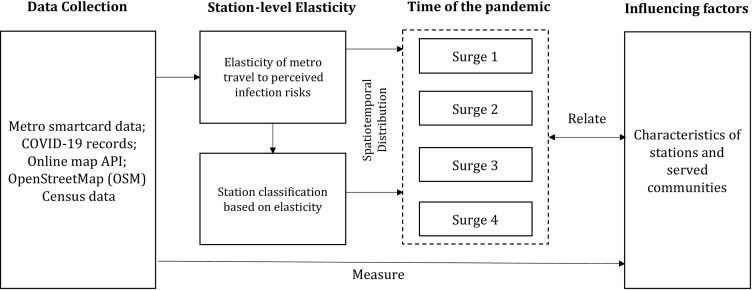
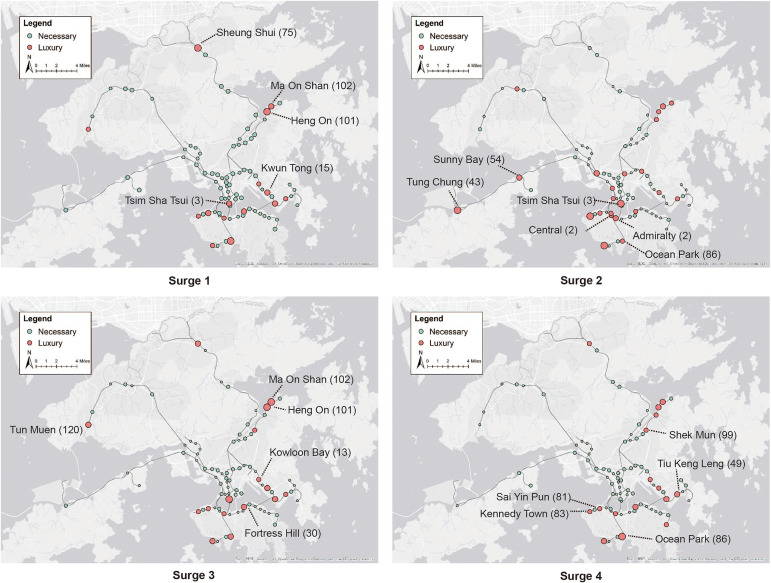
The COVID-19 pandemic has exerted unprecedented impacts on travel behaviors because of people's increased health precautions and the presence of various COVID-19 containment measures. However, little research has explored whether and how people changed their travel with respect to their perceived local infection risks across space and time. In this article, we relate elasticity and resilience thinking to the changes in metro travel and perceived infection risks at the station or community level over time. Using empirical data from Hong Kong, we measure a metro station's elasticity as the ratio of changes in its average trip length to the COVID-19 cases' footprints around that station. We regard those footprints as a proxy for people's perceived infection risks when making trips to that station. To explore influencing factors on travel in the ups and downs of perceived infection risks, we classify stations based on their elasticity values and examine the association between stations' elasticities and characteristics of stations and their served communities. The findings show that stations varied in elasticity values across space and different surges of the local pandemic. The elasticity of stations can be predicted by socio-demographics and physical attributes of station areas. Stations serving a larger percentage of population with higher education degrees and certain occupations observed more pronounced trip length decrease for the same level of perceived infection risks. The number of parking spaces and retail facilities significantly explained variations in stations' elasticity. The results provide references on crisis management and resilience improvement amid and post COVID-19.
由于人们加强了健康预防措施以及存在各种新冠疫情防控措施,新冠疫情对出行行为产生了前所未有的影响。然而,很少有研究探讨人们是否以及如何根据他们对不同时空的当地感染风险的认知来改变出行。在本文中,我们将弹性和恢复力思维与地铁出行的变化以及车站或社区层面随时间变化的感知感染风险联系起来。利用香港的实证数据,我们将地铁站的弹性衡量为其平均出行长度变化与该站周围新冠病例足迹的比率。我们将这些足迹视为人们前往该站出行时感知感染风险的一个代理指标。为了探究在感知感染风险起伏中影响出行的因素,我们根据弹性值对车站进行分类,并研究车站弹性与车站及其服务社区特征之间的关联。研究结果表明,不同空间的车站以及当地疫情的不同激增阶段,弹性值存在差异。车站的弹性可以通过车站区域的社会人口统计学和物理属性来预测。对于相同水平的感知感染风险,服务于较高比例高学历人口和某些职业人群的车站,出行长度下降更为明显。停车位数量和零售设施显著解释了车站弹性的差异。研究结果为新冠疫情期间及之后的危机管理和恢复力提升提供了参考。