
在新冠疫情期间使用共享出行服务的感知风险。
Perceived risk of using shared mobility services during the COVID-19 pandemic.
作者信息
Rahimi Ehsan, Shabanpour Ramin, Shamshiripour Ali, Kouros Mohammadian Abolfazl
机构信息
Department of Civil, Materials, and Environmental Engineering, University of Illinois at Chicago, IL, USA.
College of Computing, Engineering & Construction, University of North Florida, FL, USA.
出版信息
Transp Res Part F Traffic Psychol Behav. 2021 Aug;81:271-281. doi: 10.1016/j.trf.2021.06.012. Epub 2021 Jun 29.
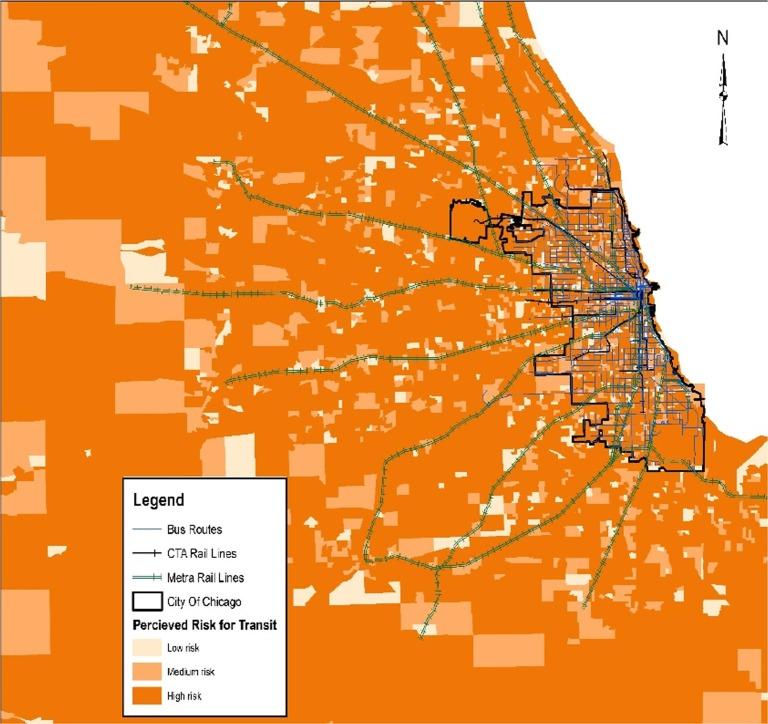
The COVID-19 pandemic has caused our daily routines to change quickly. The pandemic provokes public fear, resulting in changes in what modes of transport people use to perform their daily activities. It is imperative for transportation authorities to properly identify the different degrees of behavioral change among various social groups. A major factor that can substantially explain individuals' behavioral changes is the personal risk perceptions toward using shared mobility solutions. Thus, this study explores the risk that individuals perceive while using public transit and ridesharing services (as the most widespread forms of shared mobility) during the COVID-19 pandemic. To do so, we designed and implemented a multidimensional travel-behavior survey in the Chicago metropolitan area that comprises socio-demographic information and retrospective questions related to attitudes and travel behavior before and during the pandemic. Utilizing a bivariate ordered probit modeling approach to better account for the potential correlation between unobserved factors, we simultaneously modeled the perceived risk of exposure to the novel coronavirus in case of riding transit and using ridesharing services. A wide range of factors is found to be influential on the perceived risk of using shared mobility services, including the socio-demographic attributes, built environment settings, and the virus spread. Further, our results indicate that the mitigation strategies to increase the ridership of shared mobility services should be adaptive considering the spatial variations.
新冠疫情使我们的日常生活迅速发生变化。疫情引发了公众恐慌,导致人们在日常活动中使用的交通方式发生改变。交通部门必须正确识别不同社会群体行为变化的不同程度。一个能充分解释个人行为变化的主要因素是对使用共享出行解决方案的个人风险认知。因此,本研究探讨了在新冠疫情期间,个人在使用公共交通和拼车服务(作为共享出行最普遍的形式)时所感知到的风险。为此,我们在芝加哥大都市区设计并实施了一项多维出行行为调查,其中包括社会人口信息以及与疫情之前和期间的态度和出行行为相关的回顾性问题。利用双变量有序概率模型方法来更好地考虑未观察因素之间的潜在相关性,我们同时对乘坐公共交通和使用拼车服务时接触新型冠状病毒的感知风险进行了建模。研究发现,包括社会人口属性、建成环境设置和病毒传播在内的多种因素,对使用共享出行服务的感知风险有影响。此外,我们的结果表明,考虑到空间差异,增加共享出行服务乘客量的缓解策略应该具有适应性。


 Zotero 插件