Department of Orthopaedic Surgery, Hanyang University Medical Center, Seoul, Korea.
Department of Orthopaedic Surgery, Hanyang University Guri Hospital, Guri, Korea.
Clin Orthop Surg. 2023 Apr;15(2):290-299. doi: 10.4055/cios22163. Epub 2022 Nov 22.
The aim of this study was to determine the nationwide shoulder arthroplasty trends in South Korea based on an analysis of nationwide data acquired from the Korean Health Insurance Review and Assessment Service (HIRA).
We analyzed a nationwide database acquired from the HIRA that covered 2008 to 2017. International Classification of Diseases, 10th Revision (ICD-10) codes and procedure codes were used to identify patients who underwent shoulder arthroplasty, including total shoulder arthroplasty (TSA), hemiarthroplasty (HA), and revision shoulder arthroplasty.
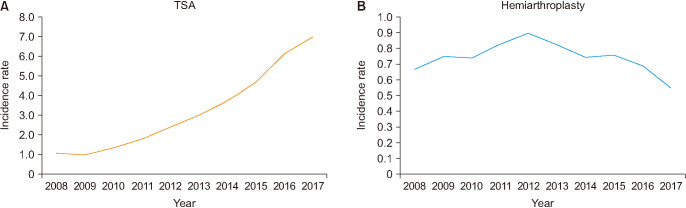
From 2008 to 2017, a total of 19,831 shoulder arthroplasties were performed; there were 16,162 TSAs and 3,669 hemiarthroplasties. During the 10-year study period, there was an exponential increase in the incidence of TSA (from 513 cases in 2008 to 3,583 cases in 2017), while the number of hemiarthroplasties remained steady. The most common diagnoses for TSA were rotator cuff tears (6,304 cases, 39.0%) and osteoarthritis (6,589 cases, 40.8%) for all 9 years. Osteoarthritis was the most common reason for TSA during the first 3 years (2008-2010), but rotator cuff tears ultimately surpassed osteoarthritis during the last 3 years (2015-2017). HA was performed to treat proximal humerus fracture (1,770 cases, 48.2%) and osteoarthritis (774 cases, 21.1%). In terms of hospital types, the rate of TSA in hospitals with 30-100 inpatient beds increased from 21.83% to 46.27%, while the rates of the other types of surgery decreased. A total of 430 revision surgeries were performed during the study period, and infection (152 cases, 35.3%) was the most common reason for revision surgery.
Overall, the total count and incidence of TSA, unlike HA, increased rapidly between 2008 and 2017 in South Korea. Moreover, at the end of the study period, nearly half of the TSAs were performed in small hospitals (30 to 100 beds). Rotator cuff tears were the leading cause of TSA at the end of the study period. These findings revealed an explosive increase in reverse TSA surgery.
本研究旨在通过对韩国健康保险审查与评估服务(HIRA)获得的全国性数据进行分析,确定韩国全国范围内的肩关节置换趋势。
我们分析了 HIRA 获得的一个全国性数据库,该数据库涵盖了 2008 年至 2017 年的数据。使用国际疾病分类,第 10 版(ICD-10)代码和手术代码来识别接受肩关节置换术的患者,包括全肩关节置换术(TSA)、半肩关节置换术(HA)和肩关节翻修术。
2008 年至 2017 年期间,共进行了 19831 例肩关节置换术;其中 TSA 为 16162 例,HA 为 3669 例。在 10 年的研究期间,TSA 的发病率呈指数增长(从 2008 年的 513 例增加到 2017 年的 3583 例),而 HA 的数量保持稳定。TSA 的最常见诊断是肩袖撕裂(6304 例,39.0%)和所有 9 年的骨关节炎(6589 例,40.8%)。在最初的 3 年(2008-2010 年),骨关节炎是 TSA 最常见的原因,但在最后 3 年(2015-2017 年),肩袖撕裂最终超过了骨关节炎。HA 用于治疗肱骨头骨折(1770 例,48.2%)和骨关节炎(774 例,21.1%)。就医院类型而言,30-100 张住院病床的医院中 TSA 的比例从 21.83%增加到 46.27%,而其他类型手术的比例则下降。在研究期间共进行了 430 例翻修手术,感染(152 例,35.3%)是翻修手术的最常见原因。
总体而言,与 HA 不同,2008 年至 2017 年期间,韩国 TSA 的总数和发病率迅速增加。此外,在研究期末,近一半的 TSA 手术是在小医院(30 至 100 张床位)进行的。肩袖撕裂是研究期末 TSA 的主要原因。这些发现显示了反向 TSA 手术的爆发式增长。