Schuster Randi M, Cather Corinne, Pachas Gladys N, Nielsen Lindsay, Iroegbulem Vanessa, Dufour Jason, Potter Kevin, Levy Sharon, Gray Kevin M, Evins A Eden
Department of Psychiatry, Center of Addiction Medicine, Massachusetts General Hospital, Boston, MA, United States.
Harvard Medical School, Boston, MA, United States.
Front Psychiatry. 2023 Mar 15;14:1083791. doi: 10.3389/fpsyt.2023.1083791. eCollection 2023.
Approximately one-fifth of high-school seniors and college students currently vape nicotine. Adolescents express a desire to quit vaping, and case reports have shown promise for e-cigarette tapering with dual behavioral and pharmacologic therapies. However, there are no published clinical trials to date that test these intervention approaches for adolescent nicotine vaping cessation. In this three-arm randomized, placebo-controlled, parallel-group study, we aim to assess the efficacy of varenicline in combination with brief behavioral counseling and texting support on vaping cessation in adolescents dependent on vaped nicotine.
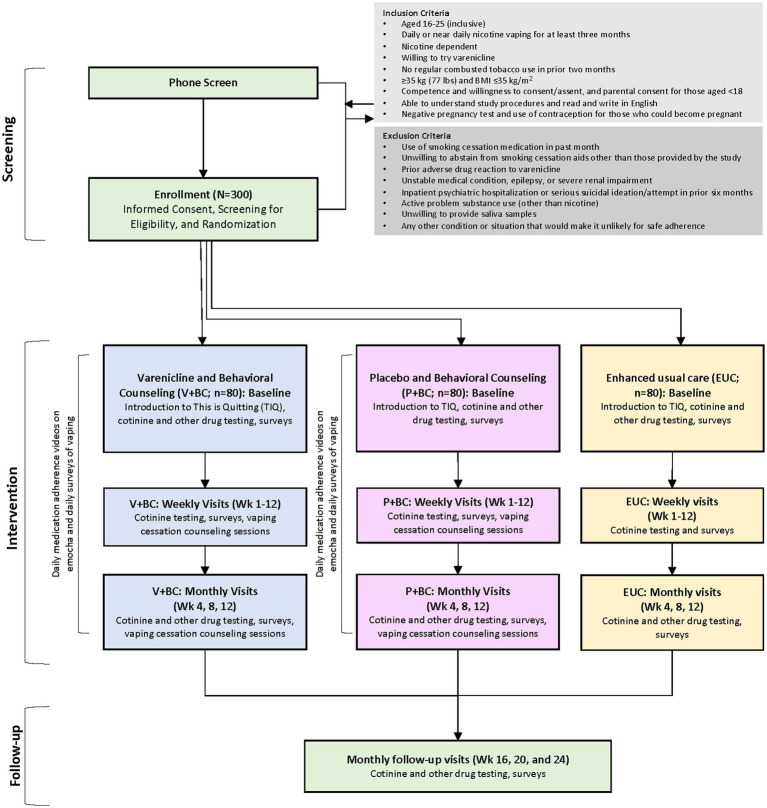
The study will enroll 300 individuals between the ages of 16-25 with daily or near-daily nicotine vaping who reside in the Greater Boston area. Participants will be randomly assigned in a 1:1:1 ratio in blocks of six to one of the three arms: (1) a 12-week course of varenicline titrated to 1 mg bid, brief behavioral counseling delivered by a lay counselor, and an introduction to This is Quitting (TIQ) texting support created by the Truth Initiative; (2) a 12-week course of placebo, brief behavioral counseling, and TIQ; and (3) 12 weeks of enhanced usual care, consisting of advice to quit and an introduction to TIQ. The primary outcome will be biochemically verified continuous vaping abstinence at the end of the treatment (week 12). Secondary outcomes include continuous abstinence at follow-up (week 24), 7-day point prevalence abstinence at weeks 12 and 24, safety and tolerability of varenicline in an adolescent vaping population, as well as change in mood and nicotine withdrawal symptoms across the intervention period. Exploratory outcomes include change in comorbid substance use behaviors and nicotine dependence. Analysis will be intent-to-treat, with multiple imputation sensitivity analyses for participants with missing or incomplete outcome data.
This is the first study to evaluate varenicline in combination with a novel, brief, lay counselor delivered vaping cessation program for adolescents who vape nicotine. Results will inform clinicians on the effectiveness and acceptability of this promising, but not yet tested intervention.: ClinicalTrials.gov, identifier NCT05367492.
目前,约五分之一的高中高年级学生和大学生吸食含尼古丁的电子烟。青少年表示有戒烟的意愿,病例报告显示,双重行为和药物疗法在逐渐减少电子烟使用方面具有前景。然而,迄今为止,尚无已发表的临床试验来测试这些干预方法对青少年尼古丁电子烟戒烟的效果。在这项三臂随机、安慰剂对照、平行组研究中,我们旨在评估伐尼克兰联合简短行为咨询和短信支持对依赖含尼古丁电子烟的青少年戒烟的疗效。
该研究将招募300名年龄在16至25岁之间、居住在大波士顿地区、每天或几乎每天吸食含尼古丁电子烟的个体。参与者将以1:1:1的比例,按每六个一组进行随机分配,进入以下三个组之一:(1)为期12周的伐尼克兰疗程,滴定至每日两次、每次1毫克,由非专业顾问提供简短行为咨询,并介绍由真相倡议组织创建的“这就是戒烟”(TIQ)短信支持;(2)为期12周的安慰剂疗程、简短行为咨询和TIQ;(3)为期12周的强化常规护理,包括戒烟建议和TIQ介绍。主要结局将是治疗结束时(第12周)经生化验证的持续电子烟戒断。次要结局包括随访时(第24周)的持续戒断、第12周和第24周的7天点患病率戒断、伐尼克兰在青少年电子烟人群中的安全性和耐受性,以及整个干预期内情绪和尼古丁戒断症状的变化。探索性结局包括共病物质使用行为和尼古丁依赖的变化。分析将采用意向性治疗,对结局数据缺失或不完整的参与者进行多重插补敏感性分析。
这是第一项评估伐尼克兰联合一种新颖、简短、由非专业顾问提供的针对吸食含尼古丁电子烟青少年的戒烟计划的研究。结果将为临床医生提供有关这种有前景但尚未经过测试的干预措施的有效性和可接受性的信息。:ClinicalTrials.gov标识符NCT05367492。