Huang Linxi, Yoo Hye-Jong, Abe Satoko, Yoon Jihyun
Department of Food and Nutrition, Seoul National University, Seoul 08826, Korea.
Research Institute of Human Ecology, Seoul National University, Seoul 08826, Korea.
Nutr Res Pract. 2023 Apr;17(2):341-355. doi: 10.4162/nrp.2023.17.2.341. Epub 2022 Sep 23.
BACKGROUND/OBJECTIVES: The consumption of dietary supplements has shown an increase among young people in their 20s. We aimed to compare the use of dietary supplements and related factors between Chinese international and Korean college students living in South Korea.
SUBJECTS/METHODS: We conducted online surveys of 400 Chinese international students and 452 Korean college students from January to February 2021. We analyzed the factors related to the use of dietary supplements by these students using multi-group structural equation modeling and logistic regression analysis.
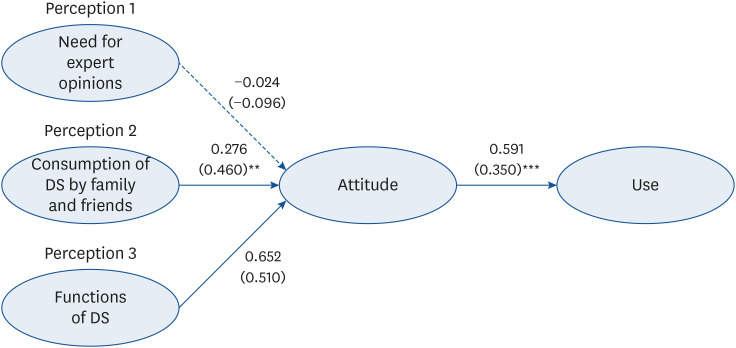
Approximately 65% of the Chinese international students and 93% of the Korean college students consumed dietary supplements at least once in the year preceding the survey. The common types of dietary supplements consumed by both groups of students were vitamin and mineral supplements, products, and red ginseng products. Structural equation modeling showed that perception of the consumption of dietary supplements by family and friends positively influenced attitude toward dietary supplements. This effect was higher for Korean college students than for Chinese international students ( < 0.01). Attitude toward dietary supplements positively influenced their use, and this effect was higher for Chinese international students than for Korean college students ( < 0.001). Logistic regression analysis showed that the use of dietary supplements by Chinese international students was significantly associated with age, self-reported health status, interest in health, perception of and attitude toward dietary supplements, and length of residence in South Korea. Among Korean college students, it was associated with exercise frequency and attitude toward dietary supplements.
This study showed significant differences in the use of dietary supplements and related factors between Chinese international and Korean college students. Therefore, nutrition education programs on dietary supplements need to have differentiated content for each group. Such differences also suggest that the industry should consider the relevant characteristics of college students while developing and marketing dietary supplements.
背景/目的:20多岁的年轻人对膳食补充剂的消费呈上升趋势。我们旨在比较在韩国生活的中国留学生和韩国大学生对膳食补充剂的使用情况及相关因素。
对象/方法:2021年1月至2月,我们对400名中国留学生和452名韩国大学生进行了在线调查。我们使用多组结构方程模型和逻辑回归分析,分析了这些学生使用膳食补充剂的相关因素。
在调查前一年,约65%的中国留学生和93%的韩国大学生至少消费过一次膳食补充剂。两组学生消费的常见膳食补充剂类型为维生素和矿物质补充剂、产品以及红参产品。结构方程模型显示,家人和朋友对膳食补充剂消费的认知对膳食补充剂的态度有积极影响。韩国大学生的这种影响高于中国留学生(<0.01)。对膳食补充剂的态度对其使用有积极影响,中国留学生的这种影响高于韩国大学生(<0.001)。逻辑回归分析显示,中国留学生使用膳食补充剂与年龄、自我报告的健康状况、对健康的兴趣、对膳食补充剂的认知和态度以及在韩国的居住时间显著相关。在韩国大学生中,它与运动频率和对膳食补充剂的态度有关。
本研究表明,中国留学生和韩国大学生在膳食补充剂的使用及相关因素方面存在显著差异。因此,关于膳食补充剂的营养教育项目需要针对每个群体有不同的内容。这些差异还表明,该行业在开发和销售膳食补充剂时应考虑大学生的相关特征。