• 文献检索
  • 文档翻译
  • 深度研究
  • 学术资讯
  • Suppr Zotero 插件Zotero 插件
  • 邀请有礼
  • 套餐&价格
  • 历史记录
应用&插件
Suppr Zotero 插件Zotero 插件浏览器插件Mac 客户端Windows 客户端微信小程序
定价
高级版会员购买积分包购买API积分包
服务
文献检索文档翻译深度研究API 文档MCP 服务
关于我们
关于 Suppr公司介绍联系我们用户协议隐私条款
关注我们

Suppr 超能文献

核心技术专利:CN118964589B侵权必究
粤ICP备2023148730 号-1Suppr @ 2026

文献检索

告别复杂PubMed语法,用中文像聊天一样搜索,搜遍4000万医学文献。AI智能推荐,让科研检索更轻松。

立即免费搜索

文件翻译

保留排版,准确专业,支持PDF/Word/PPT等文件格式,支持 12+语言互译。

免费翻译文档

深度研究

AI帮你快速写综述,25分钟生成高质量综述,智能提取关键信息,辅助科研写作。

立即免费体验

受体通过 E3 泛素连接酶招募进行消除(REULR):一种靶向蛋白质降解工具箱。

Receptor Elimination by E3 Ubiquitin Ligase Recruitment (REULR): A Targeted Protein Degradation Toolbox.

机构信息

Department of Molecular and Cellular Physiology, Stanford University School of Medicine, Stanford, California 94305, United States.

Department of Structural Biology, Stanford University School of Medicine, Stanford, California 94305, United States.

出版信息

ACS Synth Biol. 2023 Apr 21;12(4):1081-1093. doi: 10.1021/acssynbio.2c00587. Epub 2023 Apr 3.

DOI:10.1021/acssynbio.2c00587
PMID:37011906
原文链接:https://pmc.ncbi.nlm.nih.gov/articles/PMC10127277/
Abstract

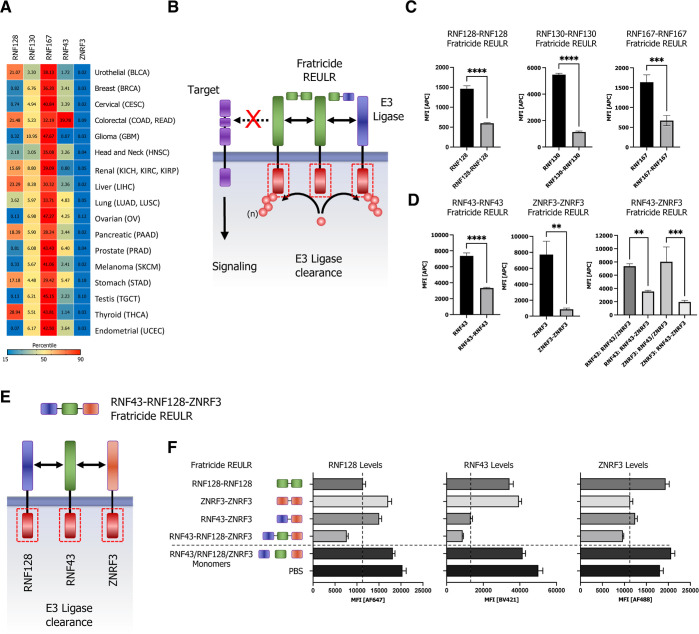
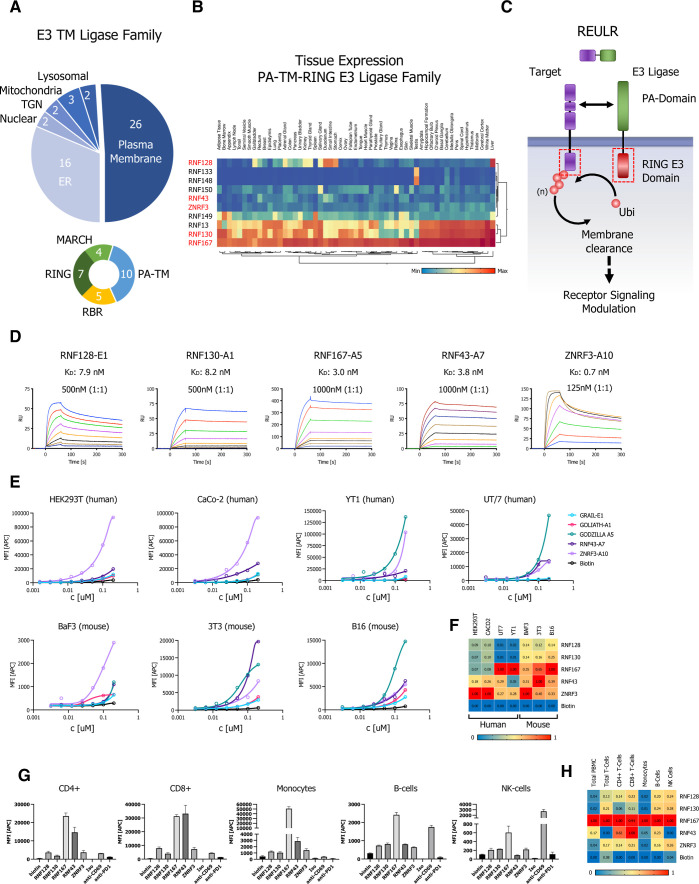
In recent years, targeted protein degradation (TPD) of plasma membrane proteins by hijacking the ubiquitin proteasome system (UPS) or the lysosomal pathway has emerged as a novel therapeutic avenue in drug development to address and inhibit canonically difficult targets. While TPD strategies have been successful in targeting cell surface receptors, these approaches are limited by the availability of suitable binders to generate heterobifunctional molecules. Here, we present the development of a nanobody (VHH)-based degradation toolbox termed REULR (Receptor Elimination by E3 Ubiquitin Ligase Recruitment). We generated human and mouse cross-reactive nanobodies against five transmembrane PA-TM-RING-type E3 ubiquitin ligases (RNF128, RNF130, RNF167, RNF43, and ZNRF3), covering a broad range and selectivity of tissue expression, with which we characterized the expression in human and mouse cell lines and immune cells (PBMCs). We demonstrate that heterobifunctional REULR molecules can enforce transmembrane E3 ligase interactions with a variety of disease-relevant target receptors (EGFR, EPOR, and PD-1) by induced proximity, resulting in effective membrane clearance of the target receptor at varying levels. In addition, we designed E3 ligase self-degrading molecules, "fratricide" REULRs (RNF128, RNF130, RENF167, RNF43, and ZNRF3), that allow downregulation of one or several E3 ligases from the cell surface and consequently modulate receptor signaling strength. REULR molecules represent a VHH-based modular and versatile "mix and match" targeting strategy for the facile modulation of cell surface proteins by induced proximity to transmembrane PA-TM-RING E3 ligases.

摘要

近年来,通过劫持泛素蛋白酶体系统 (UPS) 或溶酶体途径靶向质膜蛋白的靶向蛋白降解 (TPD) 已成为药物开发中的一种新的治疗途径,以解决和抑制传统上难以靶向的靶点。虽然 TPD 策略在靶向细胞表面受体方面取得了成功,但这些方法受到可用的合适配体来产生异双功能分子的限制。在这里,我们提出了一种基于纳米抗体 (VHH) 的降解工具箱,称为 REULR(通过 E3 泛素连接酶招募受体消除)。我们针对五个跨膜 PA-TM-RING 型 E3 泛素连接酶 (RNF128、RNF130、RNF167、RNF43 和 ZNRF3) 生成了人源和鼠源交叉反应性纳米抗体,涵盖了广泛的组织表达选择性,并用其对人源和鼠源细胞系和免疫细胞(PBMCs)进行了特征描述。我们证明,异双功能 REULR 分子可以通过诱导接近,强制跨膜 E3 连接酶与各种与疾病相关的靶受体(EGFR、EPOR 和 PD-1)相互作用,从而有效清除靶受体的膜。此外,我们设计了 E3 连接酶自降解分子,“自噬”REULR(RNF128、RNF130、RENF167、RNF43 和 ZNRF3),允许从细胞表面下调一个或几个 E3 连接酶,从而调节受体信号强度。REULR 分子代表了一种基于 VHH 的模块化和多功能“混合搭配”的靶向策略,用于通过与跨膜 PA-TM-RING E3 连接酶的诱导接近来方便地调节细胞表面蛋白。
https://cdn.ncbi.nlm.nih.gov/pmc/blobs/c7ba/10127277/6b90af8c5dca/sb2c00587_0007.jpg
https://cdn.ncbi.nlm.nih.gov/pmc/blobs/c7ba/10127277/b7a97eb59b2c/sb2c00587_0002.jpg
https://cdn.ncbi.nlm.nih.gov/pmc/blobs/c7ba/10127277/4ccfcbde0ab0/sb2c00587_0003.jpg
https://cdn.ncbi.nlm.nih.gov/pmc/blobs/c7ba/10127277/f55ad7caf025/sb2c00587_0004.jpg
https://cdn.ncbi.nlm.nih.gov/pmc/blobs/c7ba/10127277/b3593e46c638/sb2c00587_0005.jpg
https://cdn.ncbi.nlm.nih.gov/pmc/blobs/c7ba/10127277/cb482a74b331/sb2c00587_0006.jpg
https://cdn.ncbi.nlm.nih.gov/pmc/blobs/c7ba/10127277/6b90af8c5dca/sb2c00587_0007.jpg
https://cdn.ncbi.nlm.nih.gov/pmc/blobs/c7ba/10127277/b7a97eb59b2c/sb2c00587_0002.jpg
https://cdn.ncbi.nlm.nih.gov/pmc/blobs/c7ba/10127277/4ccfcbde0ab0/sb2c00587_0003.jpg
https://cdn.ncbi.nlm.nih.gov/pmc/blobs/c7ba/10127277/f55ad7caf025/sb2c00587_0004.jpg
https://cdn.ncbi.nlm.nih.gov/pmc/blobs/c7ba/10127277/b3593e46c638/sb2c00587_0005.jpg
https://cdn.ncbi.nlm.nih.gov/pmc/blobs/c7ba/10127277/cb482a74b331/sb2c00587_0006.jpg
https://cdn.ncbi.nlm.nih.gov/pmc/blobs/c7ba/10127277/6b90af8c5dca/sb2c00587_0007.jpg

相似文献

1
Receptor Elimination by E3 Ubiquitin Ligase Recruitment (REULR): A Targeted Protein Degradation Toolbox.受体通过 E3 泛素连接酶招募进行消除(REULR):一种靶向蛋白质降解工具箱。
ACS Synth Biol. 2023 Apr 21;12(4):1081-1093. doi: 10.1021/acssynbio.2c00587. Epub 2023 Apr 3.
2
Ligandability of E3 Ligases for Targeted Protein Degradation Applications.E3 连接酶的配体化在靶向蛋白降解应用中的研究进展。
Biochemistry. 2023 Feb 7;62(3):588-600. doi: 10.1021/acs.biochem.1c00464. Epub 2021 Sep 2.
3
Targeted Degradation of 53BP1 Using Ubiquitin Variant Induced Proximity.利用泛素变体诱导的邻近性靶向降解 53BP1。
Biomolecules. 2022 Mar 22;12(4):479. doi: 10.3390/biom12040479.
4
Targeted Protein Degradation through E2 Recruitment.通过 E2 招募实现靶向蛋白降解。
ACS Chem Biol. 2023 Apr 21;18(4):897-904. doi: 10.1021/acschembio.3c00040. Epub 2023 Mar 20.
5
Redirecting the specificity of tripartite motif containing-21 scaffolds using a novel discovery and design approach.利用新发现和设计方法改变三结构域包含蛋白 21 支架的特异性。
J Biol Chem. 2023 Dec;299(12):105381. doi: 10.1016/j.jbc.2023.105381. Epub 2023 Oct 21.
6
A label-free quantitative proteomics strategy to identify E3 ubiquitin ligase substrates targeted to proteasome degradation.一种用于鉴定靶向蛋白酶体降解的E3泛素连接酶底物的无标记定量蛋白质组学策略。
Mol Cell Proteomics. 2009 Jul;8(7):1719-27. doi: 10.1074/mcp.M800410-MCP200. Epub 2009 Apr 17.
7
Cullin-RING E3 Ubiquitin Ligases: Bridges to Destruction.Cullin-RING E3泛素连接酶:通往破坏之路的桥梁
Subcell Biochem. 2017;83:323-347. doi: 10.1007/978-3-319-46503-6_12.
8
Homo-PROTACs: bivalent small-molecule dimerizers of the VHL E3 ubiquitin ligase to induce self-degradation.同源PROTACs:VHL E3泛素连接酶的二价小分子二聚体,用于诱导自我降解。
Nat Commun. 2017 Oct 10;8(1):830. doi: 10.1038/s41467-017-00954-1.
9
Perspectives on the development of first-in-class protein degraders.对首创蛋白降解剂开发的看法。
Future Med Chem. 2021 Jul;13(14):1203-1226. doi: 10.4155/fmc-2021-0033. Epub 2021 May 21.
10
E3 Ligase Ligands for PROTACs: How They Were Found and How to Discover New Ones.E3 连接酶配体用于 PROTACs:它们是如何被发现的,以及如何发现新的配体。
SLAS Discov. 2021 Apr;26(4):484-502. doi: 10.1177/2472555220965528. Epub 2020 Nov 3.

引用本文的文献

1
Nanoparticle-Mediated Targeted Protein Degradation: An Emerging Therapeutics Technology.纳米颗粒介导的靶向蛋白质降解:一种新兴的治疗技术。
Angew Chem Int Ed Engl. 2025 May 5:e202503958. doi: 10.1002/anie.202503958.
2
A No-Brainer! The Therapeutic Potential of TRIM Proteins in Viral and Central Nervous System Diseases.显而易见!TRIM蛋白在病毒和中枢神经系统疾病中的治疗潜力。
Viruses. 2025 Apr 14;17(4):562. doi: 10.3390/v17040562.
3
Targeted protein degradation for cancer therapy.用于癌症治疗的靶向蛋白质降解

本文引用的文献

1
Identification of orphan ligand-receptor relationships using a cell-based CRISPRa enrichment screening platform.利用基于细胞的 CRISPRa 富集筛选平台鉴定孤儿配体-受体关系。
Elife. 2022 Sep 30;11:e81398. doi: 10.7554/eLife.81398.
2
Modular cytokine receptor-targeting chimeras for targeted degradation of cell surface and extracellular proteins.模块化细胞因子受体靶向嵌合体用于细胞表面和细胞外蛋白的靶向降解。
Nat Biotechnol. 2023 Feb;41(2):273-281. doi: 10.1038/s41587-022-01456-2. Epub 2022 Sep 22.
3
Antibody targeting of E3 ubiquitin ligases for receptor degradation.
Nat Rev Cancer. 2025 Apr 25. doi: 10.1038/s41568-025-00817-8.
4
Induced proximity at the cell surface.细胞表面的诱导接近
Nat Biotechnol. 2025 May;43(5):702-711. doi: 10.1038/s41587-025-02592-1. Epub 2025 Mar 26.
5
Protein-Based Degraders: From Chemical Biology Tools to Neo-Therapeutics.基于蛋白质的降解剂:从化学生物学工具到新型疗法。
Chem Rev. 2025 Feb 26;125(4):2120-2183. doi: 10.1021/acs.chemrev.4c00595. Epub 2025 Jan 17.
6
How to target membrane proteins for degradation: Bringing GPCRs into the TPD fold.如何靶向降解膜蛋白:将G蛋白偶联受体纳入靶向蛋白质降解框架
J Biol Chem. 2024 Dec;300(12):107926. doi: 10.1016/j.jbc.2024.107926. Epub 2024 Oct 23.
7
Targeted protein degradation through site-specific antibody conjugation with mannose 6-phosphate glycan.通过与甘露糖 6-磷酸聚糖的特异性抗体缀合进行靶向蛋白降解。
MAbs. 2024 Jan-Dec;16(1):2415333. doi: 10.1080/19420862.2024.2415333. Epub 2024 Oct 21.
8
Reshaping the tumor microenvironment by degrading glycoimmune checkpoints Siglec-7 and -9.通过降解糖免疫检查点Siglec-7和-9重塑肿瘤微环境
bioRxiv. 2024 Oct 12:2024.10.11.617879. doi: 10.1101/2024.10.11.617879.
9
CYpHER: catalytic extracellular targeted protein degradation with high potency and durable effect.CYpHER:高效能、长效的催化细胞外靶向蛋白降解。
Nat Commun. 2024 Oct 9;15(1):8731. doi: 10.1038/s41467-024-52975-2.
10
Transferrin receptor targeting chimeras for membrane protein degradation.用于膜蛋白降解的转铁蛋白受体靶向嵌合体
Nature. 2025 Feb;638(8051):787-795. doi: 10.1038/s41586-024-07947-3. Epub 2024 Sep 25.
抗体靶向 E3 泛素连接酶进行受体降解。
Nature. 2022 Oct;610(7930):182-189. doi: 10.1038/s41586-022-05235-6. Epub 2022 Sep 21.
4
Protein tyrosine kinase inhibitor resistance in malignant tumors: molecular mechanisms and future perspective.恶性肿瘤中蛋白酪氨酸激酶抑制剂耐药性:分子机制及未来展望。
Signal Transduct Target Ther. 2022 Sep 17;7(1):329. doi: 10.1038/s41392-022-01168-8.
5
The RING finger protein family in health and disease.RING 指蛋白家族在健康和疾病中的作用。
Signal Transduct Target Ther. 2022 Aug 30;7(1):300. doi: 10.1038/s41392-022-01152-2.
6
The Role of Membrane-Associated E3 Ubiquitin Ligases in Cancer.膜相关E3泛素连接酶在癌症中的作用。
Front Pharmacol. 2022 Jul 1;13:928794. doi: 10.3389/fphar.2022.928794. eCollection 2022.
7
Emerging strategies to overcome resistance to third-generation EGFR inhibitors.克服第三代 EGFR 抑制剂耐药性的新兴策略。
J Hematol Oncol. 2022 Jul 15;15(1):94. doi: 10.1186/s13045-022-01311-6.
8
RNF43 G659fs is an oncogenic colorectal cancer mutation and sensitizes tumor cells to PI3K/mTOR inhibition.RNF43 G659fs 是一种致癌的结直肠癌突变,可使肿瘤细胞对 PI3K/mTOR 抑制敏感。
Nat Commun. 2022 Jun 8;13(1):3181. doi: 10.1038/s41467-022-30794-7.
9
PROTACs: past, present and future.PROTACs:过去、现在和未来。
Chem Soc Rev. 2022 Jun 20;51(12):5214-5236. doi: 10.1039/d2cs00193d.
10
Structure of a Janus kinase cytokine receptor complex reveals the basis for dimeric activation.Janus 激酶细胞因子受体复合物的结构揭示了二聚体激活的基础。
Science. 2022 Apr 8;376(6589):163-169. doi: 10.1126/science.abn8933. Epub 2022 Mar 10.