Population Health Sciences, University of Bristol, Bristol, UK.
Alliance for Public Health, Kyiv, Ukraine.
J Int AIDS Soc. 2023 Apr;26(4):e26073. doi: 10.1002/jia2.26073.
People who inject drugs (PWID) in Ukraine have high prevalences of HIV and hepatitis C virus (HCV). Non-governmental organizations (NGOs) provide PWID with needles/syringes, condoms, HIV/HCV testing and linkage to opioid agonist treatment (OAT) and antiretroviral therapy (ART). We estimated their impact and cost-effectiveness among PWID.
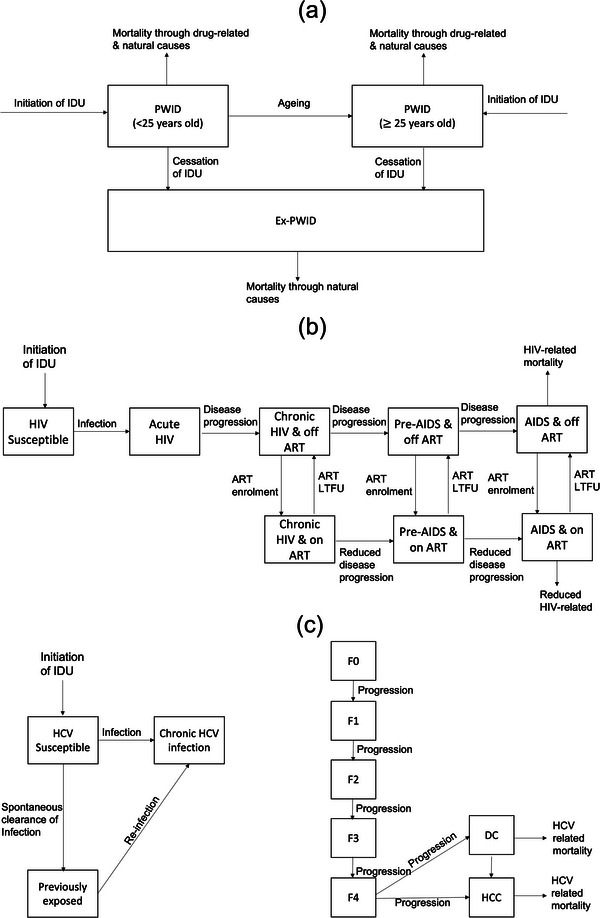
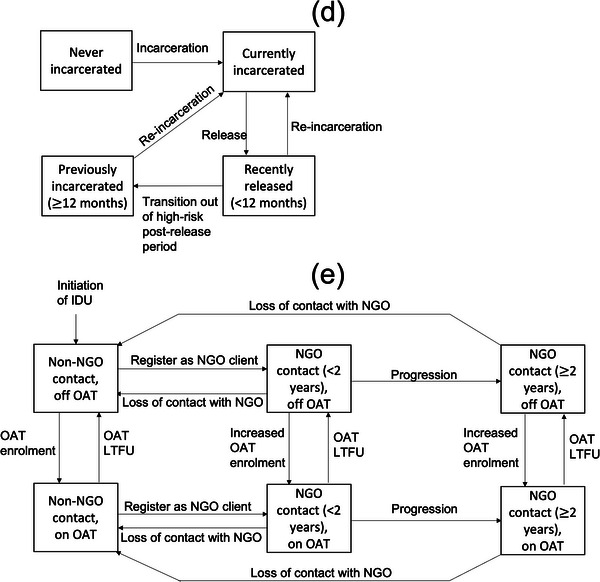
A dynamic HIV and HCV transmission model among PWID was calibrated using data from four national PWID surveys (2011-2017). The model assumed 37-49% coverage of NGOs among community PWID, with NGO contact reducing injecting risk and increasing condom use and recruitment onto OAT and ART. We estimated the historic (1997-2021) and future (2022-2030, compared to no NGO activities from 2022) impact of NGOs in terms of the proportion of HIV/HCV infections averted and changes in HIV/HCV incidence. We estimated the future impact of scaling-up NGOs to 80% coverage with/without scale-up in OAT (5-20%) and ART (64-81%). We estimated the cost per disability-adjusted life-year (DALY) averted of current NGO provision over 2022-2041 compared to NGO activities stopping over 2022-2026, but restarting after that till 2041. We assumed average unit costs of US$80-90 per person-year of NGO contact for PWID.
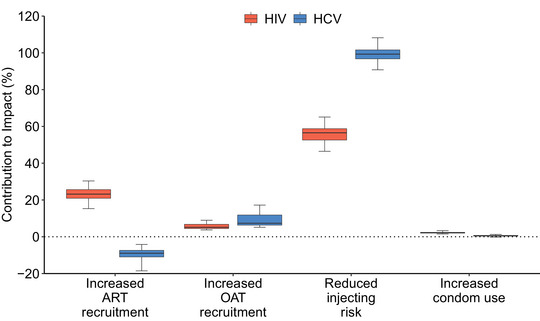
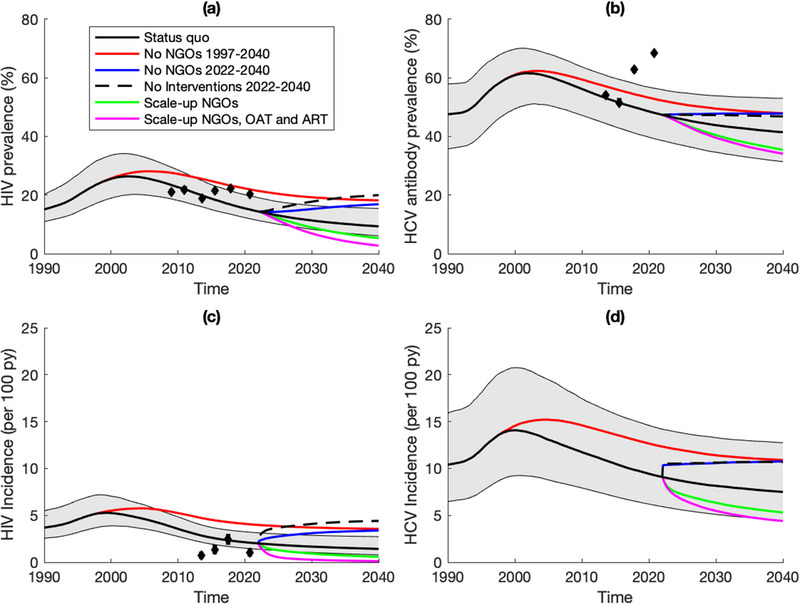
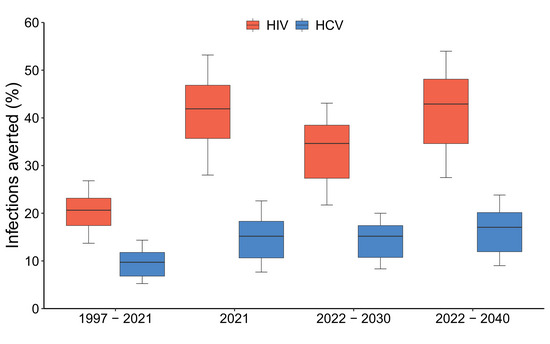
With existing coverage levels of NGOs, the model projects that NGOs have averted 20.0% (95% credibility interval: 13.3-26.1) and 9.6% (5.1-14.1) of new HIV and HCV infections among PWID over 1997-2021, respectively, and will avert 31.8% (19.6-39.9) and 13.7% (7.5-18.1) of HIV and HCV infections over 2022-2030. With NGO scale-up, HIV and HCV incidence will decrease by 54.2% (43.3-63.8) and 30.2% (20.5-36.2) over 2022-2030, or 86.7% (82.9-89.3) and 39.8% (31.4-44.8) if OAT and ART are also scaled-up. Without NGOs, HIV and HCV incidence will increase by 51.6% (23.6-76.3) and 13.4% (4.8-21.9) over 2022-2030. Current NGO provision over 2022-2026 will avert 102,736 (77,611-137,512) DALYs when tracked until 2041 (discounted 3% annually), and cost US$912 (702-1222) per DALY averted; cost-effective at a willingness-to-pay threshold of US$1548/DALY averted (0.5xGDP).
NGO activities have a crucial preventative impact among PWID in Ukraine which should be scaled-up to help achieve HIV and HCV elimination. Disruptions could have a substantial detrimental impact.
在乌克兰,注射毒品的人(PWID)中艾滋病毒和丙型肝炎病毒(HCV)的流行率很高。非政府组织(NGO)为 PWID 提供针/注射器、避孕套、艾滋病毒/丙型肝炎病毒检测以及阿片类激动剂治疗(OAT)和抗逆转录病毒治疗(ART)的联系。我们估计了它们在 PWID 中的影响和成本效益。
使用来自四个全国性 PWID 调查(2011-2017 年)的数据,对 PWID 之间的 HIV 和 HCV 传播模型进行了动态校准。该模型假设社区 PWID 中有 37-49%的 NGO 覆盖率,与 NGO 的接触减少了注射风险,并增加了避孕套的使用以及招募 OAT 和 ART。我们根据避免的 HIV/HCV 感染比例和 HIV/HCV 发病率的变化,估计了 NGO 在 1997-2021 年期间的历史影响(1997-2021 年)和未来影响(2022-2030 年,与 2022 年以后 NGO 活动停止相比)。我们还估计了扩大 NGO 覆盖范围至 80%(5-20%的 OAT 和 64-81%的 ART)的未来影响。我们估计了在 2022-2041 年期间,与 NGO 活动在 2022-2026 年停止相比,当前 NGO 提供的服务可以避免多少残疾调整生命年(DALY),但在 2022-2041 年期间会重新开始。我们假设 NGO 接触 PWID 的人均年度平均单位成本为 80-90 美元。
根据现有 NGO 覆盖水平,该模型预测,在 1997-2021 年期间,NGO 已避免了 20.0%(95%可信度区间:13.3-26.1)和 9.6%(5.1-14.1)的新 HIV 和 HCV 感染,而在 2022-2030 年期间,将避免 31.8%(19.6-39.9)和 13.7%(7.5-18.1)的 HIV 和 HCV 感染。如果扩大 NGO 规模,HIV 和 HCV 的发病率将在 2022-2030 年期间下降 54.2%(43.3-63.8)和 30.2%(20.5-36.2),或如果 OAT 和 ART 也扩大规模,下降 86.7%(82.9-89.3)和 39.8%(31.4-44.8)。如果没有 NGO,HIV 和 HCV 的发病率将在 2022-2030 年期间增加 51.6%(23.6-76.3)和 13.4%(4.8-21.9)。在 2022-2026 年期间,目前 NGO 的提供服务将在 2041 年之前避免 102736(77611-137512)个残疾调整生命年(按年度贴现 3%),并避免每一个 DALY 成本 912 美元(702-1222);在 1548 美元/避免的 DALY 的支付意愿阈值下具有成本效益(0.5xGDP)。
NGO 活动在乌克兰的 PWID 中具有至关重要的预防作用,应该扩大规模以帮助实现 HIV 和 HCV 的消除。中断可能会产生重大的不利影响。