Population Health Sciences, University of Bristol, Bristol, United Kingdom.
Alliance for Public Health, Kiev, Ukraine.
J Int AIDS Soc. 2020 Aug;23(8):e25608. doi: 10.1002/jia2.25608.
People who inject drugs (PWID) in Ukraine have high prevalences of HIV and hepatitis C (HCV). Since the turn of the century, various organizations have funded non-governmental organizations (NGOs) in Ukraine to provide PWID with needles and syringes, condoms, HIV and HCV testing, and improve linkage to opioid agonist therapy (OAT) and HIV treatment. We investigated whether contact with these NGOs was associated with improved HIV prevention and treatment outcomes among PWID.
Five rounds of respondent-driven sampled integrated bio-behavioural survey data (2009 [N = 3962], 2011 [N = 9069], 2013 [N = 9502], 2015 [N = 9405], and 2017 [N = 10076]) among PWID in Ukraine (including HIV/HCV testing and questionnaires) were analysed using mixed-effect logistic regression models (mixed-effects: city, year). These regression models assessed associations between being an NGO client and various behavioural, OAT, HIV testing and HIV treatment outcomes, adjusting for demographic characteristics (age, gender, lifetime imprisonment, registration in a drug abuse clinic, education level). We also assessed associations between being an NGO client and being HIV positive or HCV positive, likewise adjusting for demographic characteristics (as above).
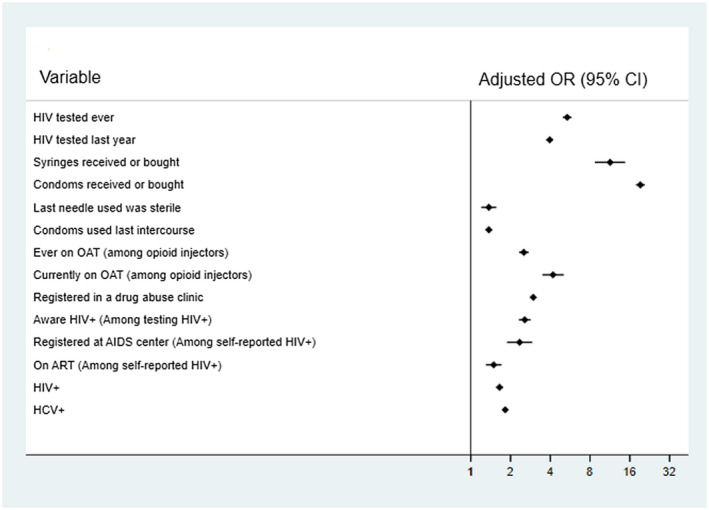
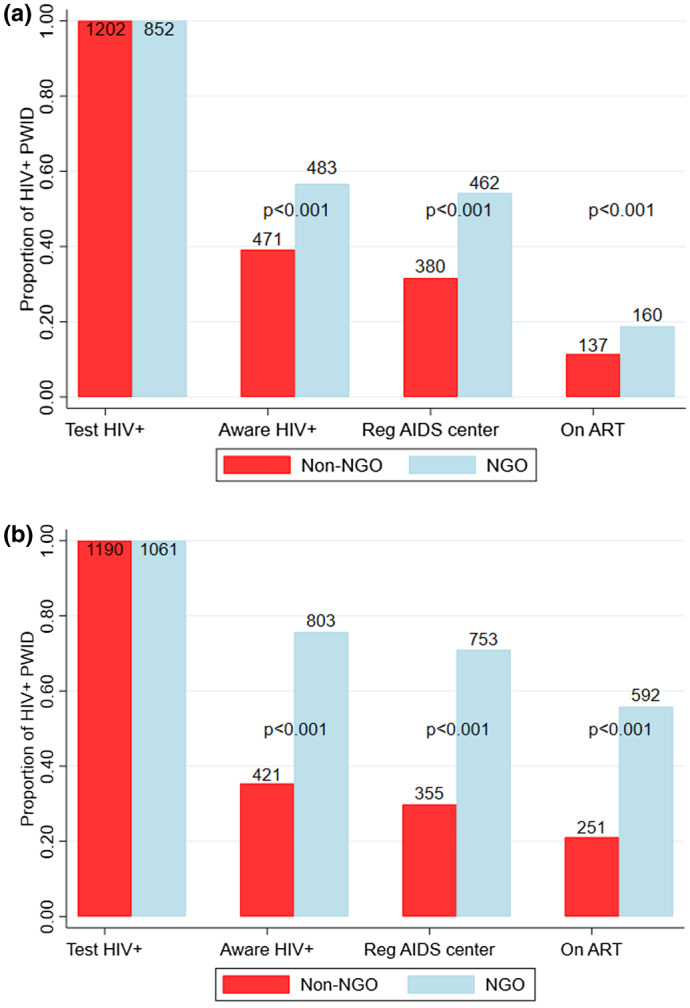
NGO clients were more likely to have received HIV testing ever (adjusted odds ratio [aOR] 5.37, 95% confidence interval [95% CI]: 4.97 to 5.80) or in the last year (aOR 3.37, 95% CI: 3.20 to 3.54), to have used condoms at last sexual intercourse (aOR 1.37, 95% CI: 1.30 to 1.44) and sterile needles at last injection (aOR 1.37, 95% CI: 1.20 to 1.56), to be currently (aOR 4.19, 95% CI: 3.48 to 5.05) or ever (aOR 2.52, 95% CI: 2.32 to 2.74) on OAT, and to have received syringes (aOR 109.89, 95% CI: 99.26 to 121.66) or condoms (aOR 54.39, 95% CI: 50.17 to 58.96) in the last year. PWID who were HIV positive (aOR 1.40, 95% CI: 1.33 to 1.48) or HCV positive (aOR 1.57, 95% CI: 1.49 to 1.65) were more likely to have contact with NGOs, with HIV positive PWID in contact with NGOs being more likely to be registered at AIDS centres (aOR 2.34, 95% CI: 1.88 to 2.92) and to be on antiretroviral therapy (aOR 1.60, 95% CI: 1.40 to 1.83).
Contact with PWID targeted NGOs in Ukraine is associated with consistently better preventive, HIV testing and HIV treatment outcomes, suggesting a beneficial impact of harm reduction NGO programming.
引言:在乌克兰,注射毒品的人(PWID)中艾滋病毒和丙型肝炎(HCV)的流行率很高。自本世纪初以来,各种组织都资助了乌克兰的非政府组织(NGO),为 PWID 提供针和注射器、避孕套、艾滋病毒和 HCV 检测,并改善阿片类药物激动剂治疗(OAT)和艾滋病毒治疗的衔接。我们研究了与这些 NGO 接触是否与 PWID 中改善艾滋病毒预防和治疗结果有关。
方法:我们分析了乌克兰 PWID 中五轮基于受访者驱动抽样的综合生物行为调查数据(2009 年[N=3962]、2011 年[N=9069]、2013 年[N=9502]、2015 年[N=9405]和 2017 年[N=10076]),包括艾滋病毒/HCV 检测和问卷,使用混合效应逻辑回归模型(混合效应:城市、年份)进行分析。这些回归模型评估了与 NGO 客户相关的各种行为、OAT、艾滋病毒检测和艾滋病毒治疗结果之间的关联,调整了人口统计学特征(年龄、性别、终身监禁、吸毒诊所登记、教育水平)。我们还评估了与 NGO 客户相关的与艾滋病毒阳性或 HCV 阳性之间的关联,同样调整了人口统计学特征(如上所述)。
结果:与 NGO 客户接触的人更有可能接受过艾滋病毒检测(调整后的优势比[aOR]5.37,95%置信区间[95%CI]:4.97 至 5.80)或在过去一年中接受过艾滋病毒检测(aOR 3.37,95%CI:3.20 至 3.54),在最近一次性行为中使用避孕套(aOR 1.37,95%CI:1.30 至 1.44)和最近一次注射时使用无菌针(aOR 1.37,95%CI:1.20 至 1.56),目前(aOR 4.19,95%CI:3.48 至 5.05)或曾经(aOR 2.52,95%CI:2.32 至 2.74)接受 OAT,并且在过去一年中收到过注射器(aOR 109.89,95%CI:99.26 至 121.66)或避孕套(aOR 54.39,95%CI:50.17 至 58.96)。艾滋病毒阳性(aOR 1.40,95%CI:1.33 至 1.48)或 HCV 阳性(aOR 1.57,95%CI:1.49 至 1.65)的 PWID 更有可能与 NGO 接触,与 NGO 接触的艾滋病毒阳性 PWID 更有可能在艾滋病中心登记(aOR 2.34,95%CI:1.88 至 2.92)并接受抗逆转录病毒治疗(aOR 1.60,95%CI:1.40 至 1.83)。
结论:与乌克兰 PWID 接触的目标 NGO 与持续更好的预防、艾滋病毒检测和艾滋病毒治疗结果有关,这表明减少伤害 NGO 方案具有有益的影响。