Gene Therapy Research Unit, Children's Medical Research Institute, Faculty of Medicine and Health, The University of Sydney and Sydney Children's Hospitals Network, Westmead, NSW, Australia.
Department of Biochemistry and Molecular Biology, Center for Structural Biology, McKnight Brain Institute, College of Medicine, University of Florida, Gainesville, FL, USA.
Mol Ther. 2023 Jul 5;31(7):1979-1993. doi: 10.1016/j.ymthe.2023.03.032. Epub 2023 Apr 3.
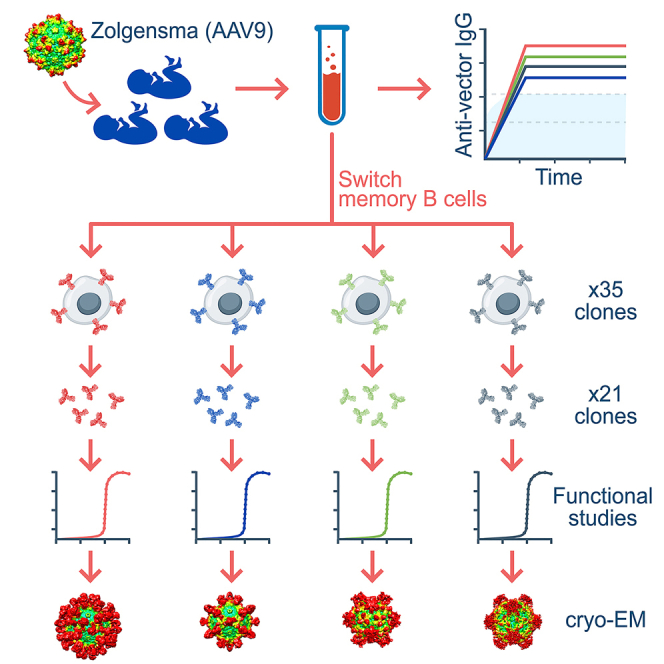
Success in the treatment of infants with spinal muscular atrophy (SMA) underscores the potential of vectors based on adeno-associated virus (AAV). However, a major obstacle to the full realization of this potential is pre-existing natural and therapy-induced anti-capsid humoral immunity. Structure-guided capsid engineering is one possible approach to surmounting this challenge but necessitates an understanding of capsid-antibody interactions at high molecular resolution. Currently, only mouse-derived monoclonal antibodies (mAbs) are available to structurally map these interactions, which presupposes that mouse and human-derived antibodies are functionally equivalent. In this study, we have characterized the polyclonal antibody responses of infants following AAV9-mediated gene therapy for SMA and recovered 35 anti-capsid mAbs from the abundance of switched-memory B (smB) cells present in these infants. For 21 of these mAbs, seven from each of three infants, we have undertaken functional and structural analysis measuring neutralization, affinities, and binding patterns by cryoelectron microscopy (cryo-EM). Four distinct patterns were observed akin to those reported for mouse-derived mAbs, but with early evidence of differing binding pattern preference and underlying molecular interactions. This is the first human and largest series of anti-capsid mAbs to have been comprehensively characterized and will prove to be powerful tools for basic discovery and applied purposes.
成功治疗脊髓性肌萎缩症(SMA)的婴儿凸显了基于腺相关病毒(AAV)的载体的潜力。然而,充分实现这一潜力的主要障碍是预先存在的天然和治疗诱导的抗衣壳体液免疫。结构导向的衣壳工程是克服这一挑战的一种可能方法,但需要在高分子分辨率上了解衣壳-抗体相互作用。目前,只有鼠源性单克隆抗体(mAb)可用于对这些相互作用进行结构作图,这假设鼠源和人源抗体在功能上是等效的。在这项研究中,我们对接受 AAV9 介导的 SMA 基因治疗的婴儿进行了多克隆抗体反应的特征分析,并从这些婴儿中丰富的转换记忆 B(smB)细胞中回收了 35 种抗衣壳 mAb。对于其中的 21 种 mAb,来自三个婴儿的每种 mAb 7 种,我们进行了功能和结构分析,通过冷冻电镜(cryo-EM)测量中和、亲和力和结合模式。观察到了四种不同的模式,类似于已报道的鼠源性 mAb,但早期有证据表明不同的结合模式偏好和潜在的分子相互作用。这是首次对人源和最大系列的抗衣壳 mAb 进行全面表征,将成为基础发现和应用目的的有力工具。