Ibañez-Solé Olga, Barrio Irantzu, Izeta Ander
Tissue Engineering Group; Biodonostia Health Research Institute, 20014 Donostia-San Sebastián, Spain.
Department of Mathematics, University of the basque Country UPV/EHU, 48940 Leioa, Spain.
iScience. 2023 Mar 9;26(4):106368. doi: 10.1016/j.isci.2023.106368. eCollection 2023 Apr 21.
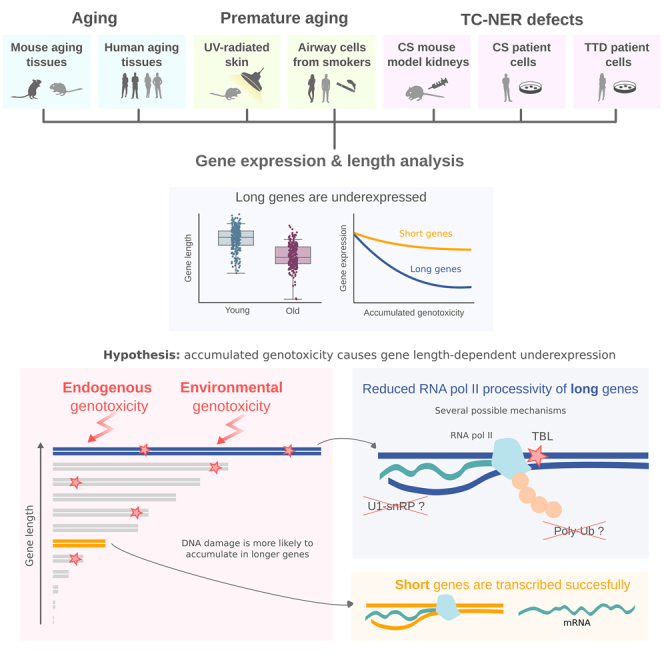
DNA damage has long been advocated as a molecular driver of aging. DNA damage occurs in a stochastic manner, and is therefore more likely to accumulate in longer genes. The length-dependent accumulation of transcription-blocking damage, unlike that of somatic mutations, should be reflected in gene expression datasets of aging. We analyzed gene expression as a function of gene length in several single-cell RNA sequencing datasets of mouse and human aging. We found a pervasive age-associated length-dependent underexpression of genes across species, tissues, and cell types. Furthermore, we observed length-dependent underexpression associated with UV-radiation and smoke exposure, and in progeroid diseases, Cockayne syndrome, and trichothiodystrophy. Finally, we studied published gene sets showing global age-related changes. Genes underexpressed with aging were significantly longer than overexpressed genes. These data highlight a previously undetected hallmark of aging and show that accumulation of genotoxicity in long genes could lead to reduced RNA polymerase II processivity.
长期以来,DNA损伤一直被认为是衰老的分子驱动因素。DNA损伤以随机方式发生,因此更有可能在较长的基因中积累。与体细胞突变不同,转录阻断损伤的长度依赖性积累应反映在衰老的基因表达数据集中。我们在小鼠和人类衰老的几个单细胞RNA测序数据集中分析了基因表达与基因长度的关系。我们发现,在跨物种、组织和细胞类型中,普遍存在与年龄相关的、长度依赖性的基因表达不足。此外,我们观察到与紫外线辐射、烟雾暴露以及早衰症、科凯恩综合征和毛发硫营养不良相关的长度依赖性表达不足。最后,我们研究了已发表的显示全球年龄相关变化的基因集。随着衰老而表达不足的基因明显比过表达的基因更长。这些数据突出了一个以前未被发现的衰老特征,并表明长基因中基因毒性的积累可能导致RNA聚合酶II的持续合成能力下降。