Vermeij Wilbert P, Alyodawi Khalid, van Galen Ivar, von der Heide Jennie L, Birkisdóttir María B, Van't Sant Lisanne J, Ozinga Rutger A, Komninos Daphne S J, Smit Kimberly, Rijksen Yvonne M A, Brandt Renata M C, Barnhoorn Sander, Jaarsma Dick, Vaiyapuri Sathivel, Ritvos Olli, Huber Tobias B, Kretz Oliver, Patel Ketan
Princess Máxima Center for Pediatric Oncology, Utrecht, Netherlands.
Oncode Institute, Utrecht, Netherlands.
J Cachexia Sarcopenia Muscle. 2024 Dec;15(6):2361-2374. doi: 10.1002/jcsm.13570. Epub 2024 Sep 8.
Ageing is a complex multifactorial process, impacting all organs and tissues, with DNA damage accumulation serving as a common underlying cause. To decelerate ageing, various strategies have been applied to model organisms and evaluated for health and lifespan benefits. Dietary restriction (DR, also known as caloric restriction) is a well-established long-term intervention recognized for its universal anti-ageing effects. DR temporarily suppresses growth, and when applied to progeroid DNA repair-deficient mice doubles lifespan with systemic health benefits. Counterintuitively, attenuation of myostatin/activin signalling by soluble activin receptor (sActRIIB), boosts the growth of muscle and, in these animals, prevents muscle wasting, improves kidney functioning, and compresses morbidity.
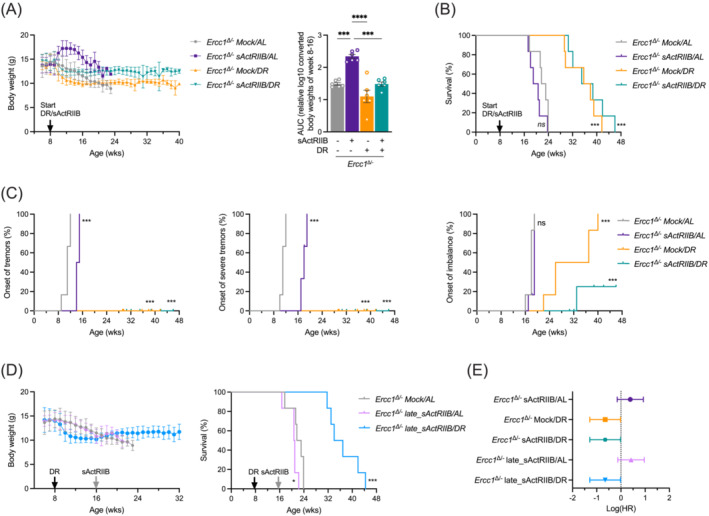
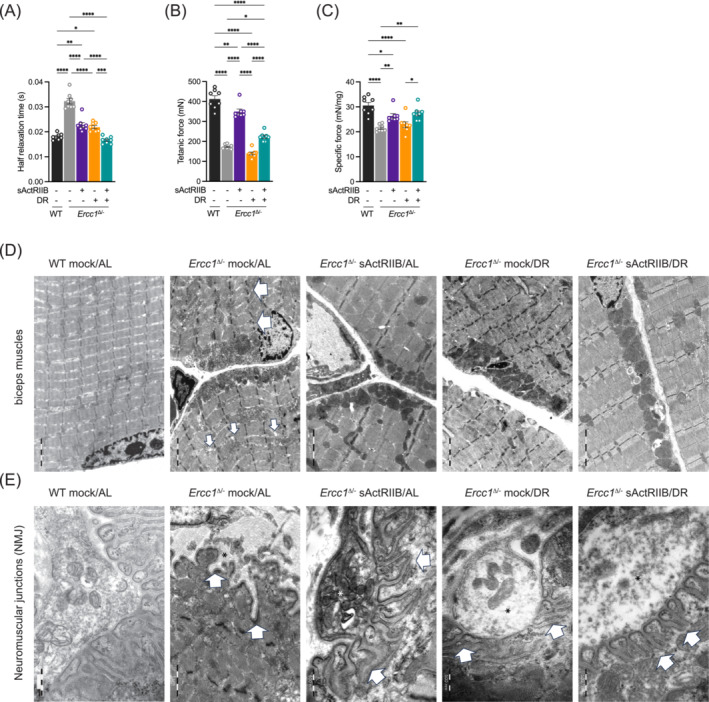
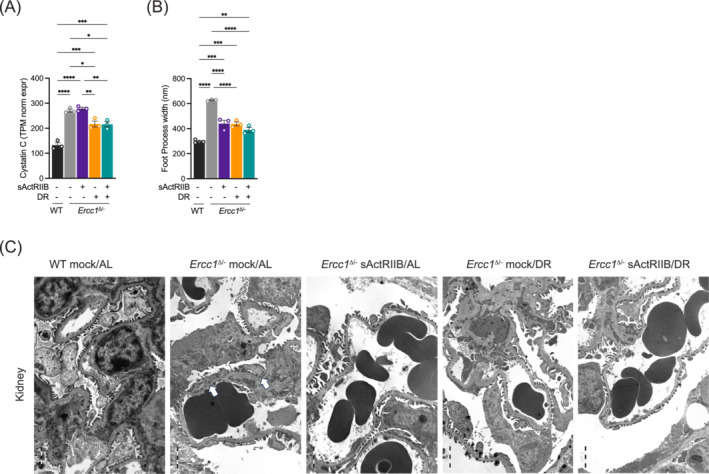
Here, we investigated a combined approach, applying an anabolic regime (sActRIIB) at the same time as DR to Ercc1 progeroid mice. Following both single treatments and combined, we monitored global effects on body weight, lifespan and behaviour, and local effects on muscle and tissue weight, muscle morphology and function, and ultrastructural and transcriptomic changes in muscle and kidney.
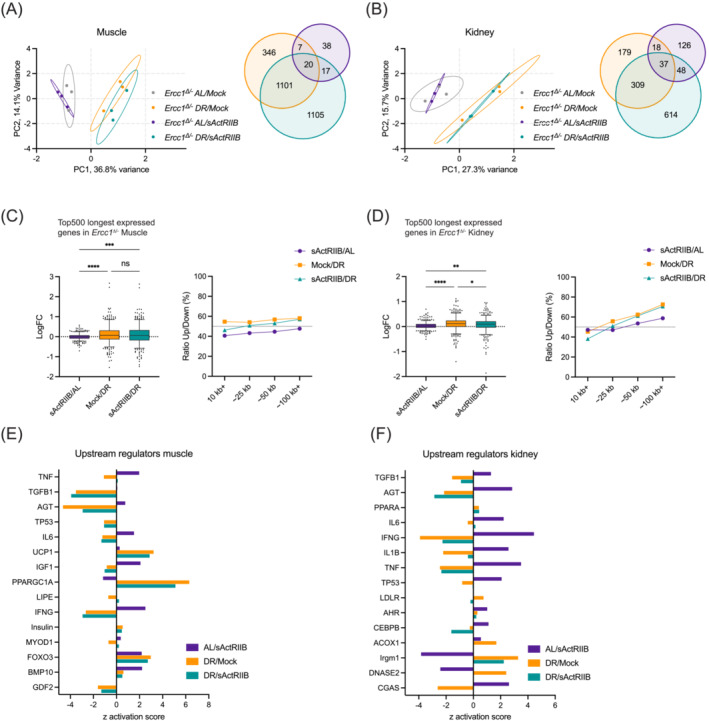
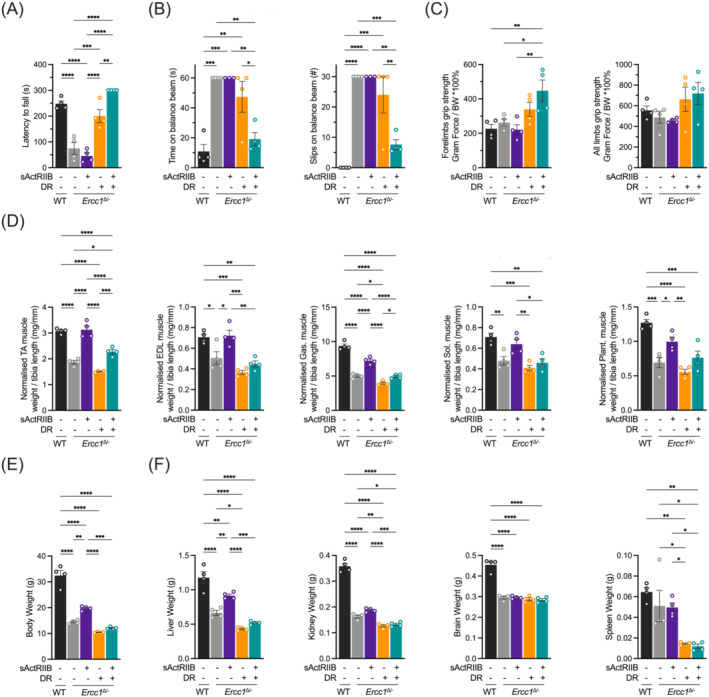
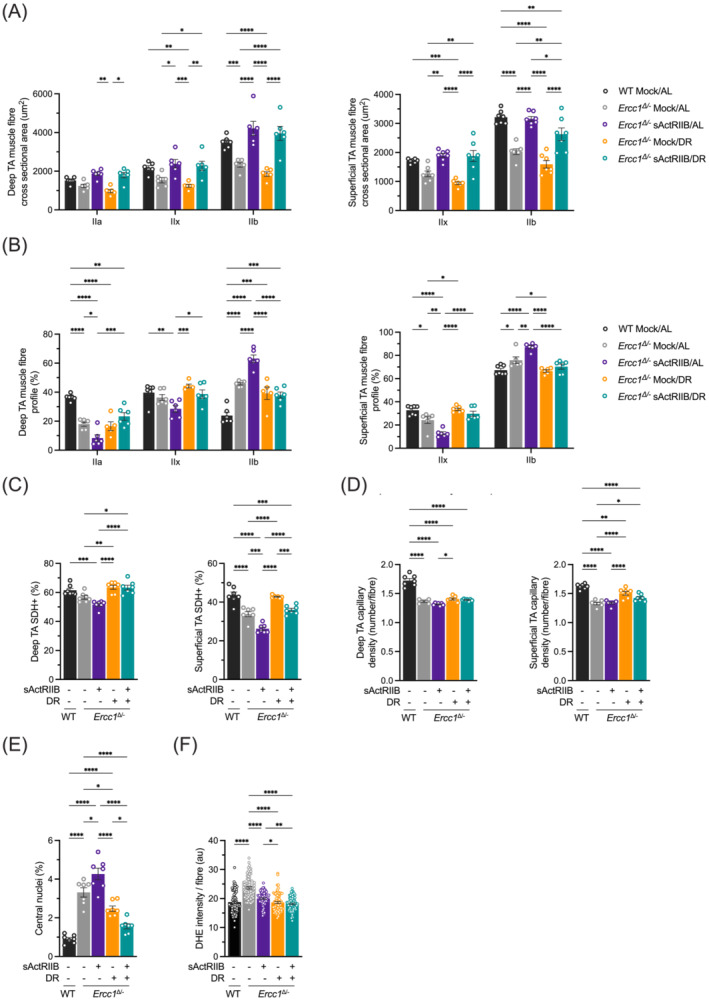
Lifespan was mostly influenced by DR (extended from approximately 20 to 40 weeks; P < 0.001), with sActRIIB clearly increasing muscle mass (35-65%) and tetanic force (P < 0.001). The combined regime yielded a stable uniform body weight, but increased compared with DR alone, synergistically improved motor coordination and further delayed the onset and development of balance problems. sActRIIB significantly increased muscle fibre size (P < 0.05) in mice subjected to DR and lowered all signs of muscle damage. Ercc1 mice showed abnormal neuromuscular junctions. Single interventions by sActRIIB treatment or DR only partially rescued this phenotype, while in the double intervention group, the regularly shaped junctional foldings were maintained. In kidney of Ercc1 mice, we observed a mild but significant foot process effacement, which was restored by either intervention. Transcriptome analysis also pointed towards reduced levels of DNA damage in muscle and kidney by DR, but not sActRIIB, while these levels retained lower in the double intervention.
In muscle, we found synergistic effects of combining sActRIIB with DR, but not in kidney, with an overall better health in the double intervention group. Crucially, the benefits of each single intervention are not lost when administered in combination, but rather strengthened, even when sActRIIB was applied late in life, opening opportunities for translation to human.
衰老过程复杂且受多因素影响,涉及所有器官和组织,而DNA损伤积累是其共同的潜在原因。为延缓衰老,人们已将多种策略应用于模式生物,并评估其对健康和寿命的益处。饮食限制(DR,也称为热量限制)是一种公认的长期干预措施,具有普遍的抗衰老作用。DR会暂时抑制生长,应用于早衰型DNA修复缺陷小鼠时,可使寿命延长一倍,并带来全身健康益处。与直觉相反的是,可溶性激活素受体(sActRIIB)减弱肌肉生长抑制素/激活素信号传导,可促进肌肉生长,在这些动物中还能防止肌肉萎缩、改善肾功能并缩短发病期。
在此,我们研究了一种联合方法,即在对Ercc1早衰小鼠进行饮食限制的同时应用合成代谢方案(sActRIIB)。在单一治疗和联合治疗后,我们监测了对体重、寿命和行为的整体影响,以及对肌肉和组织重量、肌肉形态和功能,以及肌肉和肾脏的超微结构和转录组变化的局部影响。
寿命主要受饮食限制影响(从约20周延长至40周;P < 0.001),sActRIIB明显增加肌肉质量(35 - 65%)和强直力(P < 0.001)。联合方案使体重稳定且均匀,但与单独饮食限制相比有所增加,协同改善了运动协调性,并进一步延迟了平衡问题的出现和发展。sActRIIB显著增加了接受饮食限制小鼠的肌纤维大小(P < 0.05),并降低了所有肌肉损伤迹象。Ercc1小鼠表现出异常的神经肌肉接头。单独使用sActRIIB治疗或饮食限制只能部分挽救这种表型,而在双重干预组中,规则形状的连接褶皱得以维持。在Ercc1小鼠的肾脏中,我们观察到轻度但显著的足突消失,两种干预均可使其恢复。转录组分析还表明,饮食限制可降低肌肉和肾脏中的DNA损伤水平,但sActRIIB无此作用,而在双重干预组中这些水平保持较低。
在肌肉方面,我们发现sActRIIB与饮食限制联合具有协同作用,但在肾脏中未发现,双重干预组的整体健康状况更佳。至关重要的是,联合使用时每种单一干预的益处并未丧失,反而得到增强,即使sActRIIB在生命后期应用,也为转化应用于人类带来了机会。