Faculty of Medicine, Coimbra Institute for Clinical and Biomedical Research (iCBR), University of Coimbra, Coimbra, Portugal.
Institute of Physiology, Faculty of Medicine, University of Coimbra, Coimbra, Portugal.
Intern Emerg Med. 2023 Aug;18(5):1287-1302. doi: 10.1007/s11739-023-03262-3. Epub 2023 Apr 4.
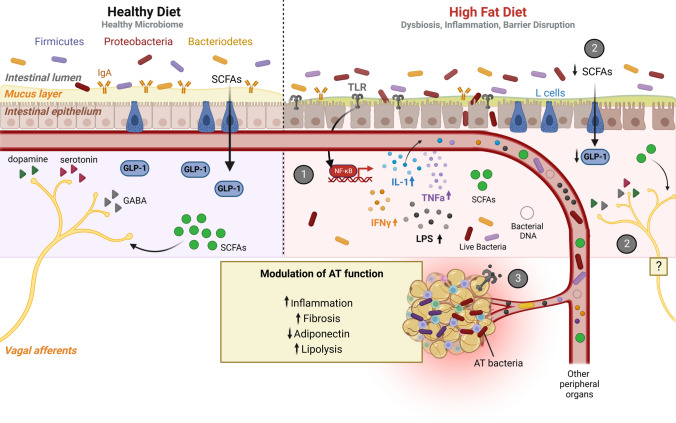
Recently, compelling evidence points to dysbiosis and disruption of the epithelial intestinal barrier as major players in the pathophysiology of metabolic disorders, such as obesity. Upon the intestinal barrier disruption, components from bacterial metabolism and bacteria itself can reach peripheral tissues through circulation. This has been associated with the low-grade inflammation that characterizes obesity and other metabolic diseases. While circulating bacterial DNA has been postulated as a common feature of obesity and even type 2 diabetes, almost no focus has been given to the existence and effects of bacteria in peripheral tissues, namely the adipose tissue. As a symbiont population, it is expected that gut microbiota modulate the immunometabolism of the host, thus influencing energy balance mechanisms and inflammation. Gut inflammatory signals cause direct deleterious inflammatory responses in adipose tissue and may also affect key gut neuroendocrine mechanisms governing nutrient sensing and energy balance, like incretins and ghrelin, which play a role in the gut-brain-adipose tissue axis. Thus, it is of major importance to disclose how gut microbiota and derived signals modulate neuroendocrine and inflammatory pathways, which contribute to the dysfunction of adipose tissue and to the metabolic sequelae of obesity and related disorders. This review summarizes the current knowledge regarding these topics and identifies new perspectives in this field of research, highlighting new pathways toward the reduction of the inflammatory burden of metabolic diseases.
最近,有强有力的证据表明,肠道微生物失调和肠上皮屏障破坏是代谢紊乱(如肥胖)病理生理学的主要因素。在肠道屏障破坏后,细菌代谢产物和细菌本身可以通过循环到达外周组织。这与肥胖和其他代谢性疾病的特征性低度炎症有关。虽然循环细菌 DNA 被认为是肥胖甚至 2 型糖尿病的共同特征,但几乎没有人关注细菌在周围组织(即脂肪组织)中的存在和作用。作为共生群体,肠道微生物群有望调节宿主的免疫代谢,从而影响能量平衡机制和炎症。肠道炎症信号会导致脂肪组织直接产生有害的炎症反应,也可能影响控制营养感应和能量平衡的关键肠道神经内分泌机制,如肠促胰岛素和胃饥饿素,它们在肠道-大脑-脂肪组织轴中发挥作用。因此,揭示肠道微生物群及其衍生信号如何调节神经内分泌和炎症途径,从而导致脂肪组织功能障碍以及肥胖和相关疾病的代谢后果,具有重要意义。这篇综述总结了目前关于这些主题的知识,并确定了该研究领域的新视角,强调了减轻代谢性疾病炎症负担的新途径。