Alzheimer Center Amsterdam, Neurology, Vrije Universiteit Amsterdam, Amsterdam UMC, location VUmc, De Boelelaan 1118, 1081, HZ, Amsterdam, The Netherlands.
Brain Research Center Amsterdam, Amsterdam, The Netherlands.
Alzheimers Res Ther. 2023 Apr 4;15(1):72. doi: 10.1186/s13195-023-01190-0.
In the context of the development of pharmaceutical interventions, expectations and experiences of participants are essential. Their insights may be particularly helpful to address the challenges of recruiting and retaining participants for Alzheimer's disease (AD) clinical trials. We examined clinical trial participants' experiences to optimize trial design in Alzheimer's disease (AD).
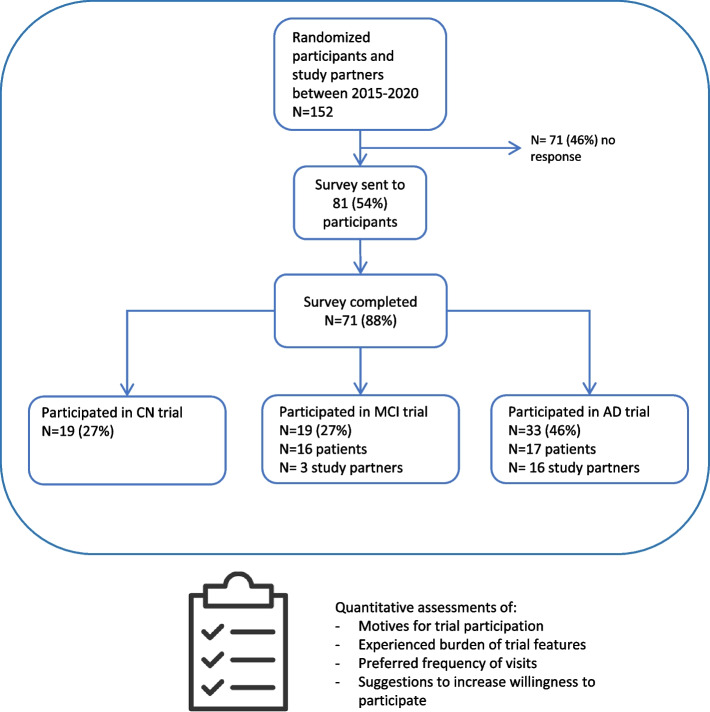
In this mixed-methods study, we included adults who participated in sponsor-initiated AD trials at Brain Research Center, a clinical trial organization in the Netherlands. Participants (N = 71, age 69 ± 6.5, 54%F, 19 cognitively normal (CN), 19 mild cognitive impairment (MCI), and 33 AD dementia) first completed an online survey. Diagnostic group differences were investigated using chi-square tests or one-way ANOVAs. Next, a subsample (N = 12; 8 = CN, 4 = MCI) participated in focus groups to gain in-depth insight into their opinions on optimizing trial design from a participants' point of view. Audio recordings from focus group interviews were transcribed verbatim and analyzed by thematic content analysis by two independent researchers.
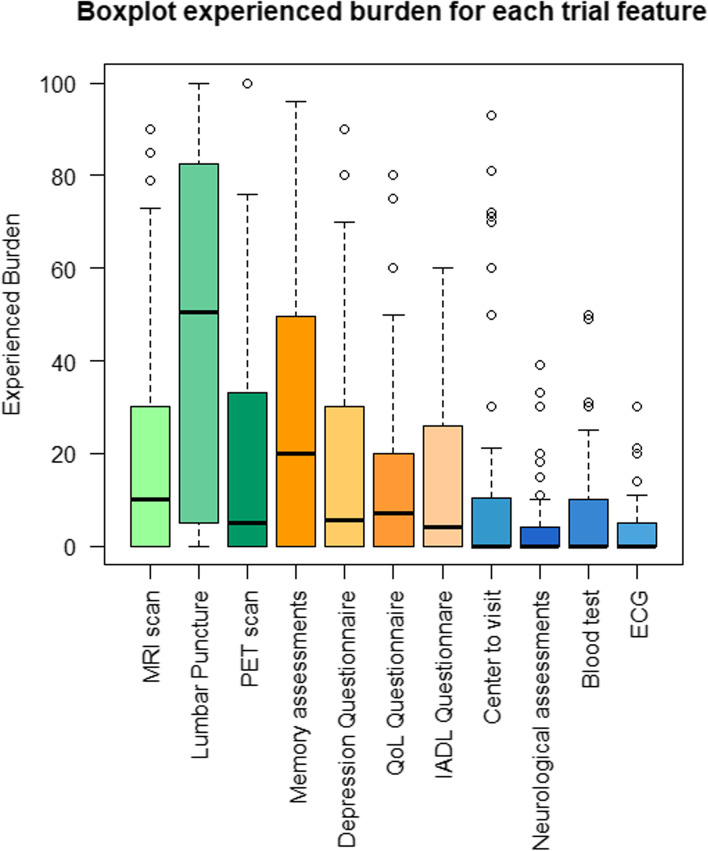
Most reported motives for enrolment included "to benefit future generations" (89%), followed by "for science" (66%) and "better monitoring" (42%). Frequent suggestions for increasing willingness to participate included a smaller chance to receive placebo (n = 38, 54%), shorter travel times (n = 27, 38%), and sharing individual results of different assessments (n = 57, 80%), as well as receiving trial results (n = 52, 73). Highest visual analogue burden scores (0-100) were found for the lumbar puncture (M = 47.2, SD = 38.2) and cognitive assessments (M = 27.2, SD = 25.7). Results did not differ between diagnostic groups, nor between patient and caregiver participants (all p-values>.05). Two additional themes emerged from the focus groups: "trial design," such as follow-up visit(s) after participating, and "trial center," including the relevance of a professional and empathic staff.
Relevant factors include expectation management and careful planning of high-burden assessments, provision of individual feedback, and prioritizing professionalism and empathy throughout conduct of the trial. Our findings provide insight into participants' priorities to increase willingness to participate and can be used to optimize trial success.
在药物干预措施的发展过程中,参与者的期望和体验至关重要。他们的见解可能有助于解决招募和留住阿尔茨海默病(AD)临床试验参与者的挑战。我们研究了临床试验参与者的经验,以优化 AD 临床试验的设计。
在这项混合方法研究中,我们纳入了在荷兰一家临床试验组织——大脑研究中心参加赞助商发起的 AD 试验的成年人。参与者(N=71,年龄 69±6.5 岁,54%女性,19 名认知正常(CN),19 名轻度认知障碍(MCI),33 名 AD 痴呆)首先完成了在线调查。使用卡方检验或单因素方差分析研究诊断组间差异。然后,一个亚样本(N=12;8 名 CN,4 名 MCI)参加了焦点小组,从参与者的角度深入了解他们对优化试验设计的看法。焦点小组访谈的音频记录被逐字转录,并由两位独立研究人员进行主题内容分析。
大多数参与者报告的参与动机包括“为了造福后代”(89%),其次是“为了科学”(66%)和“更好的监测”(42%)。增加参与意愿的常见建议包括接受安慰剂的机会更小(n=38,54%),旅行时间更短(n=27,38%),以及分享不同评估的个体结果(n=57,80%),以及获得试验结果(n=52,73%)。腰椎穿刺(M=47.2,SD=38.2)和认知评估(M=27.2,SD=25.7)的视觉模拟评分最高。结果在诊断组之间、患者和护理人员之间没有差异(所有 p 值>.05)。焦点小组还出现了另外两个主题:“试验设计”,例如参与后的随访,以及“试验中心”,包括专业和富有同理心的工作人员的相关性。
相关因素包括期望管理和精心规划高负担评估、提供个体反馈,以及在整个试验过程中优先考虑专业性和同理心。我们的研究结果提供了参与者增加参与意愿的优先事项的见解,并可用于优化试验成功。