Division of Infectious Diseases, Department of Internal Medicine, Korea University College of Medicine, Seoul, Korea.
Department of Biostatistics, Korea University College of Medicine, Seoul, Korea.
Korean J Intern Med. 2023 May;38(3):417-426. doi: 10.3904/kjim.2022.352. Epub 2023 Apr 6.
BACKGROUND/AIMS: This study aimed to investigate the clinical characteristics and outcomes of fluorescent antinuclear antibody (FANA)-positive patients admitted for coronavirus disease 2019 (COVID-19) and identify FANA as a prognostic factor of mortality.
This retrospective study was conducted at a university-affiliated hospital with 1,048 beds from September 2020 to March 2022. The participants were consecutive patients who required oxygenation through a high-flow nasal cannula, non-invasive or mechanical ventilation, or extracorporeal membrane oxygenation, and conducted the FANA test within 48 hours of admission.
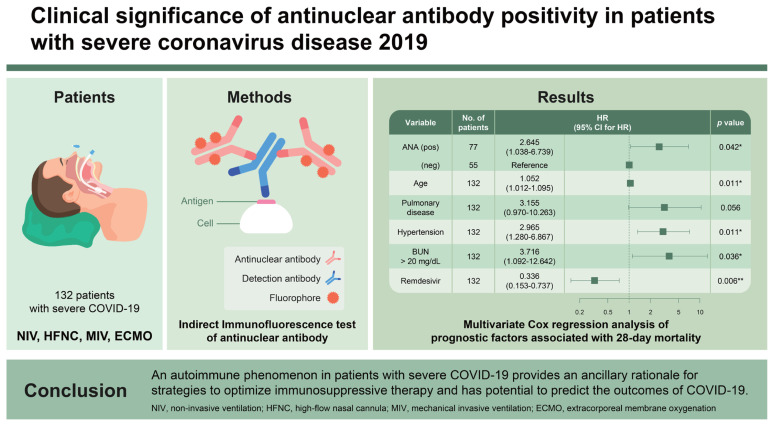
A total of 132 patients with severe COVID-19 were included in this study, of which 77 (58.3%) had FANA-positive findings (≥ 1:80). FANA-positive patients were older and had higher inflammatory markers and 28-day mortality than FANA- negative patients. In the multivariate Cox proportional hazard regression analysis, FANA-positive findings (hazard ratio [HR], 2.65; 95% confidence interval [CI], 1.04-6.74), age (per 1-year; HR, 1.05; 95% CI, 1.01-1.10), underlying pulmonary disease (HR, 3.16; 95% CI, 0.97-10.26), underlying hypertension (HR, 2.97; 95% CI, 1.28-6.87), and blood urea nitrogen > 20 mg/dL (HR, 3.72; 95% CI, 1.09-12.64) were independent predictors of 28-day mortality. Remdesivir (HR, 0.34; 95% CI, 0.15-0.74) was found to be an independent predictor that reduced mortality.
Our findings revealed an autoimmune phenomenon in patients with severe COVID-19, which provides an ancillary rationale for strategies to optimize immunosuppressive therapy. In particular, this study suggests the potential of FANA to predict the outcomes of COVID-19.
背景/目的:本研究旨在探讨因 2019 年冠状病毒病(COVID-19)住院的荧光抗核抗体(FANA)阳性患者的临床特征和结局,并确定 FANA 是死亡率的预后因素。
本回顾性研究于 2020 年 9 月至 2022 年 3 月在一家拥有 1048 张床位的大学附属医院进行。参与者为连续需要通过高流量鼻导管、无创或机械通气或体外膜氧合进行氧疗的患者,且在入院 48 小时内进行 FANA 检测。
本研究共纳入 132 例重症 COVID-19 患者,其中 77 例(58.3%)FANA 阳性(≥1:80)。FANA 阳性患者较 FANA 阴性患者年龄更大,炎症标志物水平更高,28 天死亡率也更高。在多变量 Cox 比例风险回归分析中,FANA 阳性发现(风险比[HR],2.65;95%置信区间[CI],1.04-6.74)、年龄(每增加 1 岁;HR,1.05;95%CI,1.01-1.10)、基础肺部疾病(HR,3.16;95%CI,0.97-10.26)、基础高血压(HR,2.97;95%CI,1.28-6.87)和血尿素氮>20mg/dL(HR,3.72;95%CI,1.09-12.64)是 28 天死亡率的独立预测因素。瑞德西韦(HR,0.34;95%CI,0.15-0.74)是降低死亡率的独立预测因素。
我们的研究结果表明,重症 COVID-19 患者存在自身免疫现象,这为优化免疫抑制治疗策略提供了辅助依据。特别是,本研究提示 FANA 可能有助于预测 COVID-19 的结局。