Department of Chemistry, Philipps-Universität Marburg, Marburg, Germany.
Department of Biology, Philipps-Universität Marburg, Marburg, Germany.
mBio. 2023 Apr 25;14(2):e0302822. doi: 10.1128/mbio.03028-22. Epub 2023 Apr 5.
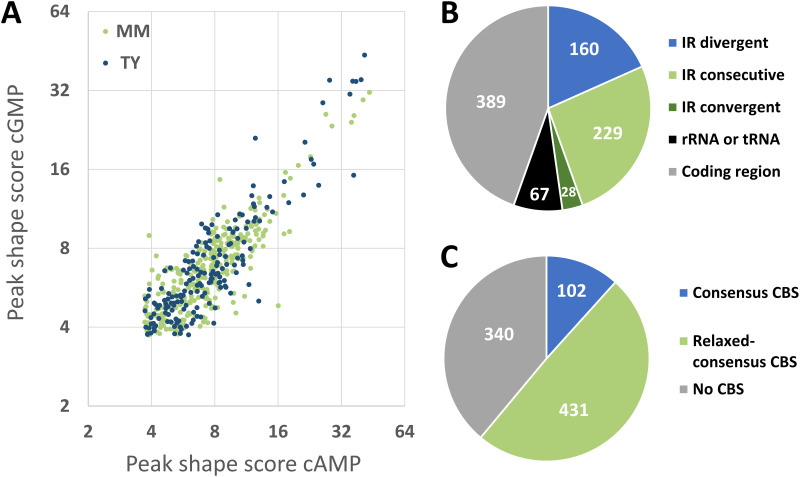
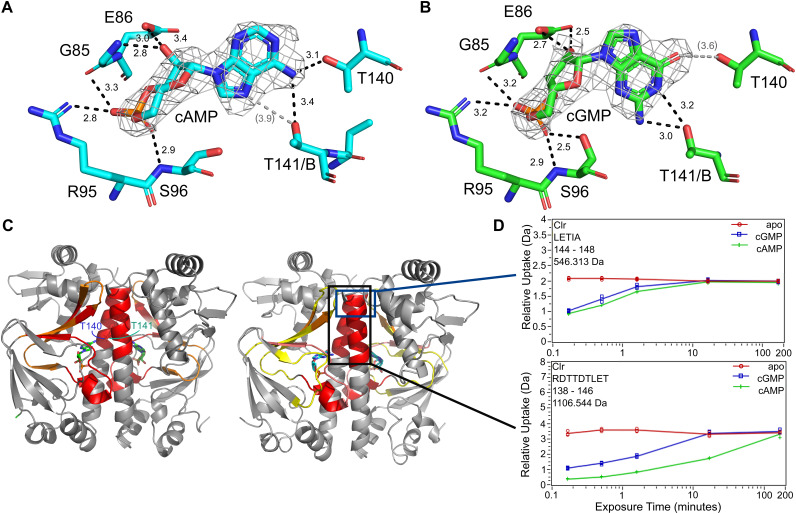
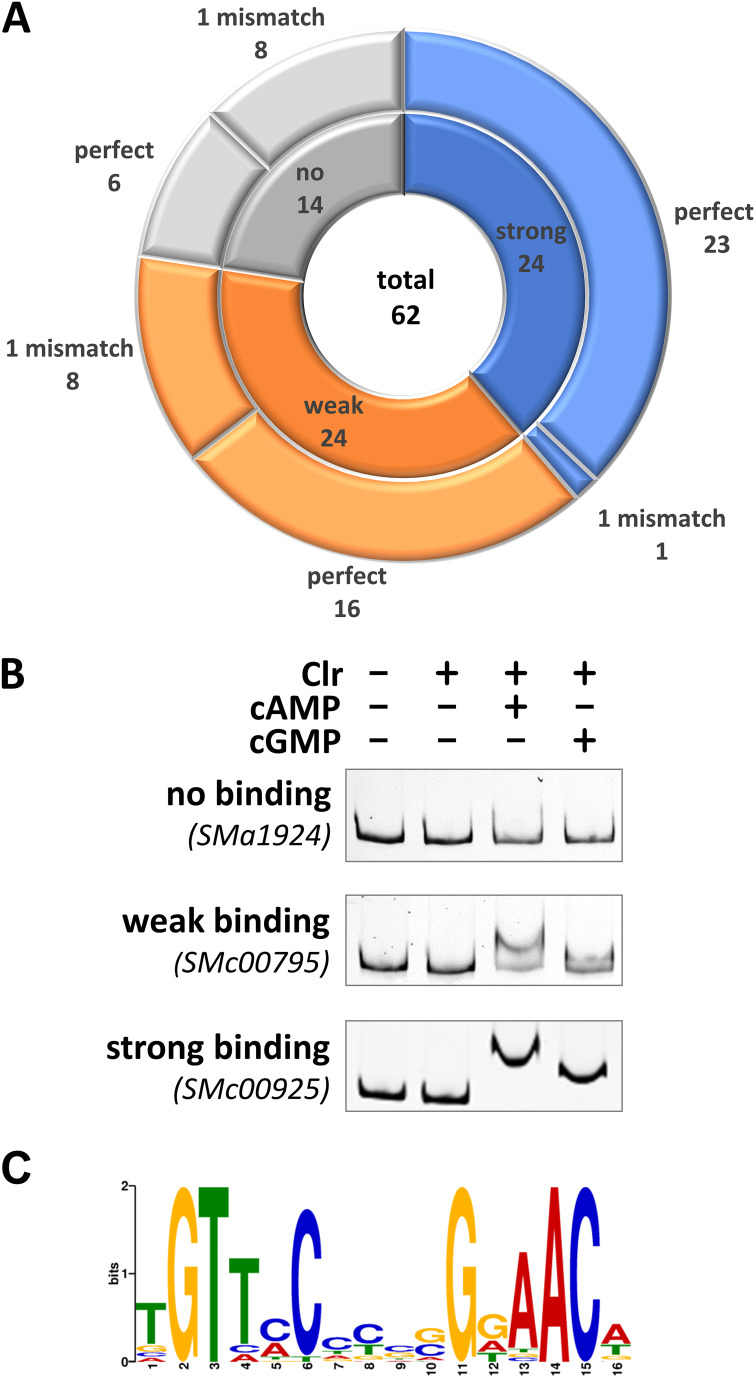
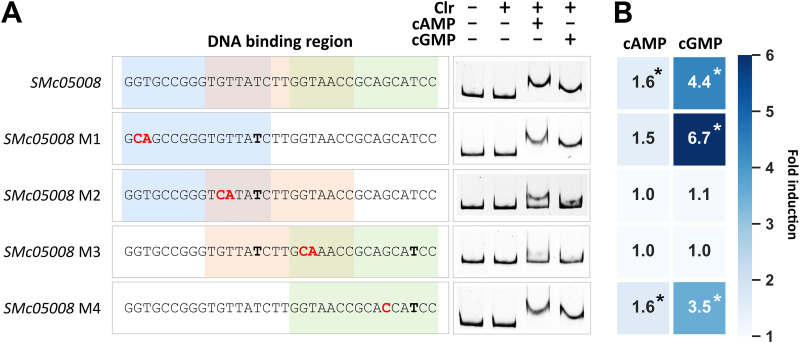
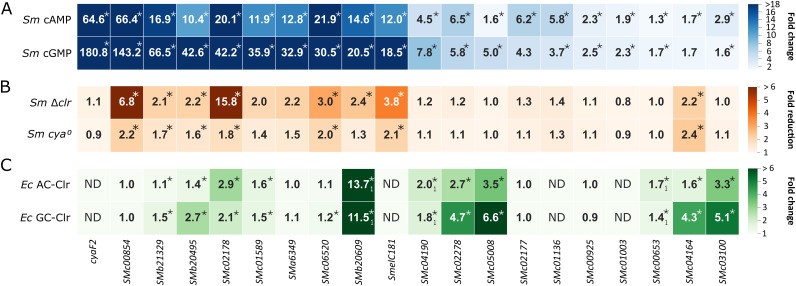
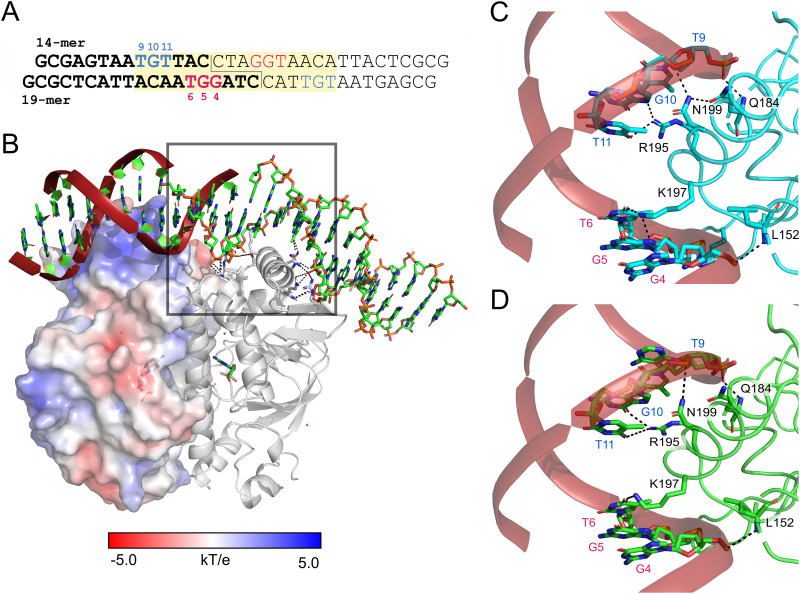
In bacteria, the most prevalent receptor proteins of 3',5'-cyclic AMP (cAMP) and 3',5'-cyclic GMP (cGMP) are found among transcription factors of the Crp-Fnr superfamily. The prototypic Escherichia coli catabolite activator protein (CAP) represents the main Crp cluster of this superfamily and is known to bind cAMP and cGMP but to mediate transcription activation only in its cAMP-bound state. In contrast, both cyclic nucleotides mediate transcription activation by Sinorhizobium meliloti Clr, mapping to cluster G of Crp-like proteins. We present crystal structures of Clr-cAMP and Clr-cGMP bound to the core motif of the palindromic Clr DNA binding site (CBS). We show that both cyclic nucleotides shift ternary Clr-cNMP-CBS-DNA complexes (where cNMP is cyclic nucleotide monophosphate) to almost identical active conformations, unlike the situation known for the E. coli CAP-cNMP complex. Isothermal titration calorimetry measured similar affinities of cAMP and cGMP binding to Clr in the presence of CBS core motif DNA (equilibrium dissociation constant for cNMP (], ~7 to 11 μM). However, different affinities were determined in the absence of this DNA (, ~24 μM; , ~6 μM). Sequencing of Clr-coimmunoprecipitated DNA as well as electrophoretic mobility shift and promoter-probe assays expanded the list of experimentally proven Clr-regulated promoters and CBS. This comprehensive set of CBS features conserved nucleobases that are consistent with the sequence readout through interactions of Clr amino acid residues with these nucleobases, as revealed by the Clr-cNMP-CBS-DNA crystal structures. Cyclic 3',5'-AMP (cAMP) and cyclic 3',5'-GMP (cGMP) are both long known as important nucleotide secondary messengers in eukaryotes. This is also the case for cAMP in prokaryotes, whereas a signaling role for cGMP in this domain of life has been recognized only recently. Catabolite repressor proteins (CRPs) are the most ubiquitous bacterial cAMP receptor proteins. Escherichia coli CAP, the prototypic transcription regulator of the main Crp cluster, binds both cyclic mononucleotides, but only the CAP-cAMP complex promotes transcription activation. In contrast, Crp cluster G proteins studied so far are activated by cGMP or by both cAMP and cGMP. Here, we report a structural analysis of the cAMP- and cGMP-activatable cluster G member Clr from Sinorhizobium meliloti, how binding of cAMP and cGMP shifts Clr to its active conformation, and the structural basis of its DNA binding site specificity.
在细菌中,3',5'-环腺苷酸(cAMP)和 3',5'-环鸟苷酸(cGMP)的最常见受体蛋白存在于 Crp-Fnr 超家族的转录因子中。典型的大肠杆菌分解代谢物激活蛋白(CAP)代表该超家族的主要 Crp 簇,已知其结合 cAMP 和 cGMP,但仅在其 cAMP 结合状态下介导转录激活。相比之下,两种环核苷酸都通过根瘤菌属 meliloti Clr 介导转录激活,映射到 Crp 样蛋白簇 G。我们展示了结合到回文 Clr DNA 结合位点(CBS)核心模体的 Clr-cAMP 和 Clr-cGMP 的晶体结构。我们表明,与大肠杆菌 CAP-cNMP 复合物的情况不同,两种环核苷酸都将三元 Clr-cNMP-CBS-DNA 复合物(其中 cNMP 是环核苷酸单磷酸)转移到几乎相同的活性构象。等温滴定量热法测量了 CBS 核心模体 DNA 存在下 cAMP 和 cGMP 与 Clr 的结合相似亲和力(平衡解离常数为 cNMP(],7 至 11 μM)。然而,在没有这种 DNA 的情况下,确定了不同的亲和力(,24 μM;,~6 μM)。Clr 共免疫沉淀 DNA 的测序以及电泳迁移率变动和启动子探针测定实验扩展了实验证明的 Clr 调节启动子和 CBS 的列表。该 CBS 的综合特征包含保守的核碱基,这些核碱基与 Clr 氨基酸残基与这些核碱基的相互作用一致,这一点通过 Clr-cNMP-CBS-DNA 晶体结构揭示出来。环 3',5'-AMP(cAMP)和环 3',5'-GMP(cGMP)都是长期以来被认为是真核生物中重要的核苷酸第二信使。在原核生物中,cAMP 也是如此,而 cGMP 在这个生命领域的信号作用直到最近才被认识到。分解代谢物阻遏蛋白(CRPs)是最普遍的细菌 cAMP 受体蛋白。大肠杆菌 CAP 是主要 Crp 簇的典型转录调节剂,它结合两种环单核苷酸,但只有 CAP-cAMP 复合物促进转录激活。相比之下,迄今为止研究过的 Crp 簇 G 蛋白被 cGMP 或 cAMP 和 cGMP 激活。在这里,我们报告了来自根瘤菌属 meliloti 的 cAMP 和 cGMP 可激活的簇 G 成员 Clr 的结构分析,cAMP 和 cGMP 的结合如何将 Clr 转变为其活性构象,以及其 DNA 结合位点特异性的结构基础。