Baluku Murungi Eric, Niyonzima Vallence, Atuhaire Evas, Nantume Susan, Beebwa Esther
Department of Nursing, Faculty of Medicine, Mbarara University of Science and Technology, Mbarara City, Uganda.
Masaka School of Comprehensive Nursing, Masaka City, Uganda.
Adv Med Educ Pract. 2023 Mar 30;14:313-322. doi: 10.2147/AMEP.S398606. eCollection 2023.
Despite the recommendations for delirium assessment in clinical settings, it stills remain a serious clinical problem associated with prolonged mechanical ventilation, stress on the patient and family, and mortality. There is paucity of data regarding delirium assessment and prevention in developing world. The Confusion Assessment Method for Intensive Care Unit (CAM-ICU) was developed to aid in the assessment of delirium. There is no documented assessment of delirium and prevention in Uganda. This study evaluated the effect of an educational intervention on nurses' knowledge and practices of delirium assessment using the CAM-ICU tool.
We used a quasi-experimental and recruited a convenience sample of 29 nurses from ICU and ER. The assessment before and after the interventions was conducted using a self-completed questionnaire from October 2020 to January 2021. The interventions were delivered through face-to-face presentations, demonstrations, watching videos, and hands on practice. Data were entered into excel, cleaned and exported to Stata version 14. Median and interquartile ranges were used for continuous variables, and frequencies and percentages for categorical variables. The mean knowledge score was calculated before and after the intervention. A paired -test was used to compare Pre- and Post-test knowledge and practice scores at P <0.05.
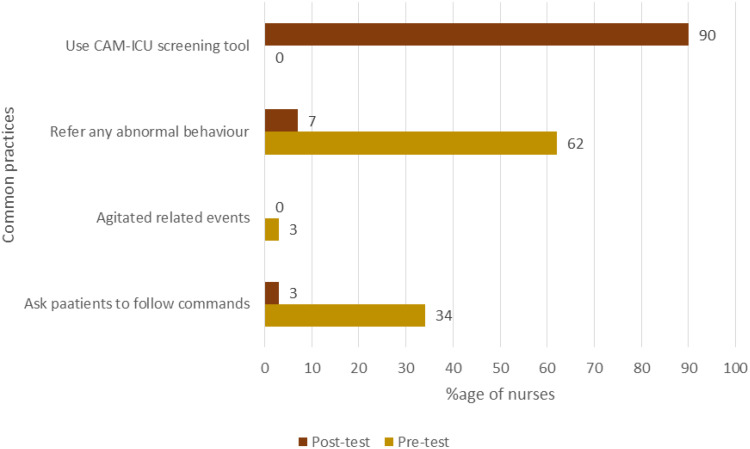
Majority (62%) were female, 48% were Diploma holders, median age was 30 (IQR = 28-32) years and median years of experience 3.5 (IQR = 3-4). The Mean knowledge scores was 10.7 (SD = 2.36) pretest and 19 (0.94) posttest. The mean practice score was 2 (SD = 0.83) pretest and 6 (0.35) posttest. There were significant differences in mean knowledge and practice scores before and after intervention mean of (t (28) =17.32, p < 0.001) and (t (28) = 25.04, p<0.001), respectively.
Educational intervention Improved nurses' knowledge and practice of delirium assessment. Continuous nursing education could improve nurses' knowledge of delirium assessment and thus quality of patient care.
尽管临床环境中有关于谵妄评估的建议,但谵妄仍然是一个严重的临床问题,与机械通气时间延长、患者及其家属承受的压力以及死亡率相关。在发展中国家,关于谵妄评估和预防的数据很少。重症监护病房谵妄评估方法(CAM-ICU)的开发旨在辅助谵妄评估。乌干达尚无关于谵妄评估和预防的文献记载。本研究评估了一项教育干预措施对护士使用CAM-ICU工具进行谵妄评估的知识和实践的影响。
我们采用了准实验研究方法,从重症监护病房(ICU)和急诊科便利抽样招募了29名护士。在2020年10月至2021年1月期间,使用自我填写的问卷进行干预前后的评估。干预通过面对面授课、演示、观看视频和实际操作进行。数据录入Excel,清理后导出到Stata 14版本。连续变量采用中位数和四分位间距,分类变量采用频率和百分比。计算干预前后的平均知识得分。采用配对t检验比较干预前后测试的知识和实践得分,P<0.05。
大多数(62%)为女性,48%为文凭持有者,年龄中位数为30岁(四分位间距=28 - 32岁),工作经验中位数为3.5年(四分位间距=3 - 4年)。干预前平均知识得分为10.7(标准差=2.36),干预后为19(标准差=0.94)。干预前平均实践得分为2(标准差=0.83),干预后为6(标准差=0.35)。干预前后平均知识和实践得分存在显著差异,分别为(t(28)=17.32,P<0.001)和(t(28)=25.04,P<0.001)。
教育干预提高了护士谵妄评估的知识和实践水平。持续的护理教育可以提高护士谵妄评估的知识,从而提高患者护理质量。