Psychological Sciences Research Institute (IPSY) and Institute of NeuroScience (IoNS), Université Catholique de Louvain, Louvain-la-Neuve, Belgium.
Department of Behavioural and Cognitive Sciences, Faculty of Humanities, Social and Educational Sciences, Institute of Cognitive Science and Assessment, University of Luxembourg, Esch-sur-Alzette, Luxembourg.
Hum Brain Mapp. 2023 Jun 15;44(9):3555-3567. doi: 10.1002/hbm.26297. Epub 2023 Apr 6.
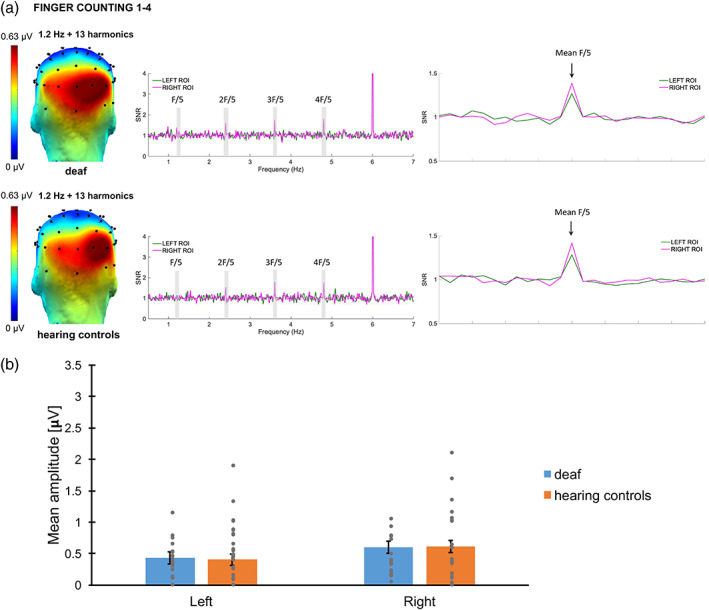
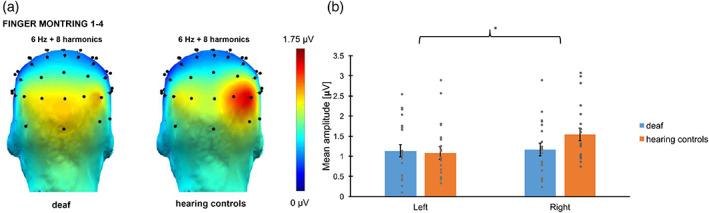
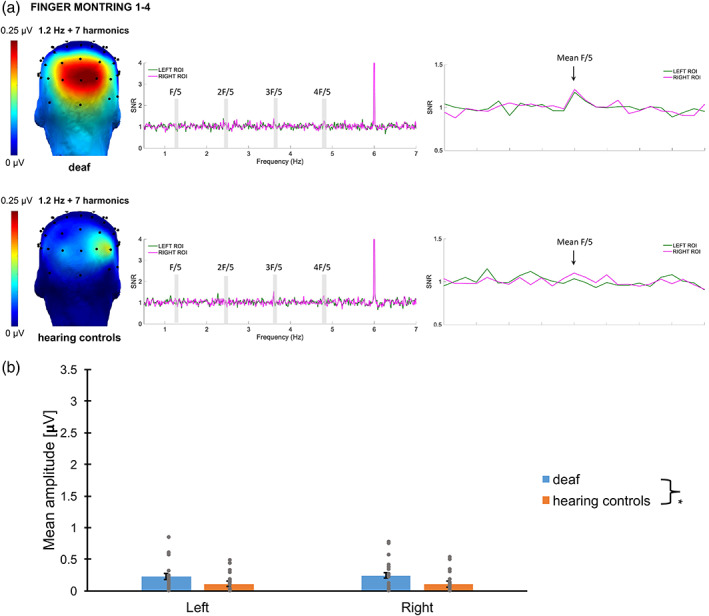
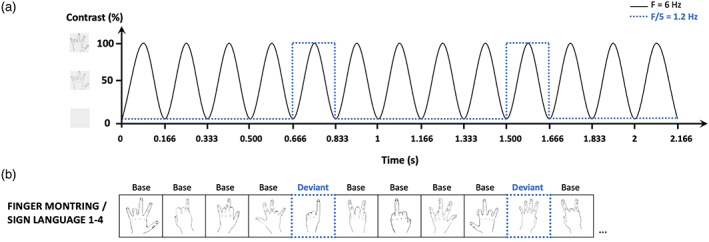
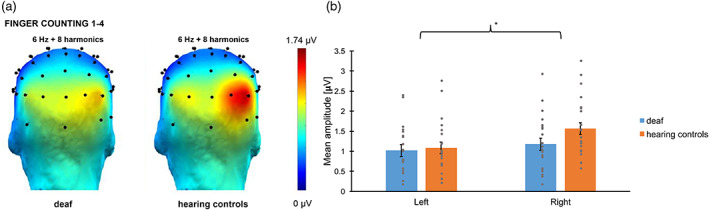
The linguistic counting system of deaf signers consists of a manual counting format that uses specific structures for number words. Interestingly, the number signs from 1 to 4 in the Belgian sign languages correspond to the finger-montring habits of hearing individuals. These hand configurations could therefore be considered as signs (i.e., part of a language system) for deaf, while they would simply be number gestures (not linguistic) for hearing controls. A Fast Periodic Visual Stimulation design was used with electroencephalography recordings to examine whether these finger-number configurations are differently processed by the brain when they are signs (in deaf signers) as compared to when they are gestures (in hearing controls). Results showed that deaf signers show stronger discrimination responses to canonical finger-montring configurations compared to hearing controls. A second control experiment furthermore demonstrated that this finding was not merely due to the experience deaf signers have with the processing of hand configurations, as brain responses did not differ between groups for finger-counting configurations. Number configurations are therefore processed differently by deaf signers, but only when these configurations are part of their language system.
聋人手语的语言计数系统包括一种手动计数形式,该形式使用特定的结构来表示数字词。有趣的是,比利时手语中的 1 到 4 的数字符号与听力个体的手指比划习惯相对应。因此,这些手部构型可以被视为聋人手势(即语言系统的一部分),而对于听力对照组来说,它们只是数字手势(非语言)。研究使用快速周期性视觉刺激设计结合脑电图记录来检查这些手指数字构型在作为手势(在听力对照组中)和作为手势(在聋人手语使用者中)时大脑是如何不同地进行处理的。结果表明,与听力对照组相比,聋人手语使用者对手指比划的标准构型表现出更强的辨别反应。此外,第二个对照实验进一步表明,这一发现不仅仅是因为聋人对手部构型处理的经验,因为对于手指计数构型,两组之间的大脑反应没有差异。因此,数字构型在由聋人手语使用者处理时会有所不同,但只有在这些构型是他们语言系统的一部分时才会如此。