Institute of Cognitive Science and Assessment, Department of Behavioural and Cognitive Sciences, Faculty of Humanities, Education and Social Sciences, University of Luxembourg, 11, Porte des Sciences, 4366, Esch-Belval, Esch-sur-Alzette, Luxembourg.
Faculty of Psychology and Educational Sciences, KU Leuven @Kulak, Kortrijk, Belgium.
Sci Rep. 2021 Nov 1;11(1):21405. doi: 10.1038/s41598-021-00738-0.
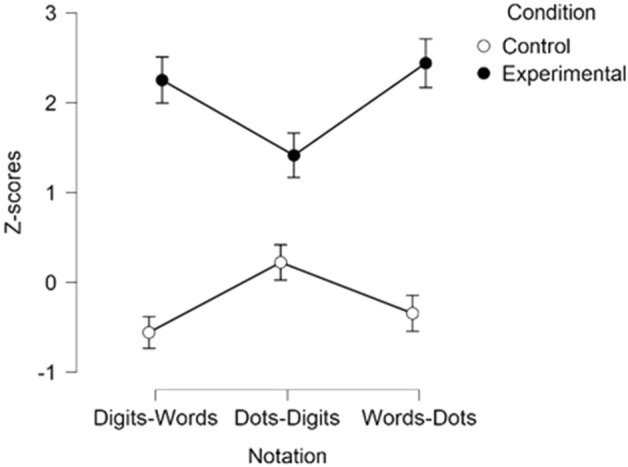
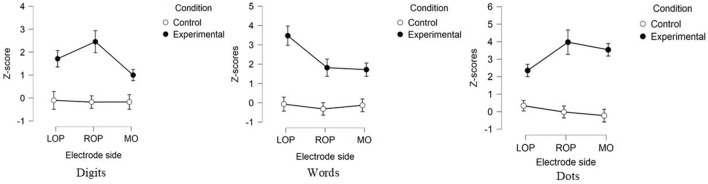
How humans integrate and abstract numerical information across different formats is one of the most debated questions in human cognition. We addressed the neuronal signatures of the numerical integration using an EEG technique tagged at the frequency of visual stimulation. In an oddball design, participants were stimulated with standard sequences of numbers (< 5) depicted in single (digits, dots, number words) or mixed notation (dots-digits, number words-dots, digits-number words), presented at 10 Hz. Periodically, a deviant stimulus (> 5) was inserted at 1.25 Hz. We observed significant oddball amplitudes for all single notations, showing for the first time using this EEG technique, that the magnitude information is spontaneously and unintentionally abstracted, irrespectively of the numerical format. Significant amplitudes were also observed for digits-number words and number words-dots, but not for digits-dots, suggesting an automatic integration across some numerical formats. These results imply that direct and indirect neuro-cognitive links exist across the different numerical formats.
人类如何整合和抽象不同格式的数字信息,是人类认知中最具争议的问题之一。我们使用标记在视觉刺激频率上的 EEG 技术来解决数值整合的神经元特征。在一种异常设计中,参与者被以 10 Hz 的速度呈现单数字(数字、点、数字单词)或混合符号(点-数字、数字单词-点、数字-数字单词)的标准数字序列刺激。定期以 1.25 Hz 的速度插入一个异常刺激(>5)。我们观察到所有单符号的显著异常振幅,这是首次使用这种 EEG 技术,表明无论数字格式如何,数量信息都是自发和无意识地抽象出来的。数字-数字单词和数字单词-点也观察到了显著的振幅,但数字-点没有,这表明在一些数字格式之间存在自动整合。这些结果表明,不同数字格式之间存在直接和间接的神经认知联系。