Brigham and Women's Hospital, Harvard Medical School, 75 Francis S, Boston, MA, 02115, USA.
McMaster University, 1280 Main Street W, Hamilton, ON, L8S 4L8, Canada.
J Patient Rep Outcomes. 2023 Apr 6;7(1):37. doi: 10.1186/s41687-023-00558-y.
The BREAST-Q is the most used patient-reported outcome measure (PROM) in breast cancer surgery. The purposes of this study were to re-examine the content validity of BREAST-Q cancer modules (mastectomy, lumpectomy and reconstruction) and to determine the need for new scales.
Interviews were conducted with women with breast cancer (Stage 0-4, any treatment), and were audio-recorded and transcribed verbatim. Deductive (based on original BREAST-Q conceptual framework) and inductive (new codes from the data) content analysis approaches were used to analyze the data. The number of codes that mapped to BREAST-Q were recorded.
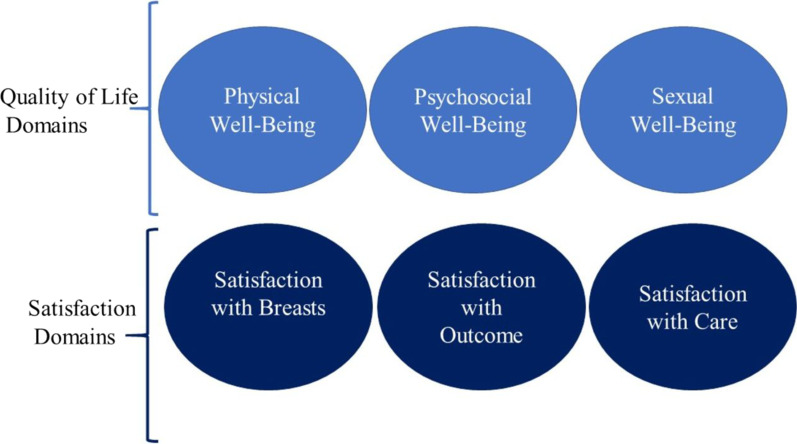
Dataset included 3948 codes from 58 participants. Most of the breast (n = 659, 96%) and all psychosocial (n = 127, 100%), sexual (n = 179, 100%) and radiation-related (n = 79, 100%) codes mapped to BREAST-Q Satisfaction with Breast, Psychosocial Wellbeing, Sexual Wellbeing and Adverse Effects of Radiation scales, respectively. For the physical wellbeing codes (n = 939) for breast/chest and arm, 34% (n = 321) mapped to the Physical Wellbeing-Chest scale. Most of the abdomen codes (n = 311) mapped to Satisfaction with Abdomen (n = 90, 76%) and Physical Wellbeing-Abdomen (n = 171, 89%) scales. Codes that did not map (n = 697, 30%) covered breast sensation and lymphedema. Concerns related to fatigue, cancer worry, and work impact were most reported and did not map to BREAST-Q.
The BREAST-Q, which was developed using extensive patient input more than a decade ago, is still relevant. To ensure the BREAST-Q remains comprehensive, new scales for upper extremity lymphedema, breast sensation, fatigue, cancer worry, and work impact were developed.
BREAST-Q 是乳腺癌手术中使用最广泛的患者报告结局测量工具(PROM)。本研究的目的是重新检验 BREAST-Q 癌症模块(乳房切除术、肿瘤切除术和重建术)的内容效度,并确定是否需要新的量表。
对患有乳腺癌(0-4 期,任何治疗方法)的女性进行访谈,并进行录音和逐字转录。采用演绎(基于 BREAST-Q 的原始概念框架)和归纳(来自数据的新代码)内容分析法分析数据。记录与 BREAST-Q 相匹配的代码数量。
数据集包括 58 名参与者的 3948 个代码。大多数乳房(n=659,96%)和所有心理社会(n=127,100%)、性(n=179,100%)和放射相关(n=79,100%)的代码分别映射到 BREAST-Q 的满意度乳房、心理社会幸福感、性幸福感和放射治疗不良反应量表上。对于乳房/胸部和手臂的身体幸福感代码(n=939),34%(n=321)映射到身体幸福感-胸部量表上。大多数腹部代码(n=311)映射到满意度腹部(n=90,76%)和身体幸福感-腹部(n=171,89%)量表上。未映射的代码(n=697,30%)涵盖了乳房感觉和淋巴水肿。报告最多但未映射到 BREAST-Q 的是与疲劳、癌症担忧和工作影响相关的问题。
BREAST-Q 是在十多年前使用广泛的患者输入开发的,仍然具有相关性。为了确保 BREAST-Q 仍然全面,开发了上肢淋巴水肿、乳房感觉、疲劳、癌症担忧和工作影响的新量表。