
在铜纳米晶体上通过电化学方法从二氧化碳合成丙烯。
Electrochemical synthesis of propylene from carbon dioxide on copper nanocrystals.
机构信息
Laboratory of Photonics and Interfaces, École Polytechnique Fédérale de Lausanne, Lausanne, Switzerland.
Group of Catalysis for Biofuels, École Polytechnique Fédérale de Lausanne, Lausanne, Switzerland.
出版信息
Nat Chem. 2023 May;15(5):705-713. doi: 10.1038/s41557-023-01163-8. Epub 2023 Apr 6.
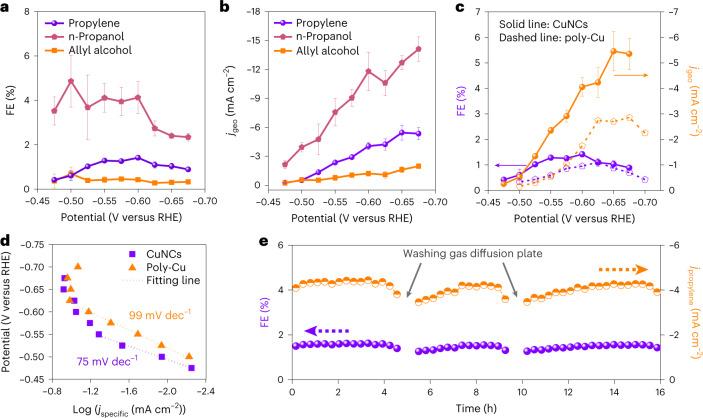
The conversion of carbon dioxide to value-added products using renewable electricity would potentially help to address current climate concerns. The electrochemical reduction of carbon dioxide to propylene, a critical feedstock, requires multiple C-C coupling steps with the transfer of 18 electrons per propylene molecule, and hence is kinetically sluggish. Here we present the electrosynthesis of propylene from carbon dioxide on copper nanocrystals with a peak geometric current density of -5.5 mA cm. The metallic copper nanocrystals formed from CuCl precursor present preponderant Cu(100) and Cu(111) facets, likely to favour the adsorption of key *C and *C intermediates. Strikingly, the production rate of propylene drops substantially when carbon monoxide is used as the reactant. From the electrochemical reduction of isotope-labelled carbon dioxide mixed with carbon monoxide, we infer that the key step for propylene formation is probably the coupling between adsorbed/molecular carbon dioxide or carboxyl with the *C intermediates that are involved in the ethylene pathway.
利用可再生电力将二氧化碳转化为高附加值产品,可能有助于解决当前的气候问题。电化学还原二氧化碳生成丙烯,这是一种关键的原料,需要经过多个 C-C 偶联步骤,每个丙烯分子转移 18 个电子,因此动力学上较为缓慢。在这里,我们在铜纳米晶体上展示了二氧化碳电合成丙烯的过程,峰值几何电流密度为-5.5 mA cm。由 CuCl 前体制备的金属铜纳米晶体呈现出占优势的 Cu(100)和 Cu(111)晶面,这可能有利于关键的 *C 和 *C 中间体的吸附。引人注目的是,当使用一氧化碳作为反应物时,丙烯的产率会大幅下降。从与一氧化碳混合的同位素标记的二氧化碳的电化学还原中,我们推断出丙烯形成的关键步骤可能是吸附/分子二氧化碳或羧基与参与乙烯途径的 *C 中间体之间的偶联。






 Zotero 插件