Department of Radiology Physics, Key Laboratory of Radiation Oncology of Zhejiang Province, Zhejiang Cancer Hospital, Institute of Basic Medicine and Cancer (IBMC), Chinese Academy of Sciences, Hangzhou, Zhejiang, China.
Department of Clinical Laboratory, Zhejiang Cancer Hospital, Institute of Basic Medicine and Cancer (IBMC), Chinese Academy of Sciences, Hangzhou, Zhejiang, China.
BMC Cancer. 2023 Apr 6;23(1):319. doi: 10.1186/s12885-023-10804-7.
Numerous studies have reported the prognostic significance of the red cell distribution width (RDW) in patients with esophageal squamous cell carcinoma (ESCC), but the relationship between the perioperative change in RDW (delta RDW) and survival in patients with ESCC after surgery has not been evaluated.
A total of 594 patients with newly diagnosed ESCC after surgery were enrolled in the study. Delta RDW (delta RDW = Postoperative RDW-Preoperative RDW) was counted based on data within one week before surgery and two weeks after surgery. To investigate the relationship between delta RDW and overall survival (OS), the median delta RDW was chosen as the cut-off value.
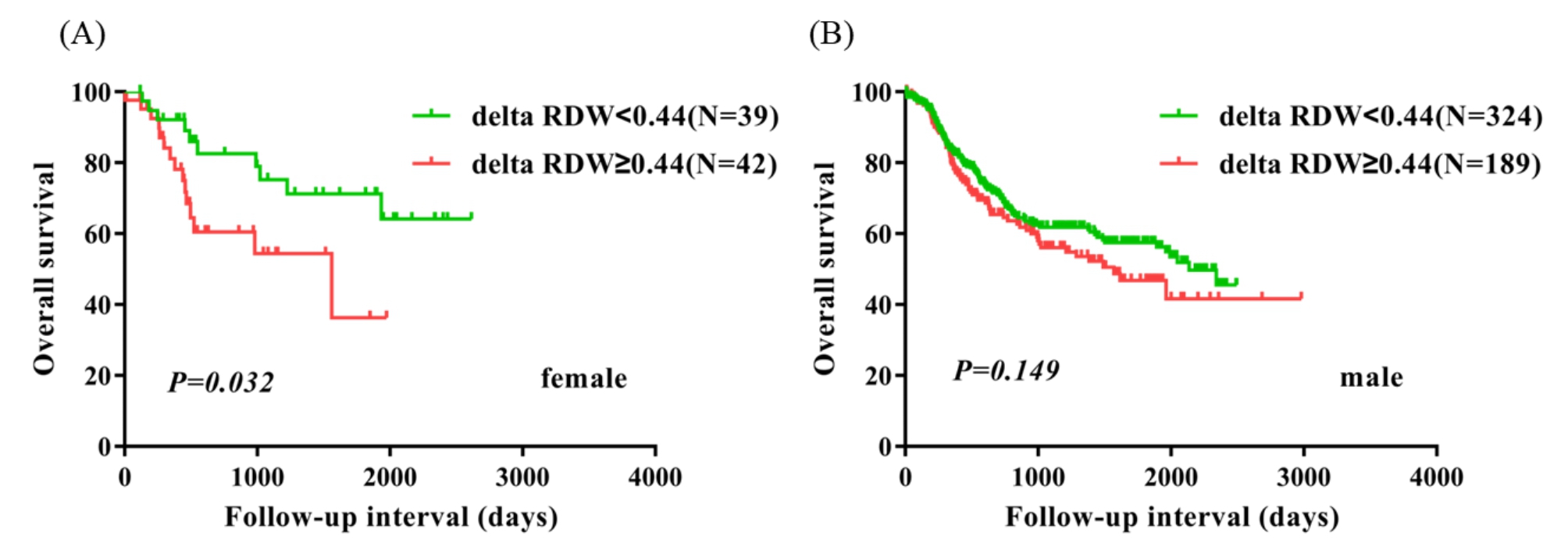
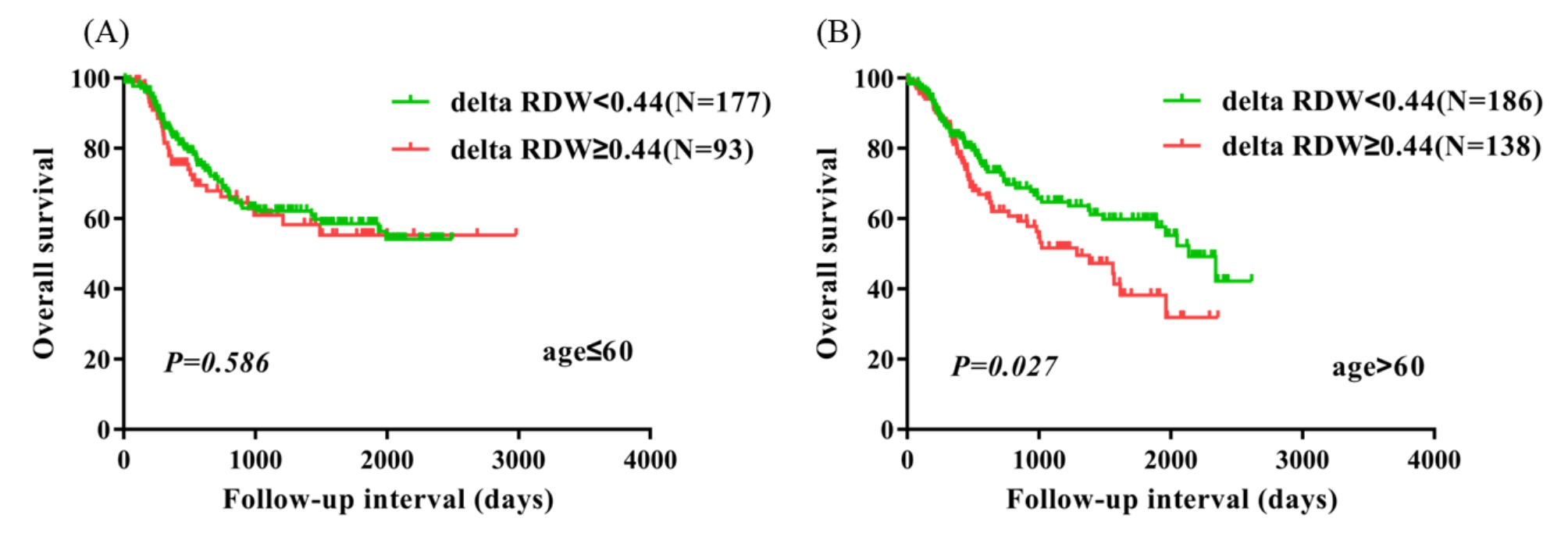
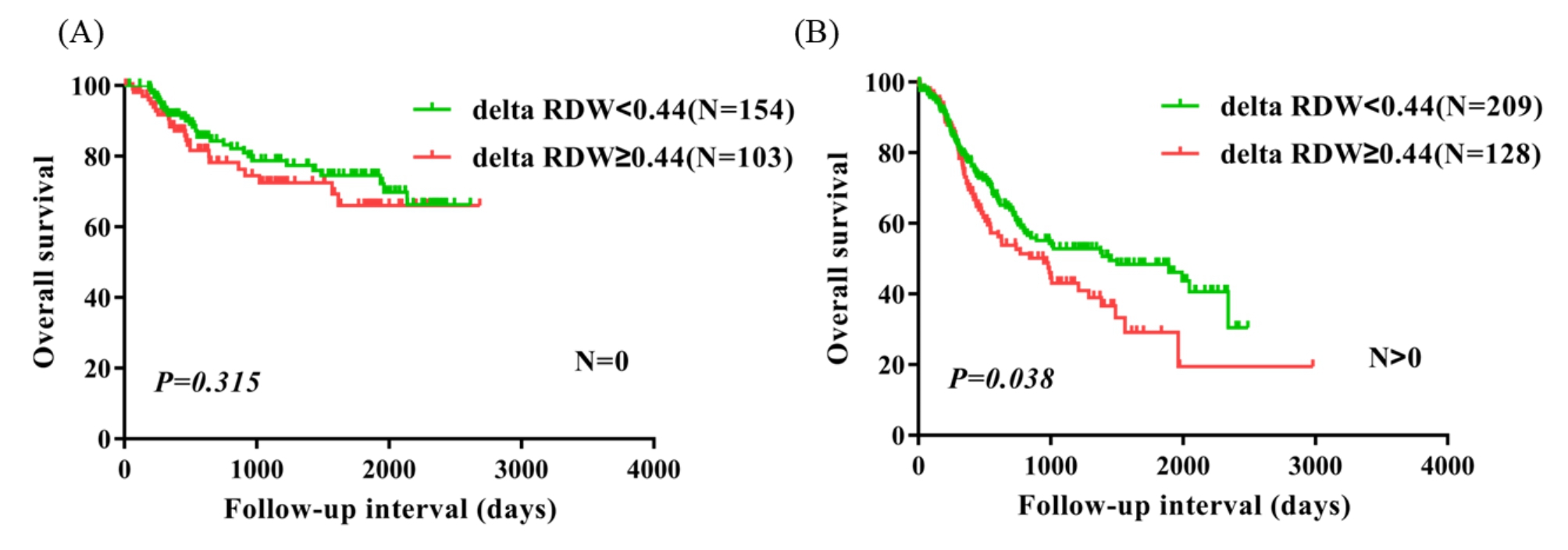
99 (16.7%) patients had pathological stage 1a-1b, 202 (34.0%) patients had pathological stage 2a-2b, and 293 (49.3%) patients had pathological stage 3a-3c.There were 179 (30.1%) patients who had vessel invasive, and 415 (69.9%) patients without vessel invasive. There were 216 (36.4%) patients with nerve infiltration, and 378 (63.6%) without nerve infiltration. In univariate analysis, five parameters including delta RDW(≥ 0.44 vs.<0.44) (P = 0.039, HR = 1.337, 95% CI = 1.014-1.762) significantly correlated with worse OS. Multivariate analysis revealed that delta RDW(≥ 0.44 vs.<0.44) was an independent prognostic marker for OS (P = 0.033, HR = 1.356, 95% CI = 1.025-1.793). Kaplan-Meier curves showed that delta RDW ≥ 0.44 was significantly associated with worse OS (P = 0.039). Subgroup analysis suggested that delta RDW ≥ 0.44 indicated worse survival in patients with ESCC exclusively in these subtypes such as female patients, age > 60 patients, patients with lymph node metastasis, and patients with vessel invasive.
Perioperative change in red cell distribution width predicts worse survival in patients with ESCC after surgery.
许多研究报告了红细胞分布宽度(RDW)在食管鳞状细胞癌(ESCC)患者中的预后意义,但尚未评估手术后 ESCC 患者的 RDW 变化(delta RDW)与生存之间的关系。
本研究共纳入 594 例手术后新诊断为 ESCC 的患者。根据手术前一周和手术后两周内的数据计算 delta RDW(delta RDW=术后 RDW-术前 RDW)。为了研究 delta RDW 与总生存期(OS)之间的关系,选择中位数 delta RDW 作为截断值。
99 例(16.7%)患者病理分期为 1a-1b,202 例(34.0%)患者病理分期为 2a-2b,293 例(49.3%)患者病理分期为 3a-3c。179 例(30.1%)患者有血管侵犯,415 例(69.9%)患者无血管侵犯。216 例(36.4%)患者有神经浸润,378 例(63.6%)患者无神经浸润。在单因素分析中,delta RDW(≥0.44 与<0.44)(P=0.039,HR=1.337,95%CI=1.014-1.762)等 5 个参数与较差的 OS 显著相关。多因素分析显示,delta RDW(≥0.44 与<0.44)是 OS 的独立预后标志物(P=0.033,HR=1.356,95%CI=1.025-1.793)。Kaplan-Meier 曲线显示,delta RDW≥0.44 与较差的 OS 显著相关(P=0.039)。亚组分析表明,delta RDW≥0.44 仅在女性患者、年龄>60 岁患者、有淋巴结转移患者和有血管侵犯患者等 ESCC 亚组中预示着较差的生存。
术后红细胞分布宽度的变化预测 ESCC 患者的生存较差。