Azizi Basit A, Munoz-Acuna Ricardo, Suleiman Aiman, Ahrens Elena, Redaelli Simone, Tartler Tim M, Chen Guanqing, Jung Boris, Talmor Daniel, Baedorf-Kassis Elias N, Schaefer Maximilian S
Department of Anesthesia, Critical Care and Pain Medicine, Beth Israel Deaconess Medical Center, Harvard Medical School, Brookline Ave 330, Boston, MA, USA.
Center for Anesthesia Research Excellence (CARE), Beth Israel Deaconess Medical Center, Harvard Medical School, Boston, MA, USA.
J Intensive Care. 2023 Apr 6;11(1):14. doi: 10.1186/s40560-023-00662-7.
Previous studies linked a high intensity of ventilation, measured as mechanical power, to mortality in patients suffering from "classic" ARDS. By contrast, mechanically ventilated patients with a diagnosis of COVID-19 may present with intact pulmonary mechanics while undergoing mechanical ventilation for longer periods of time. We investigated whether an association between higher mechanical power and mortality is modified by a diagnosis of COVID-19.
This retrospective study included critically ill, adult patients who were mechanically ventilated for at least 24 h between March 2020 and December 2021 at a tertiary healthcare facility in Boston, Massachusetts. The primary exposure was median mechanical power during the first 24 h of mechanical ventilation, calculated using a previously validated formula. The primary outcome was 30-day mortality. As co-primary analysis, we investigated whether a diagnosis of COVID-19 modified the primary association. We further investigated the association between mechanical power and days being alive and ventilator free and effect modification of this by a diagnosis of COVID-19. Multivariable logistic regression, effect modification and negative binomial regression analyses adjusted for baseline patient characteristics, severity of disease and in-hospital factors, were applied.
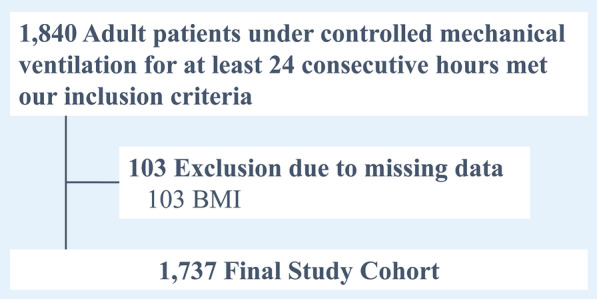
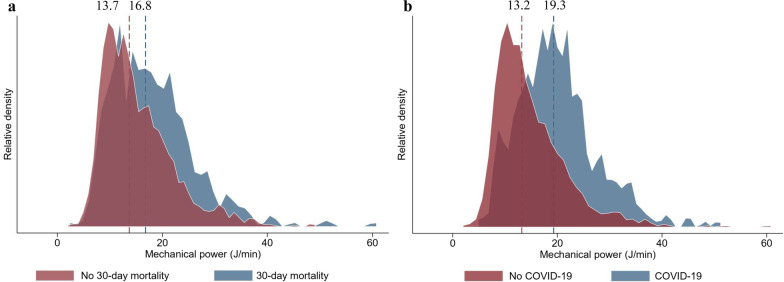
1,737 mechanically ventilated patients were included, 411 (23.7%) suffered from COVID-19. 509 (29.3%) died within 30 days. The median mechanical power during the first 24 h of ventilation was 19.3 [14.6-24.0] J/min in patients with and 13.2 [10.2-18.0] J/min in patients without COVID-19. A higher mechanical power was associated with 30-day mortality (OR 1.26 per 1-SD, 7.1J/min increase; 95% CI 1.09-1.46; p = 0.002). Effect modification and interaction analysis did not support that this association was modified by a diagnosis of COVID-19 (95% CI, 0.81-1.38; p-for-interaction = 0.68). A higher mechanical power was associated with a lower number of days alive and ventilator free until day 28 (IRR 0.83 per 7.1 J/min increase; 95% CI 0.75-0.91; p < 0.001, adjusted risk difference - 2.7 days per 7.1J/min increase; 95% CI - 4.1 to - 1.3).
A higher mechanical power is associated with elevated 30-day mortality. While patients with COVID-19 received mechanical ventilation with higher mechanical power, this association was independent of a concomitant diagnosis of COVID-19.
先前的研究将以机械功率衡量的高强度通气与“经典”急性呼吸窘迫综合征(ARDS)患者的死亡率联系起来。相比之下,诊断为新型冠状病毒肺炎(COVID-19)的机械通气患者在接受较长时间机械通气时,其肺力学功能可能保持完好。我们研究了COVID-19诊断是否会改变较高机械功率与死亡率之间的关联。
这项回顾性研究纳入了2020年3月至2021年12月期间在马萨诸塞州波士顿一家三级医疗机构接受至少24小时机械通气的成年重症患者。主要暴露因素是机械通气最初24小时内的机械功率中位数,使用先前验证的公式计算得出。主要结局是30天死亡率。作为共同主要分析,我们研究了COVID-19诊断是否改变了主要关联。我们还进一步研究了机械功率与存活且无需使用呼吸机天数之间的关联,以及COVID-19诊断对此关联的效应修正。应用多变量逻辑回归、效应修正和负二项回归分析,并对患者基线特征、疾病严重程度和院内因素进行了调整。
共纳入1737例机械通气患者,其中411例(23.7%)患有COVID-19。509例(29.3%)在30天内死亡。患有COVID-19的患者通气最初24小时内的机械功率中位数为19.3[14.6 - 24.0]焦耳/分钟,未患COVID-19的患者为13.2[10.2 - 18.0]焦耳/分钟。较高的机械功率与30天死亡率相关(每增加1标准差,即7.1焦耳/分钟,比值比为1.26;95%置信区间为1.09 - 1.46;p = 0.002)。效应修正和交互分析不支持COVID-19诊断会改变这种关联(95%置信区间为0.81 - 1.38;交互作用p值 = 0.68)。较高的机械功率与至第28天存活且无需使用呼吸机的天数减少相关(每增加7.1焦耳/分钟,发病率比值比为0.83;95%置信区间为0.75 - 0.91;p < 0.001,调整后的风险差为每增加7.1焦耳/分钟 - 2.7天;95%置信区间为 - 4.1至 - 1.3)。
较高的机械功率与30天死亡率升高相关。虽然患有COVID-19的患者接受了更高机械功率的机械通气,但这种关联独立于COVID-19的合并诊断。