Linguistic Data Consortium, University of Pennsylvania, 3600 Market Street, Philadelphia, PA, 19104, USA.
Center for Autism Research, Children's Hospital of Philadelphia, Philadelphia, PA, 19104, USA.
Mol Autism. 2023 Apr 6;14(1):13. doi: 10.1186/s13229-023-00545-6.
Autistic girls are underdiagnosed compared to autistic boys, even when they experience similar clinical impact. Research suggests that girls present with distinct symptom profiles across a variety of domains, such as language, which may contribute to their underdiagnosis. In this study, we examine sex differences in the temporal dynamics of natural conversations between naïve adult confederates and school-aged children with or without autism, with the goal of improving our understanding of conversational behavior in autistic girls and ultimately improving identification.
Forty-five school-aged children with autism (29 boys and 16 girls) and 47 non-autistic/neurotypical (NT) children (23 boys and 24 girls) engaged in a 5-min "get-to-know-you" conversation with a young adult confederate that was unaware of children's diagnostic status. Groups were matched on IQ estimates. Recordings were time-aligned and orthographically transcribed by trained annotators. Several speech and pause measures were calculated. Groups were compared using analysis of covariance models, controlling for age.
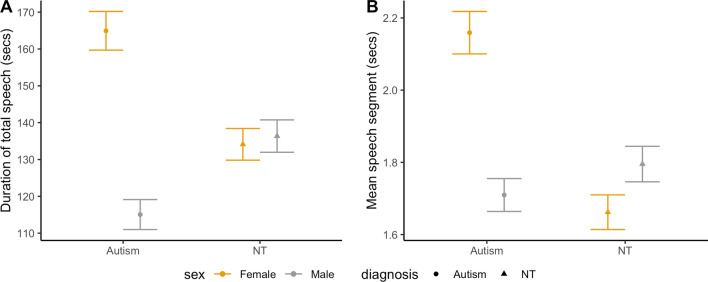
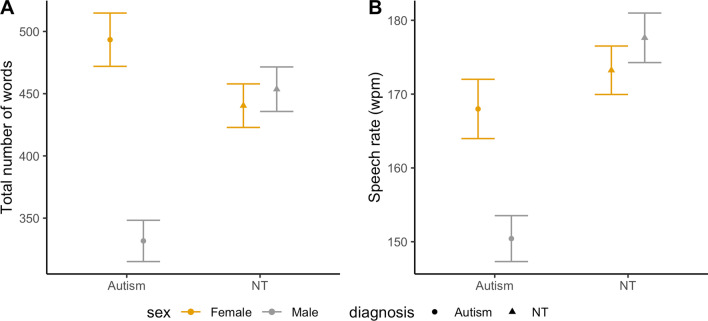
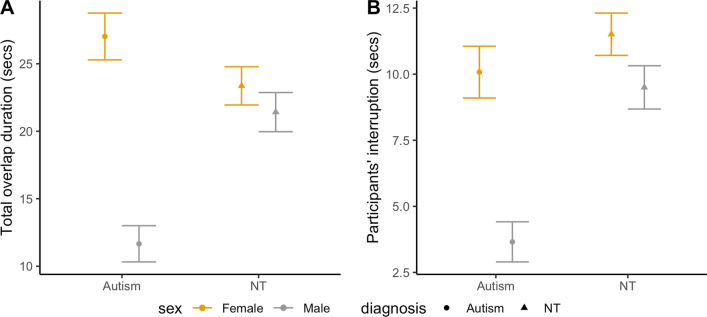
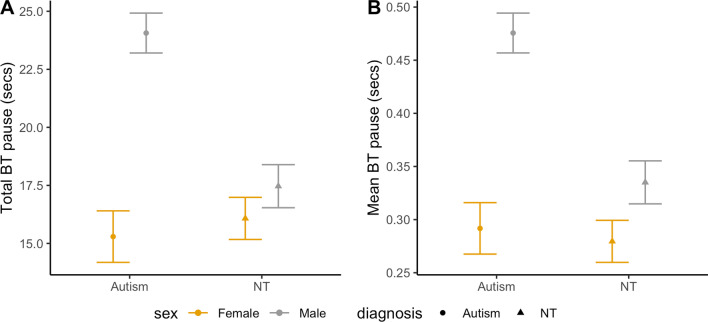
Autistic girls used significantly more words than autistic boys, and produced longer speech segments than all other groups. Autistic boys spoke more slowly than NT children, whereas autistic girls did not differ from NT children in total word counts or speaking rate. Autistic boys interrupted confederates' speech less often and produced longer between-turn pauses (i.e., responded more slowly when it was their turn) compared to other children. Within-turn pause duration did not differ by group.
Our sample included verbally fluent children and adolescents aged 6-15 years, so our study results may not replicate in samples of younger children, adults, and individuals who are not verbally fluent. The results of this relatively small study, while compelling, should be interpreted with caution and replicated in a larger sample.
This study investigated the temporal dynamics of everyday conversations and demonstrated that autistic girls and boys have distinct natural language profiles. Specifying differences in verbal communication lays the groundwork for the development of sensitive screening and diagnostic tools to more accurately identify autistic girls, and could inform future personalized interventions that improve short- and long-term social communication outcomes for all autistic children.
与自闭症男孩相比,自闭症女孩的诊断率较低,即使她们经历了类似的临床影响。研究表明,女孩在语言等各种领域表现出不同的症状特征,这可能导致她们的诊断不足。在这项研究中,我们研究了自闭症和非自闭症/神经典型(NT)儿童在与天真的成年同伴进行自然对话时的性别差异,目标是提高我们对自闭症女孩对话行为的理解,并最终提高识别能力。
45 名自闭症儿童(29 名男孩和 16 名女孩)和 47 名非自闭症/神经典型(NT)儿童(23 名男孩和 24 名女孩)与一名年轻的成年同伴进行了 5 分钟的“相互了解”对话,该同伴不知道孩子的诊断状况。各组按智商估计值进行匹配。记录经过时间对齐并由经过培训的注释者进行文字转录。计算了几种语音和停顿测量值。使用协方差分析模型比较了各组,控制了年龄因素。
自闭症女孩的用词量明显多于自闭症男孩,言语片段也比其他所有群体都长。自闭症男孩的语速比 NT 儿童慢,而自闭症女孩在总词汇量或语速方面与 NT 儿童没有差异。与其他儿童相比,自闭症男孩打断同伴讲话的次数较少,且回合间停顿时间较长(即轮到他们说话时反应较慢)。组内停顿时间没有差异。
我们的样本包括了 6-15 岁语言流利的儿童和青少年,因此我们的研究结果可能不适用于年龄较小的儿童、成年人和非语言流利的个体的样本。这项相对较小的研究结果虽然引人注目,但应谨慎解释,并在更大的样本中进行复制。
本研究调查了日常对话的时间动态,结果表明自闭症女孩和男孩具有不同的自然语言特征。明确言语交流方面的差异为开发更准确识别自闭症女孩的敏感筛查和诊断工具奠定了基础,并为未来的个性化干预措施提供信息,以改善所有自闭症儿童的短期和长期社会交流结果。