Center for Autism Spectrum Disorders, Children's National Hospital, Washington, DC, USA.
Center for Autism Research, Children's Hospital of Philadelphia, Philadelphia, PA, USA.
J Child Psychol Psychiatry. 2021 Aug;62(8):949-960. doi: 10.1111/jcpp.13348. Epub 2020 Nov 10.
Girls with autism spectrum condition (ASC) are chronically underdiagnosed compared to boys, which may be due to poorly understood sex differences in a variety of domains, including social interest and motivation. In this study, we use natural language processing to identify objective markers of social phenotype that are easily obtained from a brief conversation with a nonexpert.
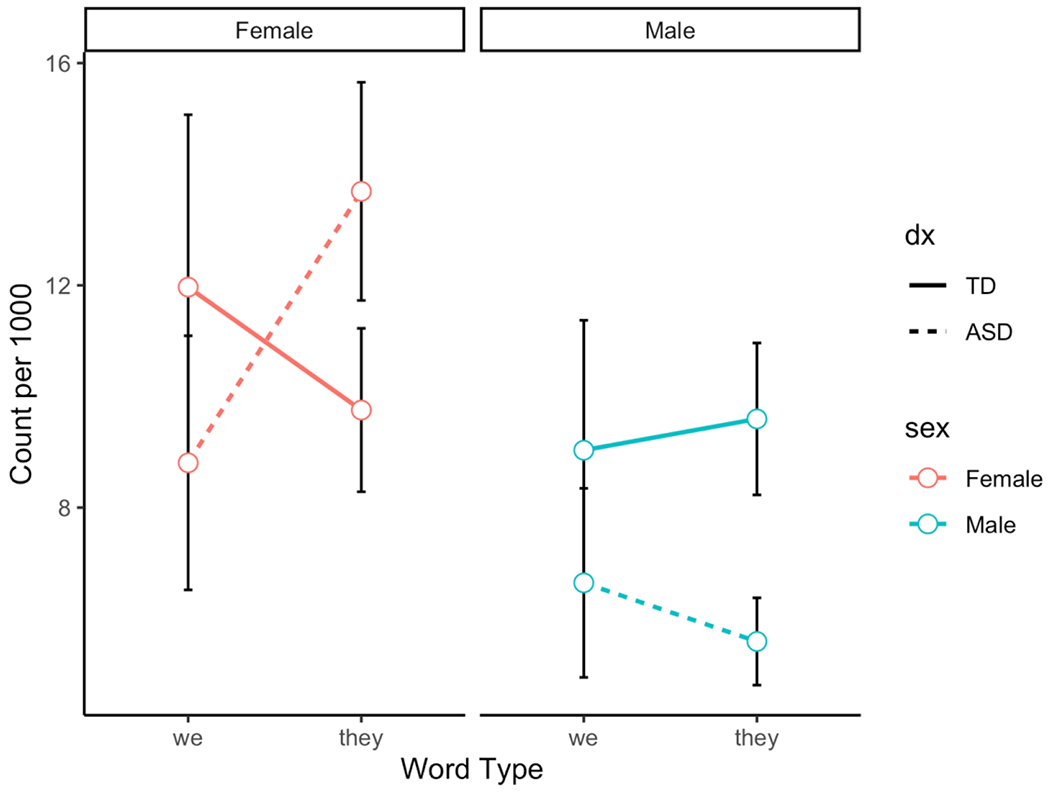
87 school-aged children and adolescents with ASC (17 girls, 33 boys) or typical development (TD; 15 girls, 22 boys) were matched on age (mean = 11.35 years), IQ estimates (mean = 107), and - for ASC participants - level of social impairment. Participants engaged in an informal 5-min 'get to know you' conversation with a nonexpert conversation partner. To measure attention to social groups, we analyzed first-person plural pronoun variants (e.g., 'we' and 'us') and third-person plural pronoun variants (e.g., 'they' and 'them').
Consistent with prior research suggesting greater social motivation in autistic girls, autistic girls talked more about social groups than did ASC boys. Compared to TD girls, autistic girls demonstrated atypically heightened discussion of groups they were not a part of ('they', 'them'), indicating potential awareness of social exclusion. Pronoun use predicted individual differences in the social phenotypes of autistic girls.
Relatively heightened but atypical social group focus is evident in autistic girls during spontaneous conversation, which contrasts with patterns observed in autistic boys and TD girls. Quantifying subtle linguistic differences in verbally fluent autistic girls is an important step toward improved identification and support for this understudied sector of the autism spectrum.
与男孩相比,患有自闭症谱系障碍(ASC)的女孩被长期误诊,这可能是由于在包括社交兴趣和动机在内的多个领域,人们对性别差异的理解不够深入。在这项研究中,我们使用自然语言处理技术来识别社交表型的客观标记,这些标记可以从与非专业人士的简短对话中轻松获得。
87 名患有 ASC(17 名女孩,33 名男孩)或典型发育(TD;15 名女孩,22 名男孩)的学龄儿童和青少年根据年龄(平均年龄 11.35 岁)、智商估计值(平均智商 107)以及 ASC 参与者的社交障碍程度进行匹配。参与者与非专业的对话伙伴进行了 5 分钟的非正式“了解你”对话。为了测量对社交群体的注意力,我们分析了第一人称复数代词变体(例如“我们”和“我们”)和第三人称复数代词变体(例如“他们”和“他们”)。
与先前的研究一致,即自闭症女孩的社交动机更强,自闭症女孩比 ASC 男孩更多地谈论社交群体。与 TD 女孩相比,自闭症女孩表现出对她们不属于的群体(“他们”、“他们”)的讨论异常活跃,这表明她们可能意识到了社会排斥。代词的使用预测了自闭症女孩社交表型的个体差异。
在自发对话中,自闭症女孩表现出相对较高但异常的社交群体关注,这与自闭症男孩和 TD 女孩观察到的模式形成对比。量化在口语流利的自闭症女孩中微妙的语言差异是提高对自闭症谱系中这一未被充分研究的领域的识别和支持的重要一步。