Department of Nursing, Hoseo University, Cheonan-si, South Korea.
Research Institute of Nursing Science, Hanyang University, Seoul, South Korea.
PLoS One. 2023 Apr 7;18(4):e0283596. doi: 10.1371/journal.pone.0283596. eCollection 2023.
The objectives of this study were 1) to investigate the prevalence and co-existence of frailty and malnutrition and 2) to identify factors related to frailty (including malnutrition) according to the level of frailty.
Data collection was conducted from July 11, 2021, to January 23, 2022, in 558 older adults residing in 16 long-term care facilities (LTCFs) in Korea. The FRAIL-NH and Mini-Nutritional Assessment short form were used to measure frailty and nutrition, respectively. The data analysis included descriptive statistics and a multivariate logistic regression.
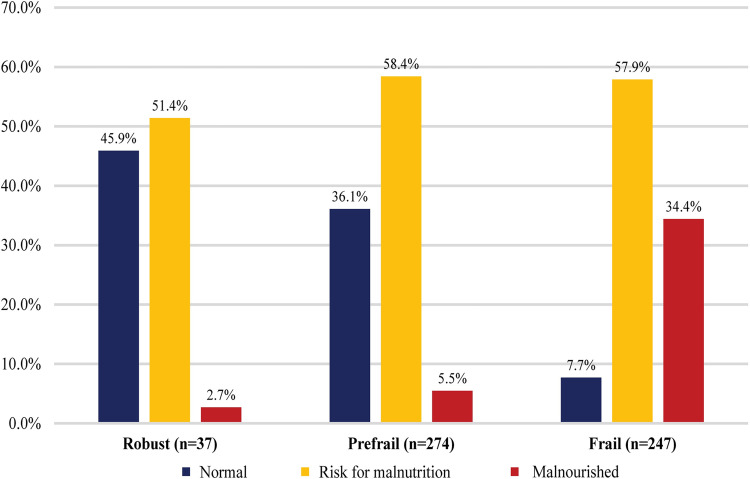
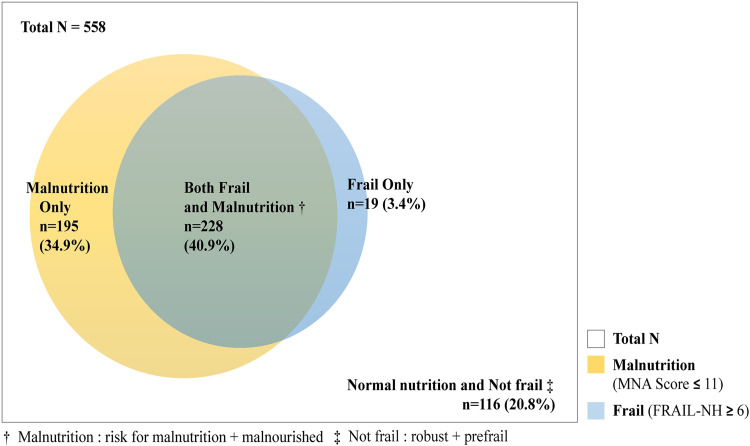
The mean age of the participants was 83.68 (± 7.39) years. Among 558 participants, 37 (6.6%), 274 (49.1%), and 247 (44.3%) were robust, prefrail, and frail, respectively. At the same time, 75.8% were categorized as having malnutrition status (malnourished: 18.1%; risk of malnutrition: 57.7%), and 40.9% had co-existing malnutrition and frailty. In the multivariate analysis, malnutrition was identified as the major frailty-related factor. Compared with a normal nutritional status, the incidence of frailty in the malnutrition group was 10.35 times (95% CI: 3.78-28.36) higher than the incidence of robustness and 4.80 times (95% CI: 2.69-8.59) higher than the incidence of prefrail.
The prevalence of frailty and malnutrition, and their co-existence, among older adults residing in LTCFs was high. Malnutrition is a major factor that increases the incidence of frailty. Therefore, active interventions are needed to improve the nutritional status of this population.
本研究的目的是 1)调查衰弱和营养不良的流行情况及共存情况,2)根据衰弱程度确定与衰弱(包括营养不良)相关的因素。
本研究于 2021 年 7 月 11 日至 2022 年 1 月 23 日在韩国的 16 家长期护理机构(LTCF)中对 558 名老年人进行了数据收集。使用 FRAIL-NH 和 Mini-Nutritional Assessment 短表分别测量衰弱和营养状况。数据分析包括描述性统计和多变量逻辑回归。
参与者的平均年龄为 83.68(±7.39)岁。558 名参与者中,分别有 37 名(6.6%)、274 名(49.1%)和 247 名(44.3%)为强壮、衰弱前期和衰弱。同时,75.8%的参与者存在营养不良状态(营养不良:18.1%;营养不良风险:57.7%),40.9%的参与者同时存在营养不良和衰弱。多变量分析表明,营养不良是与衰弱相关的主要因素。与营养状况正常相比,营养不良组的衰弱发生率是强壮组的 10.35 倍(95%CI:3.78-28.36),衰弱前期组的 4.80 倍(95%CI:2.69-8.59)。
LTCF 中老年人衰弱和营养不良的患病率及其共存率较高。营养不良是导致衰弱发生率增加的主要因素。因此,需要积极干预以改善该人群的营养状况。