Population Ecology Lab, Faculty of Biology, Adam Mickiewicz University, Poznań, Poland.
Section of Applied Entomology, Department of Plant Protection, Warsaw University of Life Sciences - SGGW, Warsaw, Poland.
Exp Appl Acarol. 2023 Apr;89(3-4):393-416. doi: 10.1007/s10493-023-00792-5. Epub 2023 Apr 8.
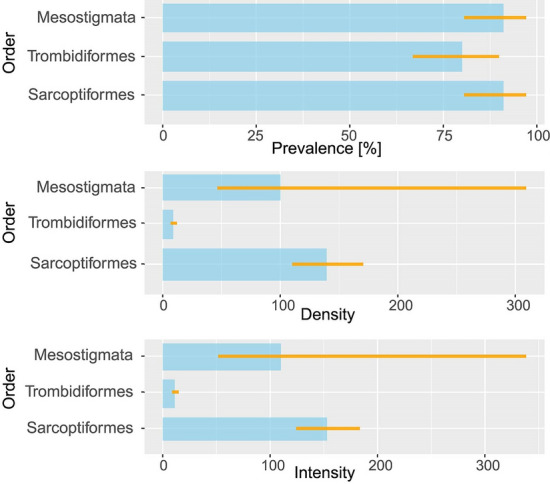
The wood warbler, Phylloscopus sibilatrix (Aves: Passeriformes), is a well-known model organism for studying bird migration, breeding habitat selection and nest predation. The nest acarofauna of this bird species has not been extensively studied so far. To provide a comprehensive report on mite species inhabiting wood warbler nests and to assess infestation parameters (prevalence, intensity, and abundance) for mite species and orders, we collected 45 nests of this bird species in the Wielkopolska National Park in western Poland. Analyses revealed a huge diversity (198 species) of mites inhabiting wood warbler nests. We found individuals belonging to the Mesostigmata, Trombidiformes and Sarcoptiformes. The Trombidiformes, represented in our study only by the Prostigmata, achieved statistically significantly lower intensity and abundance, compared to representatives of other orders. However, the number of recorded prostigmatid species was high (65). The most common were: Stigmaeus sphagneti (22 nests), Stigmaeus longipilis (16), Eupodes voxencollinus (15), Cunaxa setirostris (14), Stigmaeus pilatus (11), and Linopodes sp. 2 (10). The prevalence of Mesostigmata and Sarcoptiformes was equal, reaching 91.1%. Most of Gamasina (Mesostigmata) species found in this study were more characteristic of the soil environment and forest litter than bird nests, but there was also a typical bird parasite, viz. Ornithonyssus sylviarum. None of the observed species of Uropodina (Mesostigmata) or Oribatida (Sarcoptiformes) was typical for bird nests. Among the Uropodina, the highest parameters of nest infestation were achieved by Oodinychus ovalis, whereas among the Oribatida, they were achieved by Metabelba pulverosa. We discuss the importance of wood warbler nests for mite dispersal, survival and reproduction.
林莺(Phylloscopus sibilatrix)(鸟纲:雀形目)是研究鸟类迁徙、繁殖栖息地选择和巢捕食的知名模式生物。到目前为止,尚未对这种鸟类的巢内螨类群进行广泛研究。为了全面报告栖息在林莺巢内的螨类物种,并评估螨类和螨目类群的感染参数(流行率、强度和丰度),我们在波兰西部大波兰国家公园收集了 45 个这种鸟类的巢。分析显示,栖息在林莺巢内的螨类具有巨大的多样性(198 种)。我们发现了属于中气门目、蜱螨目和真螨目的个体。在我们的研究中,仅代表前气门目的蜱螨目,其强度和丰度统计学上显著较低,而与其他目代表相比。然而,记录的前气门目物种数量很高(65 种)。最常见的是:Stigmaeus sphagneti(22 巢)、Stigmaeus longipilis(16)、Eupodes voxencollinus(15)、Cunaxa setirostris(14)、Stigmaeus pilatus(11)和 Linopodes sp. 2(10)。中气门目和真螨目感染的流行率相等,达到 91.1%。本研究中发现的大多数 Gamasina(中气门目)物种更典型的是土壤环境和森林落叶,而不是鸟巢,但也有一个典型的鸟类寄生虫,即 Ornithonyssus sylviarum。在观察到的 Uropodina(中气门目)或 Oribatida(真螨目)物种中,没有一种是典型的鸟巢物种。在 Uropodina 中,巢内感染的最高参数是由 Oodinychus ovalis 获得的,而在 Oribatida 中,是由 Metabelba pulverosa 获得的。我们讨论了林莺巢对螨类传播、生存和繁殖的重要性。