Hospital Pharmacy, University Medical Centre Hamburg-Eppendorf, Hamburg, Germany.
Department of Intensive Care Medicine, University Medical Centre Hamburg-Eppendorf, Hamburg, Germany.
Int J Clin Pharm. 2023 Aug;45(4):847-856. doi: 10.1007/s11096-023-01559-z. Epub 2023 Apr 8.
Pharmacists are essential team members in critical care and contribute to the safety of pharmacotherapy for this vulnerable group of patients, but little is known about remote pharmacy services in intensive care units (ICU).
We compared the acceptance of pharmacist interventions (PI) in ICU patients working remotely with ward-based service. We evaluated both pharmacy services, including further information on PI, including reasons, actions and impact.
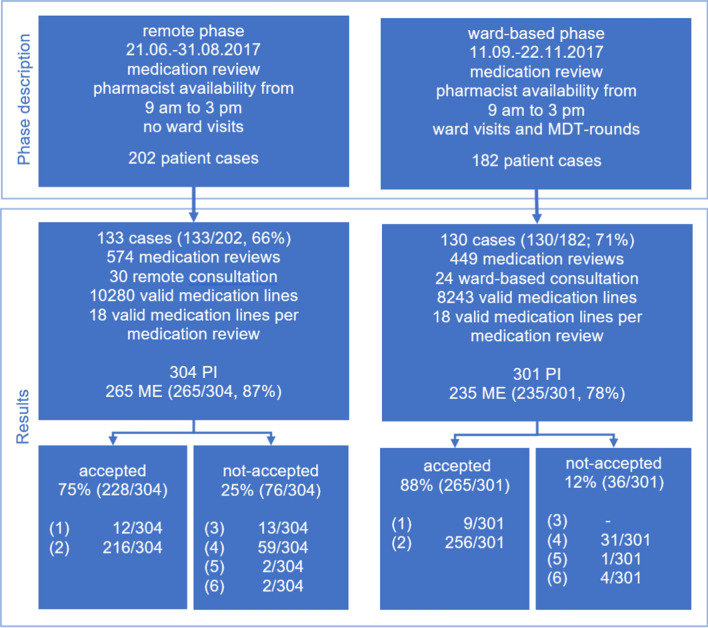
Over 5 months, a prospective single-centre observational study divided into two sequential phases (remote and ward-based) was performed on two ICU wards at a university hospital. After a structured medication review, PI identified were addressed to healthcare professionals. For documentation, the national database (ADKA-DokuPIK) was used. Acceptance was used as the primary endpoint. All data were analysed using descriptive methods.
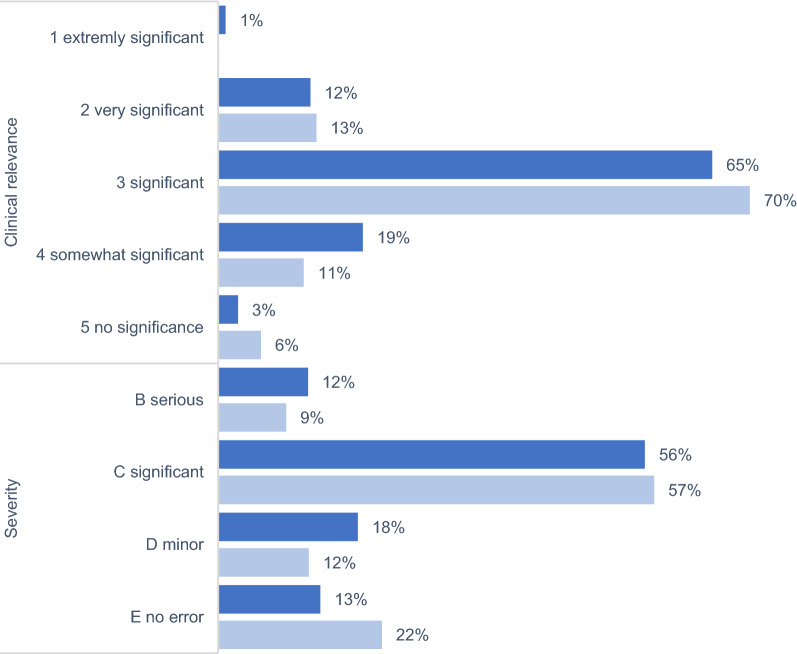
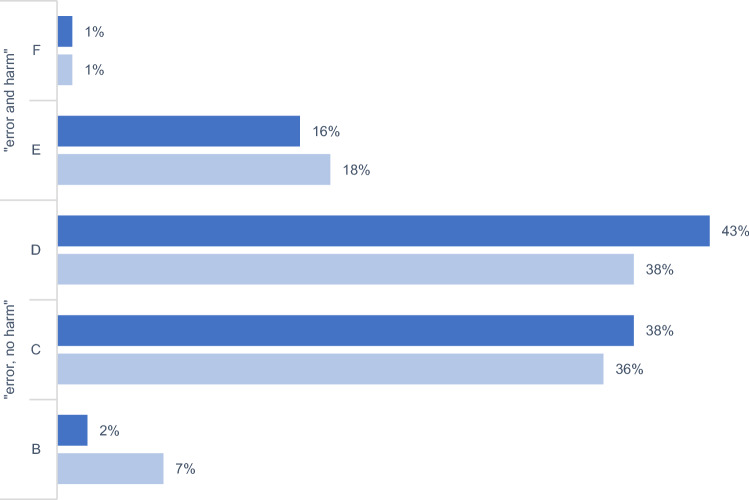
In total, 605 PI resulted from 1023 medication reviews. Acceptance was 75% (228/304) for remote and 88% (265/301; p < 0.001) for ward-based services. Non-inferiority was not demonstrated. Most commonly, drug- (44% and 36%) and dose-related (36% and 35%) reasons were documented. Frequently, drugs were stopped/paused (31% and 29%) and dosage changed (31% and 30%). PI were classified as "error, no harm" (National Coordinating Council for Medication Error Reporting and Prevention [NCC MERP] categories B to D; 83% and 81%). The severity and clinical relevance were at least ranked as "significant" (68% and 66%) and at least as "important" for patients (77% and 83%).
The way pharmacy services are provided influences the acceptance of PI. Remote pharmacy services may be seen as an addition, but acceptance rates in remote services failed to show non-inferiority.
药剂师是重症监护病房的重要团队成员,他们为这群脆弱的患者的药物治疗安全做出了贡献,但人们对重症监护病房(ICU)中的远程药学服务知之甚少。
我们比较了远程 ICU 患者和基于病房的服务对药剂师干预(PI)的接受程度。我们评估了这两种药学服务,包括关于 PI 的进一步信息,包括原因、行动和影响。
在一家大学医院的两个 ICU 病房进行了为期 5 个月的前瞻性单中心观察性研究,分为远程和基于病房的两个连续阶段。在进行了结构化的药物审查后,确定的 PI 将被转达给医护人员。为了记录,使用了国家数据库(ADKA-DokuPIK)。接受度被用作主要终点。所有数据均采用描述性方法进行分析。
总共从 1023 次药物审查中得出了 605 个 PI。远程服务的接受率为 75%(228/304),基于病房的服务为 88%(265/301;p<0.001)。非劣效性未得到证实。最常见的是药物相关(44%和 36%)和剂量相关(36%和 35%)的原因。经常停止/暂停药物(31%和 29%)和改变剂量(31%和 30%)。PI 被归类为“错误,无危害”(国家协调药物错误报告和预防委员会 [NCC MERP] 类别 B 至 D;83%和 81%)。严重程度和临床相关性至少被评为“显著”(68%和 66%),对患者至少为“重要”(77%和 83%)。
药学服务的提供方式影响 PI 的接受程度。远程药学服务可能被视为一种补充,但远程服务中的接受率未能显示出非劣效性。