Unité d'Ecologie Systématique et Evolution, CNRS, AgroParisTech, Université Paris-Saclay, Gif-sur-Yvette, France.
Department of Biology, University of Oxford, Oxford OX1 3SZ, United Kingdom.
Genome Biol Evol. 2023 Apr 6;15(4). doi: 10.1093/gbe/evad058.
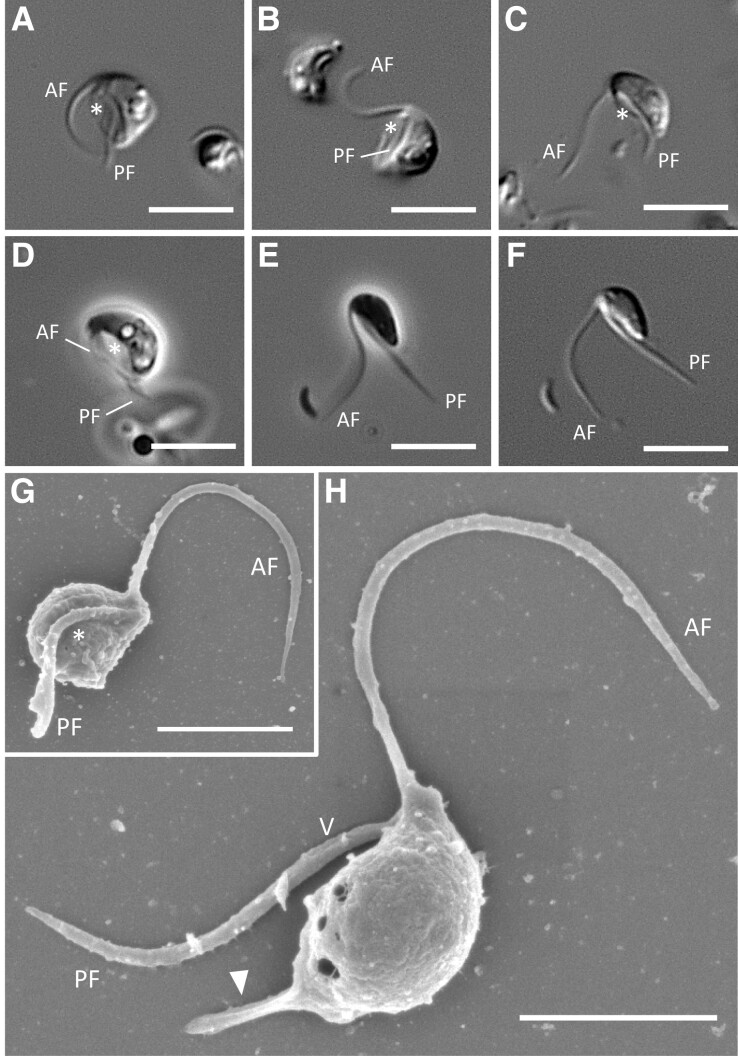
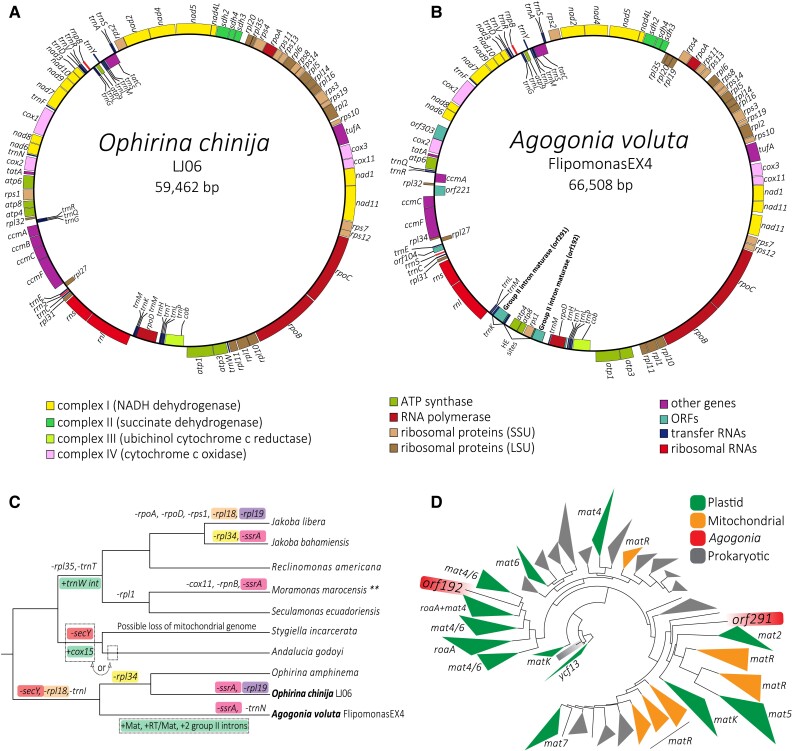
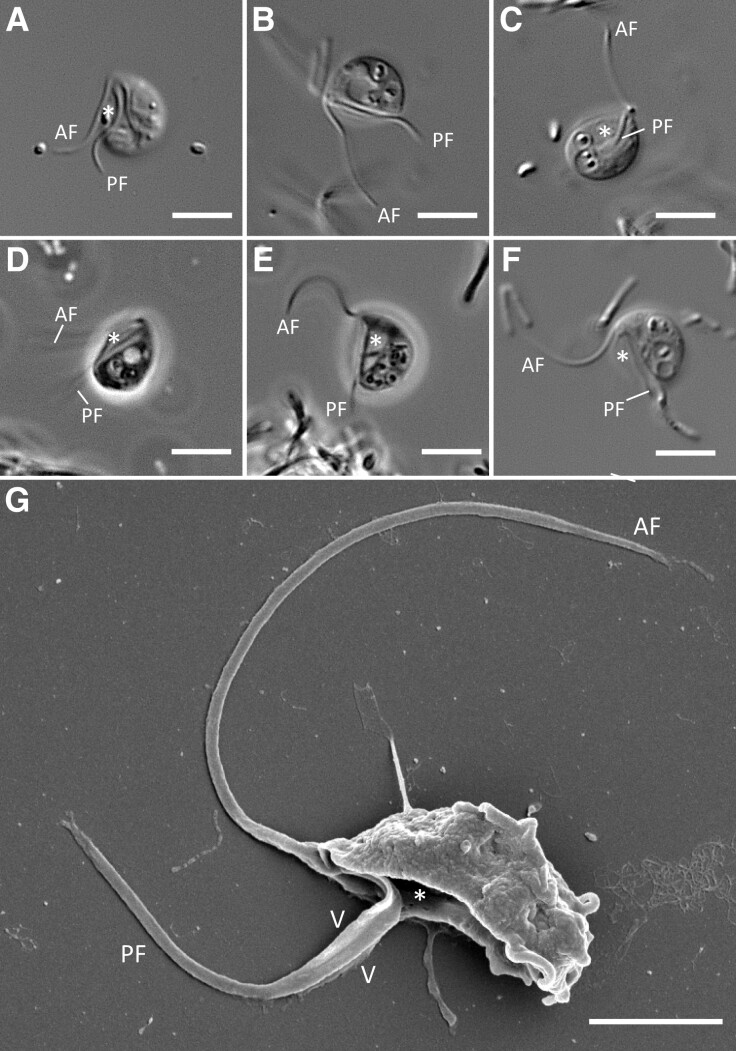
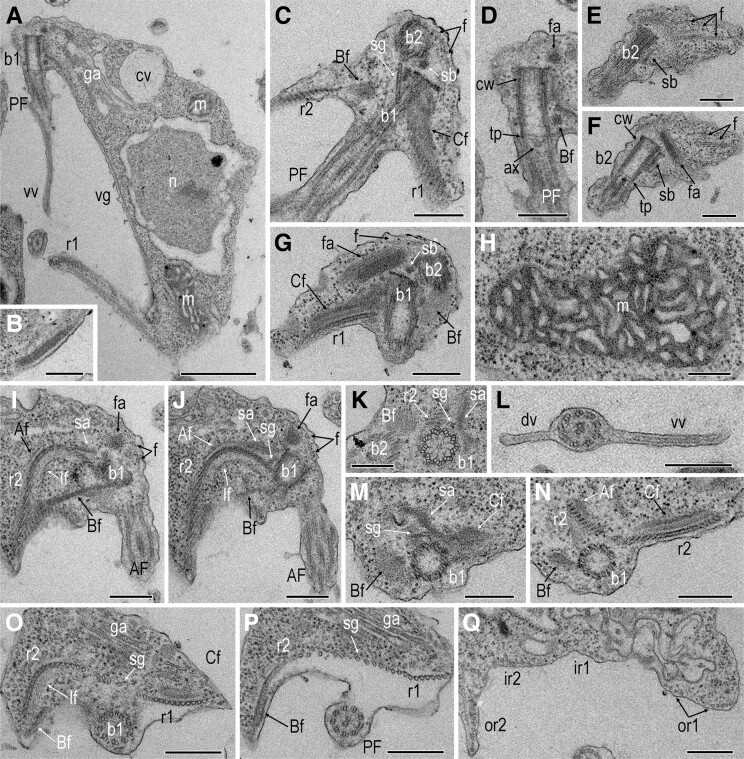
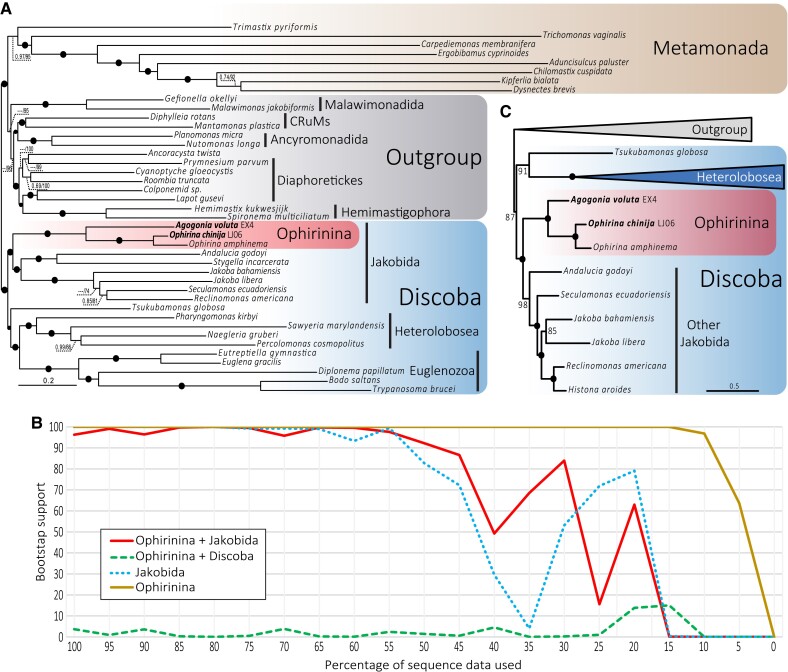
Ophirinina is a recently described suborder of jakobid protists (Excavata) with only one described species to date, Ophirina amphinema. Despite the acquisition and analysis of massive transcriptomic and mitogenomic sequence data from O. amphinema, its phylogenetic position among excavates remained inconclusive, branching as sister group either to all Jakobida or to all Discoba. From a morphological perspective, it has not only several typical jakobid features but also unusual traits for this group, including the morphology of mitochondrial cristae (sac-shaped to flattened-curved cristae) and the presence of two flagellar vanes. In this study, we have isolated, morphologically characterized, and sequenced genome and transcriptome data of two new Ophirinina species: Ophirina chinija sp. nov. and Agogonia voluta gen. et sp. nov. Ophirina chinija differs from O. amphinema in having rounded cell ends, subapically emerging flagella and a posterior cell protrusion. The much more distantly related A. voluta has several unique ultrastructural characteristics, including sac-shaped mitochondrial cristae and a complex "B" fiber. Phylogenomic analyses with a large conserved-marker dataset supported the monophyly of Ophirina and Agogonia within the Ophirinina and, more importantly, resolved the conflicting position of ophirinids as the sister clade to all other jakobids. The characterization of the mitochondrial genomes showed that Agogonia differs from all known gene-rich jakobid mitogenomes by the presence of two group II introns and their corresponding maturase protein genes. A phylogenetic analysis of the diversity of known maturases confirmed that the Agogonia proteins are highly divergent from each other and define distant families among the prokaryotic and eukaryotic maturases. This opens the intriguing possibility that, compared to other jakobids, Ophirinina may have retained additional mitochondrial elements that may help to understand the early diversification of eukaryotes and the evolution of mitochondria.
Ophirinina 是最近描述的 jakobid 原生动物(真核生物)的一个亚目,迄今为止只有一个描述的物种,Ophirina amphinema。尽管从 O. amphinema 获得并分析了大量转录组和线粒体基因组序列数据,但它在真核生物中的系统发育位置仍然不确定,分支为 jakobida 或 Discoba 的姐妹群。从形态学的角度来看,它不仅具有几种典型的 jakobid 特征,而且还具有该组不常见的特征,包括线粒体嵴的形态(囊状到扁平弯曲嵴)和两个鞭毛叶片的存在。在这项研究中,我们分离、形态特征描述并测序了两个新的 Ophirinina 物种的基因组和转录组数据:Ophirina chinija sp. nov. 和 Agogonia voluta gen. et sp. nov.。Ophirina chinija 与 O. amphinema 的区别在于细胞末端呈圆形、亚根尖出现的鞭毛和后细胞突起。而远缘的 A. voluta 具有几个独特的超微结构特征,包括囊状的线粒体嵴和复杂的“B”纤维。利用包含大量保守标记物的数据集进行的系统基因组分析支持 Ophirinina 和 Agogonia 的单系性,并且更重要的是,解决了 ophirinids 作为所有其他 jakobids 的姐妹群的冲突位置。线粒体基因组的特征表明,Agogonia 与所有已知富含基因的 jakobid 线粒体基因组的不同之处在于存在两个 II 组内含子及其对应的成熟酶蛋白基因。对已知成熟酶多样性的系统发育分析证实,Agogonia 的蛋白质彼此高度不同,并在原核生物和真核生物成熟酶中定义了遥远的家族。这开辟了一个有趣的可能性,即与其他 jakobids 相比,Ophirinina 可能保留了更多的线粒体元件,这有助于理解真核生物的早期多样化和线粒体的进化。