Chang Wei-Ting, Sun Cheuk-Kwan, Wu Jheng-Yan, Huang Po-Yu, Liu Ting-Hui, Chang Ying-Jen, Lin Yao-Tsung, Kang Fu-Chi, Hung Kuo-Chuan
Division of Cardiology, Department of Internal Medicine, Chi-Mei Medical Center, Tainan City, Taiwan.
Department of Biotechnology, Southern Taiwan University of Science and Technology, Tainan City, Taiwan.
Front Nutr. 2023 Mar 23;10:1154409. doi: 10.3389/fnut.2023.1154409. eCollection 2023.
Although prognostic nutritional index (PNI) has been frequently applied in patients with malignancy or those during postoperative recovery, whether it is also an optimal indicator of the risk of contrast-induced nephropathy (CIN) in patients receiving coronary angiography remains uncertain. This meta-analysis aimed at investigating the clinical association of PNI with the risk of CIN in patients receiving coronary angiography or percutaneous coronary intervention.
Embase, Medline, Cochrane Library, and Google scholar were searched for studies until January 2023. The relationship between CIN risk and PNI (i.e., low vs. high) (primary outcome) as well as other variables (secondary outcomes) were analyzed using a random-effects model.
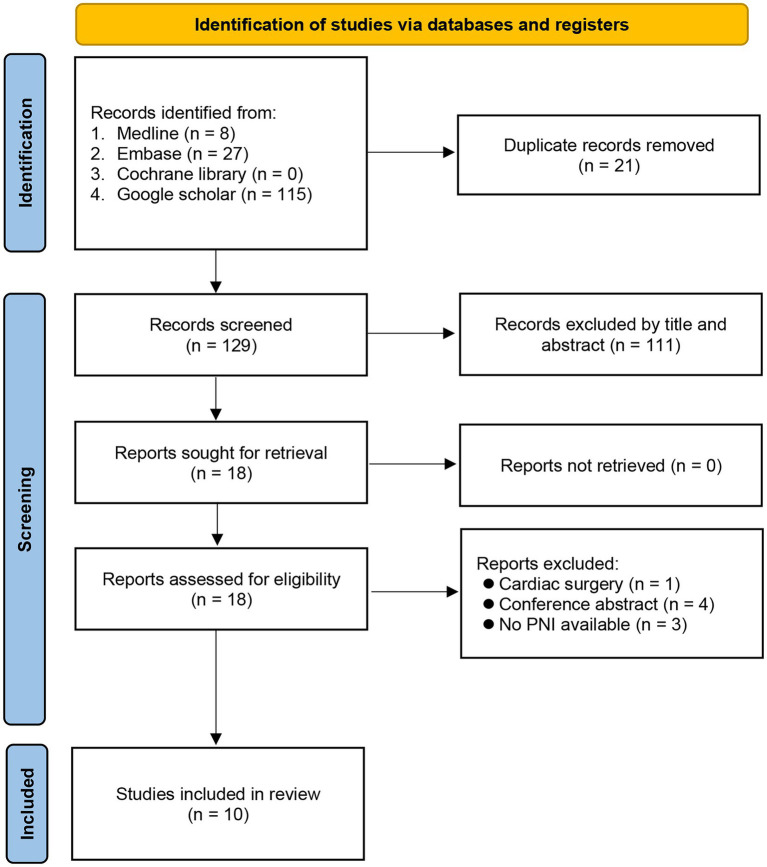
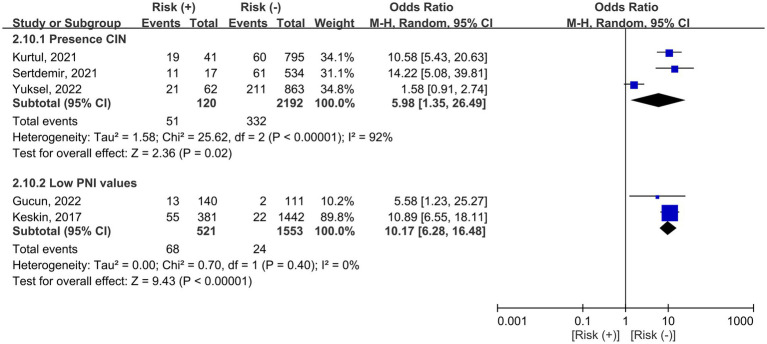
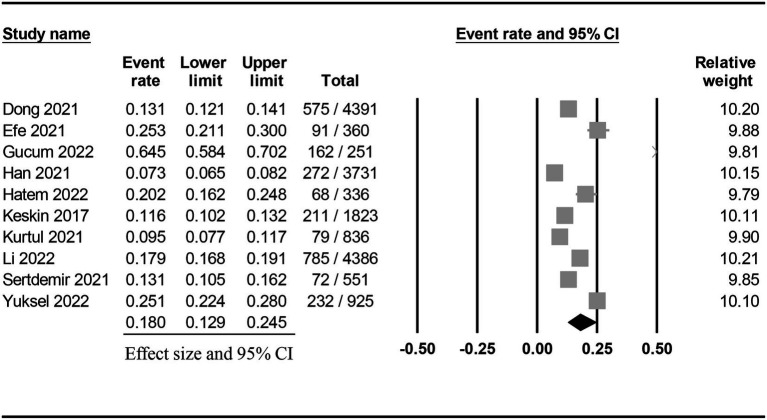
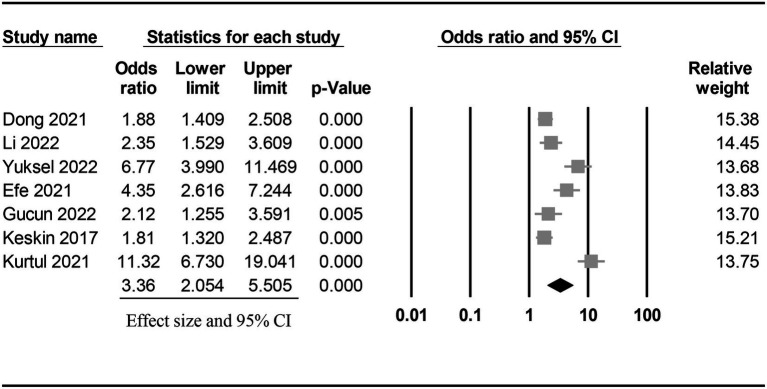
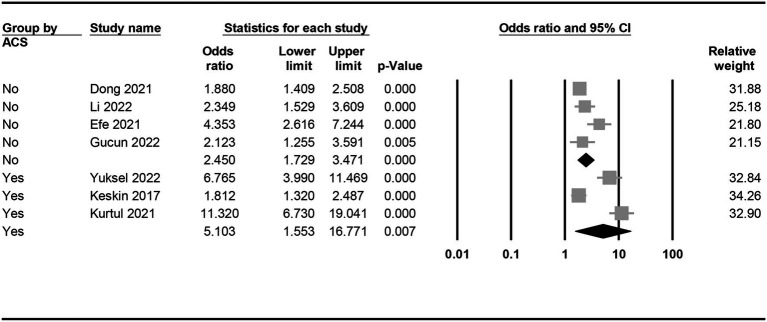
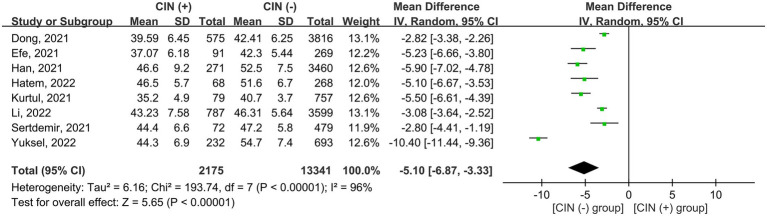
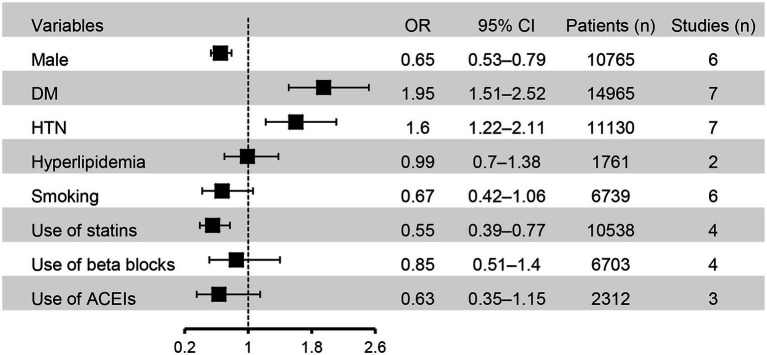
Overall, 10 observational studies with 17,590 patients (pooled incidence of CIN: 18%) were eligible for analysis. There was a higher risk of CIN in patients with a low PNI compared to those with a high PNI [odd ratio (OR) = 3.362, 95% confidence interval (CI): 2.054 to 5.505, < 0.0001, = 89.6%, seven studies, 12,972 patients, certainty of evidence: very low]. Consistently, a lower PNI was noted in patients with CIN compared to those without (Mean difference = -5.1, 95% CI: -6.87 to -3.33, < 0.00001, = 96%, eight studies, 15,516 patients, certainty of evidence: very low). Other risks of CIN included diabetes and hypertension, while male gender and the use of statins were associated with a lower risk of CIN. Patients with CIN were older, had a higher creatinine level, and received a higher contrast volume compared to those without. On the other hand, pre-procedural albumin, estimated glomerular filtration rate, ejection fraction, hemoglobin, lymphocyte ratio were found to be lower in patients with CIN than in those without.
This meta-analysis highlighted an inverse association of PNI with the risk of CIN, which required further studies for verification.
[https://www.crd.york.ac.uk/prospero/], identifier [CRD42023389185].
尽管预后营养指数(PNI)已频繁应用于恶性肿瘤患者或术后恢复患者,但它是否也是接受冠状动脉造影患者发生对比剂肾病(CIN)风险的最佳指标仍不确定。这项荟萃分析旨在研究PNI与接受冠状动脉造影或经皮冠状动脉介入治疗患者发生CIN风险之间的临床关联。
检索Embase、Medline、Cochrane图书馆和谷歌学术,检索截至2023年1月的研究。使用随机效应模型分析CIN风险与PNI(即低与高)(主要结局)以及其他变量(次要结局)之间的关系。
总体而言,10项观察性研究共17590例患者(CIN合并发病率:18%)符合分析条件。与PNI高的患者相比,PNI低的患者发生CIN的风险更高[比值比(OR)=3.362,95%置信区间(CI):2.054至5.505,P<0.0001,I²=89.6%,7项研究,12972例患者,证据确定性:非常低]。同样,与未发生CIN的患者相比,发生CIN的患者PNI更低(平均差异=-5.1,95%CI:-6.87至-3.33,P<0.00001,I²=96%,8项研究,15516例患者,证据确定性:非常低)。CIN的其他风险因素包括糖尿病和高血压,而男性和使用他汀类药物与CIN风险较低相关。与未发生CIN的患者相比,发生CIN的患者年龄更大、肌酐水平更高、接受的对比剂剂量更大。另一方面,术前白蛋白、估计肾小球滤过率、射血分数、血红蛋白、淋巴细胞比例在发生CIN的患者中低于未发生CIN的患者。
这项荟萃分析强调了PNI与CIN风险之间的负相关,这需要进一步研究验证。