Gremese Elisa, Tolusso Barbara, Bruno Dario, Perniola Simone, Ferraccioli Gianfranco, Alivernini Stefano
Division of Clinical Immunology, Fondazione Policlinico Universitario A. Gemelli-IRCCS, Rome, Italy.
Immunology Core Facility, Fondazione Policlinico Universitario A. Gemelli-IRCCS, Rome, Italy.
Front Med (Lausanne). 2023 Mar 22;10:956127. doi: 10.3389/fmed.2023.956127. eCollection 2023.
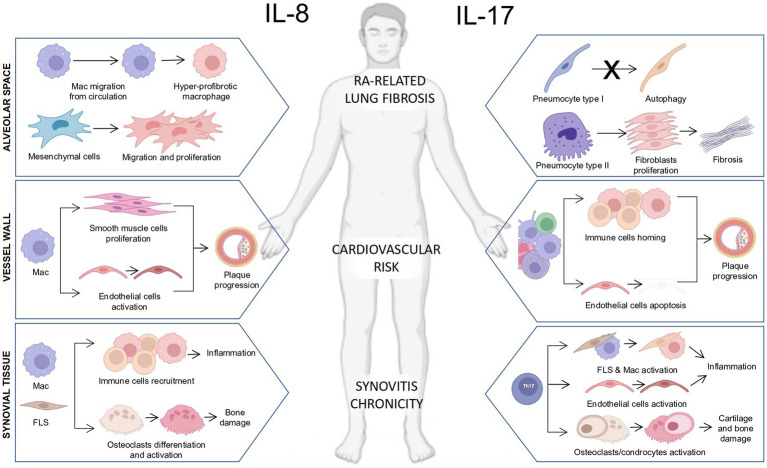
Despite the relevant advances in our understanding of the pathogenetic mechanisms regulating inflammation in rheumatoid arthritis (RA) and the development of effective therapeutics, to date, there is still a proportion of patients with RA who do not respond to treatment and end up progressing toward the development of joint damage, extra-articular complications, and disability. This is mainly due to the inter-individual heterogeneity of the molecular and cellular taxonomy of the synovial membrane, which represents the target tissue of RA inflammation. Tumor necrosis factor alpha (TNFα) and interleukin-6 (IL-6) are crucial key players in RA pathogenesis fueling the inflammatory cascade, as supported by experimental evidence derived from animal models and the effectiveness of biologic-Disease Modifying Anti-Rheumatic Drugs (b-DMARDs) in patients with RA. However, additional inflammatory soluble mediators such as IL-8 and IL-17 exert their pathogenetic actions promoting the detrimental activation of immune and stromal cells in RA synovial membrane, tendons, and extra-articular sites, as well as blood vessels and lungs, causing extra-articular complications, which might be excluded by the action of anti-TNFα and anti-IL6R targeted therapies. In this narrative review, we will discuss the role of IL-8 and IL-17 in promoting inflammation in multiple biological compartments (i.e., synovial membrane, blood vessels, and lung, respectively) in animal models of arthritis and patients with RA and how their selective targeting could improve the management of treatment resistance in patients.
尽管我们对类风湿关节炎(RA)中调节炎症的发病机制有了相关进展,并且开发出了有效的治疗方法,但迄今为止,仍有一部分RA患者对治疗无反应,最终发展为关节损伤、关节外并发症和残疾。这主要是由于滑膜的分子和细胞分类的个体间异质性,滑膜是RA炎症的靶组织。肿瘤坏死因子α(TNFα)和白细胞介素-6(IL-6)是RA发病机制中的关键参与者,推动炎症级联反应,动物模型的实验证据以及生物性疾病改善抗风湿药物(b-DMARDs)对RA患者的有效性都支持了这一点。然而,其他炎症可溶性介质,如IL-8和IL-17,通过促进RA滑膜、肌腱、关节外部位以及血管和肺部的免疫细胞和基质细胞的有害激活发挥其致病作用,导致关节外并发症,而抗TNFα和抗IL6R靶向治疗可能无法消除这些并发症。在这篇叙述性综述中,我们将讨论IL-8和IL-17在关节炎动物模型和RA患者的多个生物区室(即分别为滑膜、血管和肺)中促进炎症的作用,以及对它们的选择性靶向如何改善对治疗抵抗患者的管理。