Ke Yuhe, Shannon Nicholas Brian, Abdullah Hairil Rizal
Department of Anesthesia, Singapore General Hospital, Singapore, Singapore.
Department of General Surgery, Singapore General Hospital, Singapore, Singapore.
Front Med (Lausanne). 2023 Mar 24;10:998477. doi: 10.3389/fmed.2023.998477. eCollection 2023.
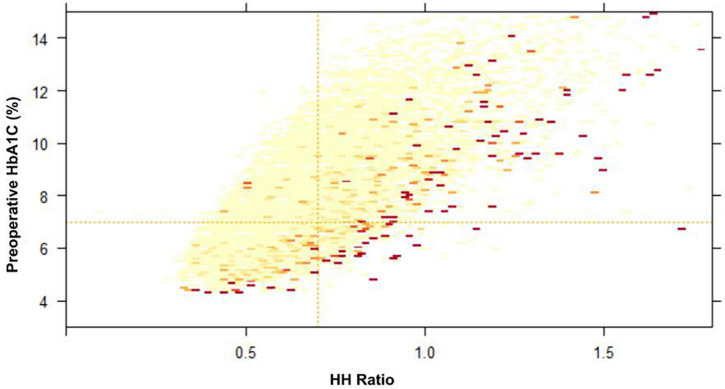
The current Lee's Revised cardiac risk index (RCRI) was created in 1999. Validation studies have found RCRI to be only moderately discriminant. The "Diabetes Mellitus on insulin" component of the score does not accurately reflect the severity of the disease. A previously studied HbA1C:Hemoglobin ratio shows an improved association with outcomes than individual components alone.
A retrospective cohort study was performed in diabetic patients undergoing non-cardiac surgery. Ethics approval was obtained. The study compares the predictive value of RCRI and substitution of the "DM on insulin" component with HH ratio for 30- and 90-day mortality, and postoperative acute myocardial injury (AMI) and acute kidney injury (AKI).
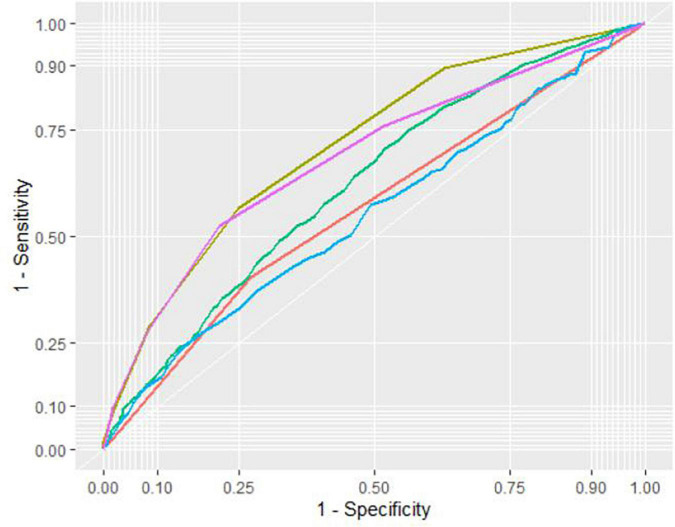
A total of 20,099 adult patients were included in the final analysis. The incidence of 30- and 90-day mortality was at 4.2 and 6.5%, respectively. Substitution of HH ratio in RCRI resulted in 687 more patients being in the moderate to high-risk category. The substituted HH-RCRI score had better prediction for 30-day (AUC 0.66 vs. 0.69, < 0.001) and 90-day mortality (AUC 0.67 vs. 0.70, < 0.001), and postoperative AMI (AUC 0.69 vs. 0.71, < 0.001) and AKI (AUC 0.57 vs. 0.62, < 0.001).
Although currently not an universal practice, substitution of "DM on insulin" with HbA1C:Hemoglobin ratio in RCRI score improves the accuracy of the RCRI risk prediction model in diabetic patients going for non-cardiac surgery.
当前的李式修订心脏风险指数(RCRI)于1999年制定。验证研究发现RCRI的判别能力仅为中等。该评分中的“胰岛素治疗的糖尿病”成分不能准确反映疾病的严重程度。先前一项关于糖化血红蛋白(HbA1C)与血红蛋白比值的研究表明,与单独的个体成分相比,该比值与预后的关联性更好。
对接受非心脏手术的糖尿病患者进行了一项回顾性队列研究。已获得伦理批准。该研究比较了RCRI以及用HbA1C与血红蛋白比值替代“胰岛素治疗的糖尿病”成分后,对30天和90天死亡率、术后急性心肌损伤(AMI)和急性肾损伤(AKI)的预测价值。
最终分析共纳入20,099例成年患者。30天和90天死亡率分别为4.2%和6.5%。在RCRI中用HbA1C与血红蛋白比值替代后,处于中高风险类别的患者增加了687例。替代后的HbA1C与血红蛋白比值-RCRI评分对30天死亡率(AUC 0.66对0.69,P<0.001)、90天死亡率(AUC 0.67对0.70,P<0.001)、术后AMI(AUC 0.69对0.71,P<0.001)和AKI(AUC 0.57对0.62,P<0.001)具有更好的预测能力。
虽然目前并非普遍做法,但在RCRI评分中用HbA1C与血红蛋白比值替代“胰岛素治疗的糖尿病”成分,可提高RCRI风险预测模型对接受非心脏手术糖尿病患者的预测准确性。