Gong Yuxi, Yan Haitao, Yang Yefan, Zhai Boya, Huang Zhendong, Zhang Zhihong
Department of Pathology, The First Affiliated Hospital of Nanjing Medical University, Nanjing, People's Republic of China.
Department of Interventional Radiology, The First Affiliated Hospital of Nanjing Medical University, Nanjing, People's Republic of China.
Pharmgenomics Pers Med. 2023 Apr 1;16:291-301. doi: 10.2147/PGPM.S399336. eCollection 2023.
To explore recurrence-risk factors of diffuse large B cell lymphoma (DLBCL) and construct a risk nomogram for predicting recurrence.
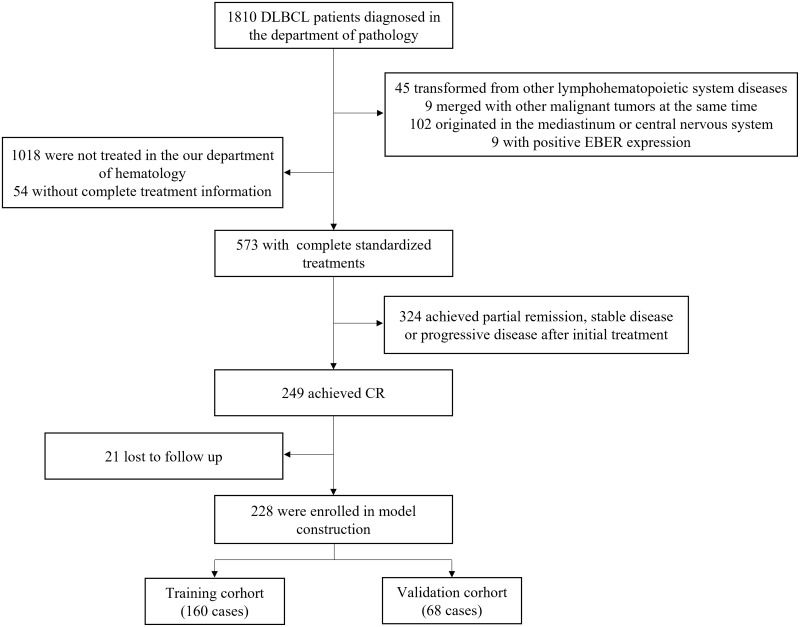
A retrospective analysis was performed on 228 DLBCL patients who achieved complete remission after R-CHOP treatment between January 2015 and December 2019. Univariate and multivariate analyses were applied to identify recurrence-related risk factors from the pretreatment evaluation factors covering patients' demographic characteristics, clinical manifestations, serological indicators, pathological and immunohistochemical results. A nomogram was developed based on the above results and validated by the concordance index (C-index), the receiver operating characteristic (ROC) curve, and the calibration curve.
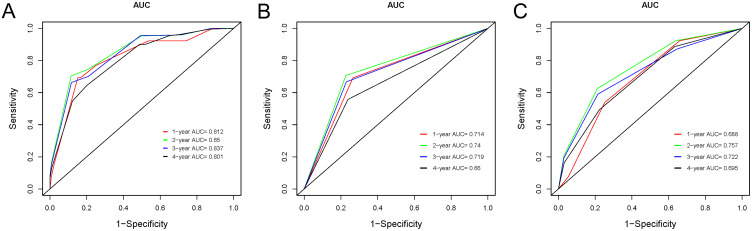
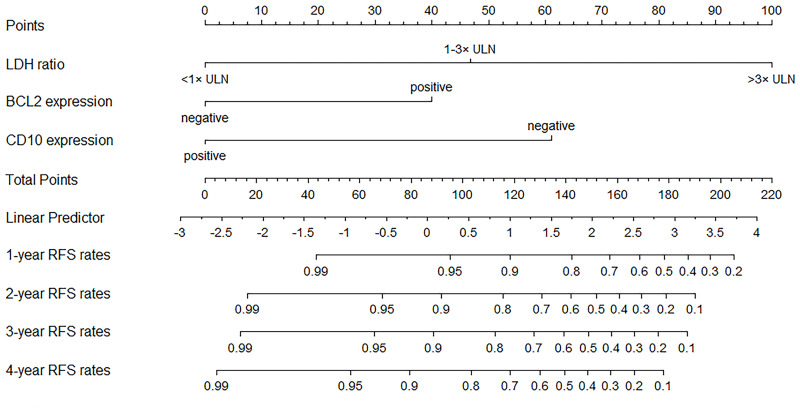
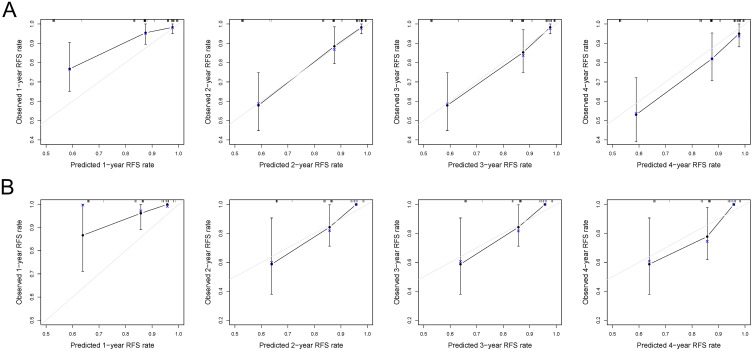
The training and validation cohorts consisted of 160 and 68 patients (randomized by 7:3). Of the whole cohort, 50 of 228 (21.9%) cases recurred during follow-up. Three recurrence-risk factors including BCL2 expression (P = 0.027), CD10 expression (P = 0.021), LDH level (P = 0.004) were identified from multivariate analysis and entered the final nomogram. The C-index of the nomogram was 0.815 in training cohort and 0.797 in the validation cohort, higher than that of IPI system (0.699) and NCCN-IPI system (0.709). And the 1-year, 2-year, 3-year, and 4-year areas under ROC (AUC) were 0.812, 0.850, 0.837, and 0.801, respectively. The calibration curves also showed a good discrimination capability and accuracy.
The novel nomogram incorporating the three independent risk factors (BCL2 expression, CD10 expression and LDH level) provided a valuable tool for predicting DLBCL recurrence.
探讨弥漫性大B细胞淋巴瘤(DLBCL)的复发危险因素,并构建预测复发的风险列线图。
对2015年1月至2019年12月间接受R-CHOP治疗后达到完全缓解的228例DLBCL患者进行回顾性分析。应用单因素和多因素分析从涵盖患者人口统计学特征、临床表现、血清学指标、病理及免疫组化结果的预处理评估因素中识别复发相关危险因素。基于上述结果绘制列线图,并通过一致性指数(C指数)、受试者工作特征(ROC)曲线和校准曲线进行验证。
训练队列和验证队列分别由160例和68例患者组成(按7:3随机分组)。在整个队列中,228例患者中有50例(21.9%)在随访期间复发。多因素分析确定了三个复发危险因素,包括BCL2表达(P = 0.027)、CD10表达(P = 0.021)、乳酸脱氢酶(LDH)水平(P = 0.004),并纳入最终的列线图。列线图在训练队列中的C指数为0.815,在验证队列中的C指数为0.797,高于国际预后指数(IPI)系统(0.699)和美国国立综合癌症网络(NCCN)-IPI系统(0.709)。1年、2年、3年和4年的ROC曲线下面积(AUC)分别为0.812、0.850、0.837和0.801。校准曲线也显示出良好的区分能力和准确性。
纳入三个独立危险因素(BCL2表达、CD10表达和LDH水平)的新型列线图为预测DLBCL复发提供了有价值的工具。