College of Life Sciences, Shaanxi Normal University, Xi'an 710119, People's Republic of China.
School of Biological and Behavioural Sciences, Queen Mary, University of London, London E1 4NS, UK.
Proc Biol Sci. 2023 Apr 12;290(1996):20230530. doi: 10.1098/rspb.2023.0530.
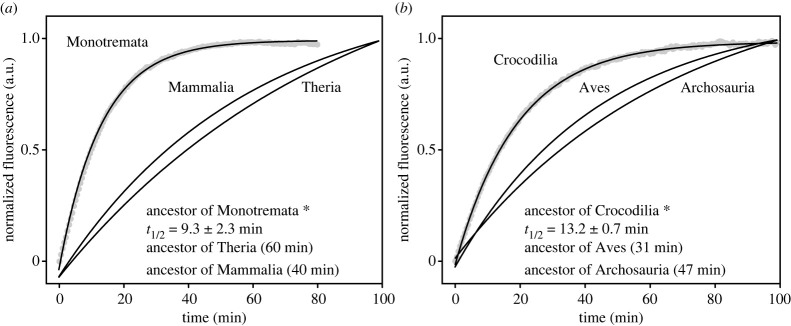
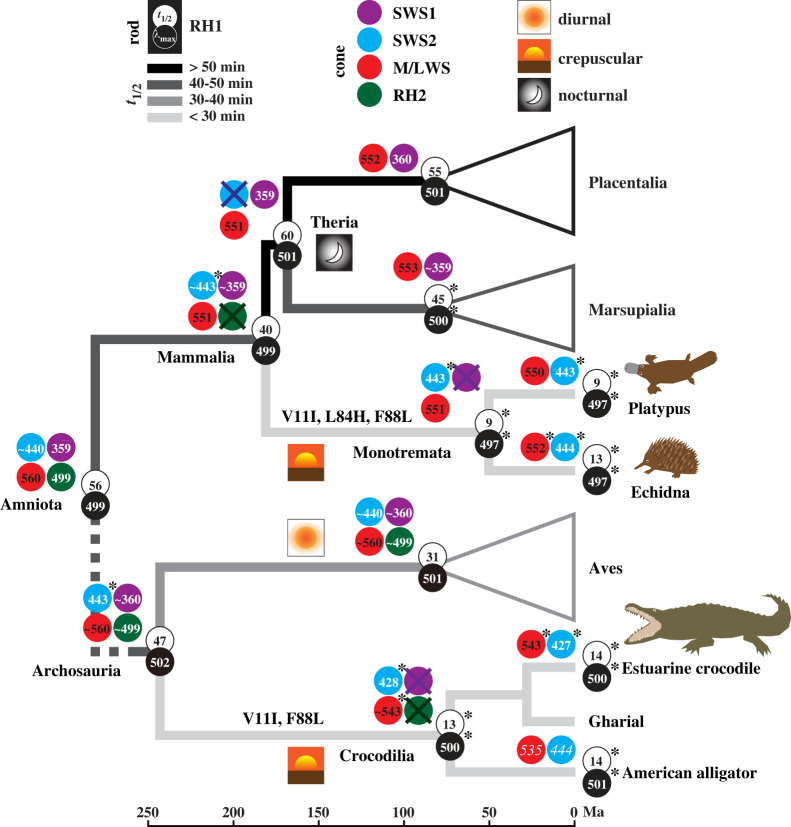
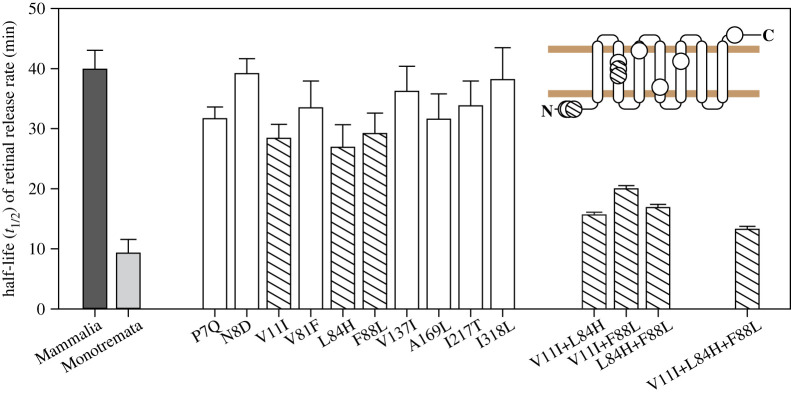
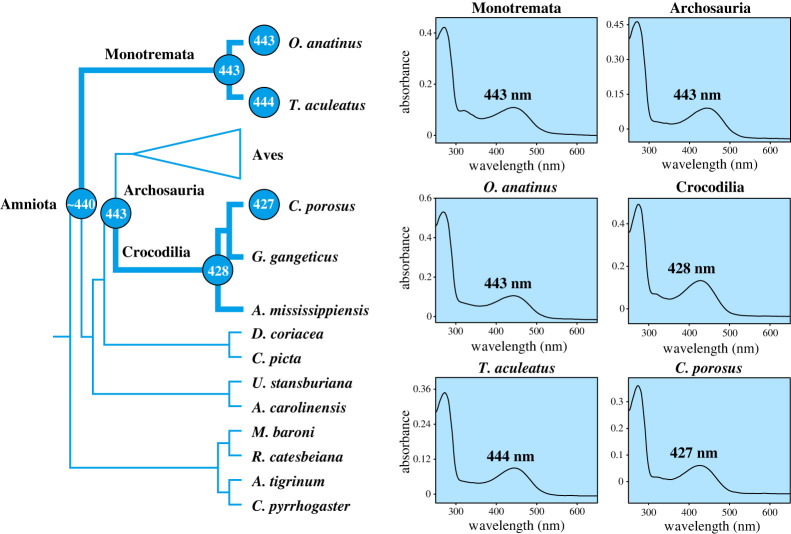
The visual ecology of early mammals remains poorly resolved. Studies of ancestral photopigments suggest an ancient transition from nocturnal to more crepuscular conditions. By contrast, the phenotypic shifts following the split of monotremes and therians-which lost their SWS1 and SWS2 opsins, respectively-are less clear. To address this, we obtained new phenotypic data on the photopigments of extant and ancestral monotremes. We then generated functional data for another vertebrate group that shares the same photopigment repertoire as monotremes: the crocodilians. By characterizing resurrected ancient pigments, we show that the ancestral monotreme underwent a dramatic acceleration in its rhodopsin retinal release rate. Moreover, this change was likely mediated by three residue replacements, two of which also arose on the ancestral branch of crocodilians, which exhibit similarly accelerated retinal release. Despite this parallelism in retinal release, we detected minimal to moderate changes in the spectral tuning of cone visual pigments in these groups. Our results imply that ancestral forms of monotremes and crocodilians independently underwent niche expansion to encompass quickly changing light conditions. This scenario-which accords with reported crepuscular activity in extant monotremes-may help account for their loss of the ultraviolet-sensitive SWS1 pigment but retention of the blue-sensitive SWS2.
早期哺乳动物的视觉生态学仍未得到很好的解决。对祖先视色素的研究表明,远古时期从夜间到黄昏的条件发生了转变。相比之下,单孔目动物和有袋类动物分离后发生的表型变化则不太明确,它们分别失去了 SWS1 和 SWS2 视蛋白。为了解决这个问题,我们获得了现存和祖先单孔目动物视色素的新表型数据。然后,我们为另一个与单孔目动物具有相同视色素库的脊椎动物群体生成了功能数据:鳄鱼。通过对复活的古老色素进行特征描述,我们发现祖先单孔目动物的视蛋白视网膜释放率显著加快。此外,这种变化可能是由三个残基替换介导的,其中两个替换也出现在鳄鱼的祖先分支上,鳄鱼的视网膜释放速度也类似加快。尽管在视网膜释放方面存在这种平行性,但我们在这些群体的锥状视觉色素的光谱调谐中检测到最小到中度的变化。我们的结果表明,祖先形式的单孔目动物和鳄鱼独立地进行了生态位扩展,以适应快速变化的光照条件。这种情况——与现存单孔目动物的黄昏活动报告相符——可能有助于解释它们失去了对紫外线敏感的 SWS1 色素,但保留了对蓝光敏感的 SWS2。