Department of Internal Medicine, Gangnam Severance Hospital, Yonsei University College of Medicine, 211, Eonju-Ro, Gangnam-Gu, Seoul, 06273, Republic of Korea.
Department of Surgery, Gangnam Severance Hospital, Yonsei University College of Medicine, 211, Eonju-Ro, Gangnam-Gu, Seoul, 06273, Republic of Korea.
BMC Gastroenterol. 2023 Apr 11;23(1):116. doi: 10.1186/s12876-023-02750-2.
Some studies have analyzed the frequency of HCV RNA testing and actual treatment among anti-HCV positive patients in Korea, which has a low prevalence of HCV infection. This study aimed to analyze the diagnosis process, treatment results, and prognosis according to care cascade in patients who are anti-HCV positive.
Three thousand two hundred fifty-three anti-HCV positive patients presented to a tertiary hospital between January 2005 and December 2020. The number of patients who underwent HCV RNA testing, treatment, and proportion of sustained virologic response (SVR) according to the type of antivirals was investigated. We investigated the cumulative incidence of hepatocellular carcinoma (HCC) and liver cirrhosis.
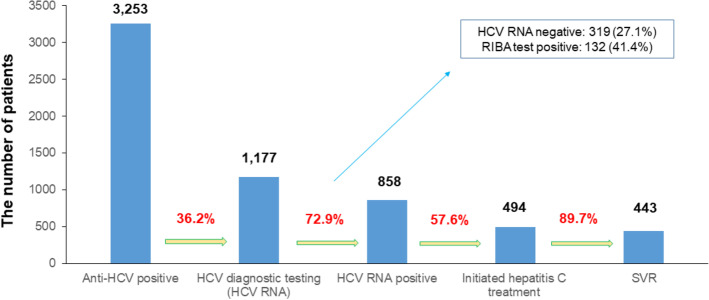
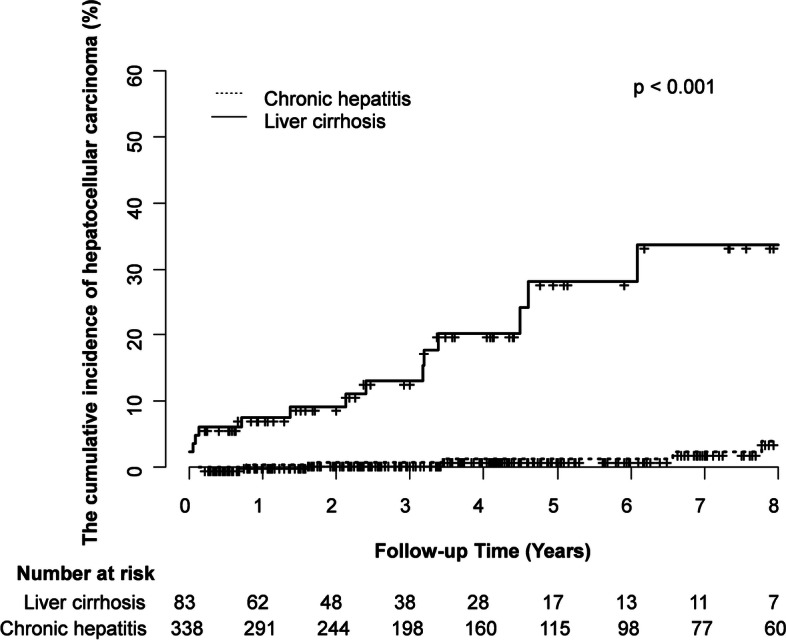
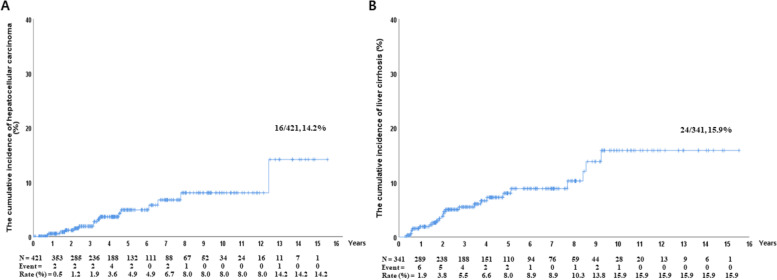
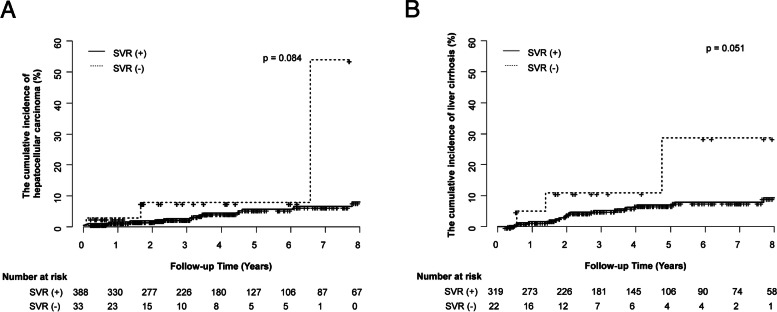
Of a total of 3,253 people, 1,177 (36.2%) underwent HCV RNA testing and 858 (72.9%) were positive for HCV RNA. 494 (57.6%) of HCV RNA positive patients received antiviral treatment, and 443 (89.7%) of initiated hepatitis C treatment experienced SVR. Of the 421 treated patients, 16 (14.2%) developed HCC. The cumulative incidence of HCC at 15 years was significantly different according to the presence of liver cirrhosis (10/83, 29.5% vs. 6/338, 10.8%, p < 0.001). The cumulative incidences of HCC or liver cirrhosis did not show significant differences according to the presence of SVR (14/388, 13.2% vs. 2/33, 52.5%, p = 0.084, 21/319, 15.0%, vs. 3/22, 28.7%, p = 0.051).
Owing to the introduction of direct-acting antivirals, high SVR was achieved, but the proportion of anti-HCV positive patients who received HCV RNA testing and treatment was not high. HCC surveillance after SVR is recommended for chronic hepatitis C patients with cirrhosis.
一些研究分析了韩国 HCV RNA 检测和实际治疗的频率,韩国 HCV 感染率较低。本研究旨在分析抗 HCV 阳性患者的护理级联中的诊断过程、治疗结果和预后。
2005 年 1 月至 2020 年 12 月期间,3253 名抗 HCV 阳性患者在一家三级医院就诊。根据抗病毒药物的类型,调查了接受 HCV RNA 检测、治疗以及持续病毒学应答(SVR)比例的患者数量。我们调查了肝细胞癌(HCC)和肝硬化的累积发病率。
在总共 3253 人中,有 1177 人(36.2%)接受了 HCV RNA 检测,其中 858 人(72.9%) HCV RNA 阳性。494 名 HCV RNA 阳性患者接受抗病毒治疗,其中 443 名(89.7%)接受 HCV 治疗的患者获得 SVR。在 421 名接受治疗的患者中,有 16 名(14.2%)发生 HCC。15 年内 HCC 的累积发病率根据肝硬化的存在情况明显不同(10/83,29.5%比 6/338,10.8%,p<0.001)。根据 SVR 的存在情况,HCC 或肝硬化的累积发病率没有显著差异(14/388,13.2%比 2/33,52.5%,p=0.084,21/319,15.0%比 3/22,28.7%,p=0.051)。
由于直接作用抗病毒药物的引入,实现了高 SVR,但接受 HCV RNA 检测和治疗的抗 HCV 阳性患者比例并不高。建议对肝硬化的慢性丙型肝炎患者进行 SVR 后 HCC 监测。