Musculoskeletal Radiology, Russell H. Morgan Department of Radiology and Radiological Science, Johns Hopkins University School of Medicine, 601 N Caroline St., JHOC 5165, Baltimore, MD, 21287, USA.
Tehran University of Medical Sciences, School of Medicine, Tehran, Iran.
Arthritis Res Ther. 2023 Apr 11;25(1):58. doi: 10.1186/s13075-023-03012-y.
We examined the association between levothyroxine use and longitudinal MRI biomarkers for thigh muscle mass and composition in at-risk participants for knee osteoarthritis (KOA) and their mediatory role in subsequent KOA incidence.
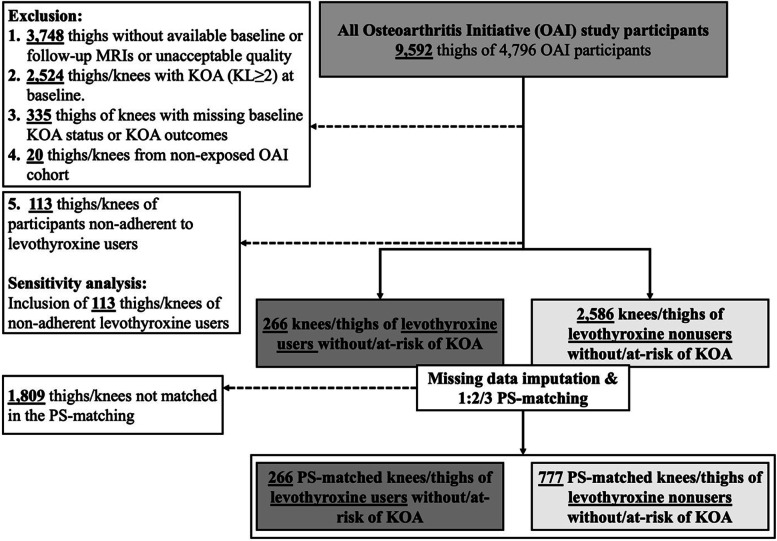
Using the Osteoarthritis Initiative (OAI) data, we included the thighs and corresponding knees of participants at risk but without established radiographic KOA (baseline Kellgren-Lawrence grade (KL) < 2). Levothyroxine users were defined as self-reported use at all annual follow-up visits until the 4th year and were matched with levothyroxine non-users for potential confounders (KOA risk factors, comorbidities, and relevant medications covariates) using 1:2/3 propensity score (PS) matching. Using a previously developed and validated deep learning method for thigh segmentation, we assessed the association between levothyroxine use and 4-year longitudinal changes in muscle mass, including cross-sectional area (CSA) and muscle composition biomarkers including intra-MAT (within-muscle fat), contractile percentage (non-fat muscle CSA/total muscle CSA), and specific force (force per CSA). We further assessed whether levothyroxine use is associated with an 8-year risk of standard KOA radiographic (KL ≥ 2) and symptomatic incidence (incidence of radiographic KOA and pain on most of the days in the past 12 months). Finally, using a mediation analysis, we assessed whether the association between levothyroxine use and KOA incidence is mediated via muscle changes.
We included 1043 matched thighs/knees (266:777 levothyroxine users:non-users; average ± SD age: 61 ± 9 years, female/male: 4). Levothyroxine use was associated with decreased quadriceps CSAs (mean difference, 95%CI: - 16.06 mm/year, - 26.70 to - 5.41) but not thigh muscles' composition (e.g., intra-MAT). Levothyroxine use was also associated with an increased 8-year risk of radiographic (hazard ratio (HR), 95%CI: 1.78, 1.15-2.75) and symptomatic KOA incidence (HR, 95%CI: 1.93, 1.19-3.13). Mediation analysis showed that a decrease in quadriceps mass (i.e., CSA) partially mediated the increased risk of KOA incidence associated with levothyroxine use.
Our exploratory analyses suggest that levothyroxine use may be associated with loss of quadriceps muscle mass, which may also partially mediate the increased risk of subsequent KOA incidence. Study interpretation should consider underlying thyroid function as a potential confounder or effect modifier. Therefore, future studies are warranted to investigate the underlying thyroid function biomarkers for longitudinal changes in the thigh muscles.
我们研究了左旋甲状腺素的使用与有膝关节骨关节炎(KOA)风险的参与者的大腿肌肉质量和成分的纵向 MRI 生物标志物之间的关系,以及它们在随后的 KOA 发病中的中介作用。
利用骨关节炎倡议(OAI)的数据,我们纳入了大腿和相应膝盖的参与者,这些参与者存在但尚未出现影像学 KOA(基线 Kellgren-Lawrence 分级(KL)<2)。将左旋甲状腺素使用者定义为在所有年度随访中直至第 4 年均报告使用,并使用 1:2/3 倾向评分(PS)匹配法与左旋甲状腺素非使用者匹配潜在混杂因素(KOA 风险因素、合并症和相关药物协变量)。使用先前开发和验证的大腿分割深度学习方法,我们评估了左旋甲状腺素使用与 4 年纵向肌肉质量变化之间的关系,包括横截面积(CSA)和肌肉成分生物标志物,包括肌内脂肪( intra-MAT)、收缩百分比(非脂肪肌肉 CSA/总肌肉 CSA)和比肌力(每 CSA 的力)。我们还评估了左旋甲状腺素的使用是否与 8 年标准 KOA 影像学(KL≥2)和症状性发病(影像学 KOA 和过去 12 个月中大多数日子的疼痛)的风险相关。最后,使用中介分析,我们评估了左旋甲状腺素使用与 KOA 发病之间的关联是否通过肌肉变化来介导。
我们纳入了 1043 对匹配的大腿/膝盖(266:777 名左旋甲状腺素使用者:非使用者;平均±标准差年龄:61±9 岁,女性/男性:4)。左旋甲状腺素的使用与股四头肌 CSA 的减少相关(平均差异,95%CI:-16.06mm/年,-26.70 至-5.41),但与大腿肌肉成分(例如肌内脂肪)无关。左旋甲状腺素的使用还与 8 年影像学(风险比(HR),95%CI:1.78,1.15-2.75)和症状性 KOA 发病(HR,95%CI:1.93,1.19-3.13)的风险增加相关。中介分析表明,股四头肌质量(即 CSA)的减少部分介导了与左旋甲状腺素使用相关的 KOA 发病风险增加。
我们的探索性分析表明,左旋甲状腺素的使用可能与股四头肌质量的丧失有关,这也可能部分介导了随后 KOA 发病风险的增加。研究结果的解释应考虑潜在的甲状腺功能作为潜在的混杂因素或效应修饰物。因此,有必要进行进一步的研究来探讨与大腿肌肉纵向变化相关的潜在甲状腺功能生物标志物。