Musculoskeletal Radiology, The Russell H. Morgan Department of Radiology and Radiological Science, Johns Hopkins University School of Medicine, 601 N Caroline St, JHOC 5165, Baltimore, MD, 21287, USA.
School of Medicine, Tehran University of Medical Sciences, Tehran, Iran.
Eur Radiol. 2023 Jan;33(1):595-605. doi: 10.1007/s00330-022-09035-4. Epub 2022 Aug 11.
We examined the association between diabetes mellitus (DM) and longitudinal MRI biomarkers for thigh muscle degeneration in patients with knee osteoarthritis (KOA) and their mediatory role in worsening KOA-related symptoms.
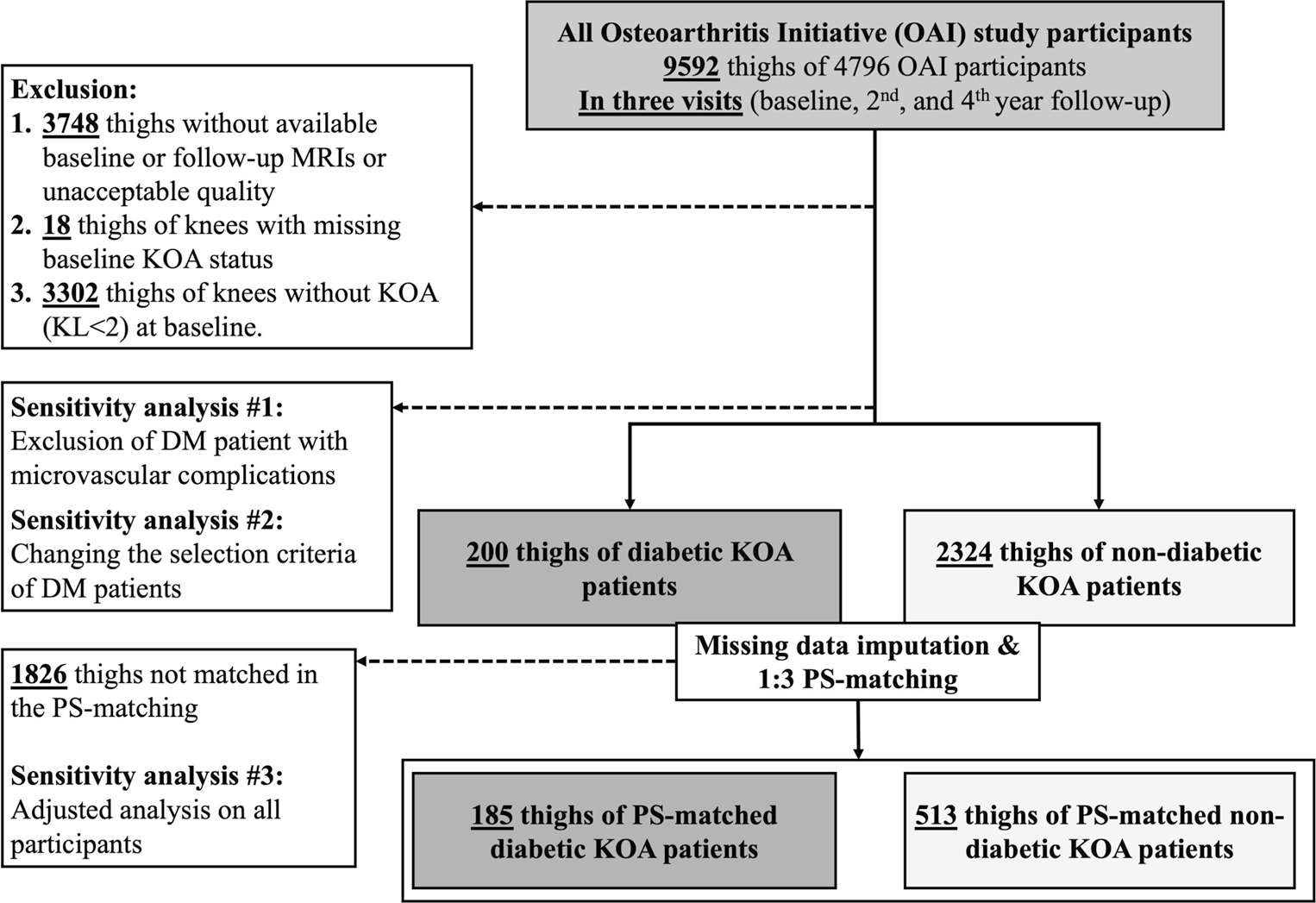
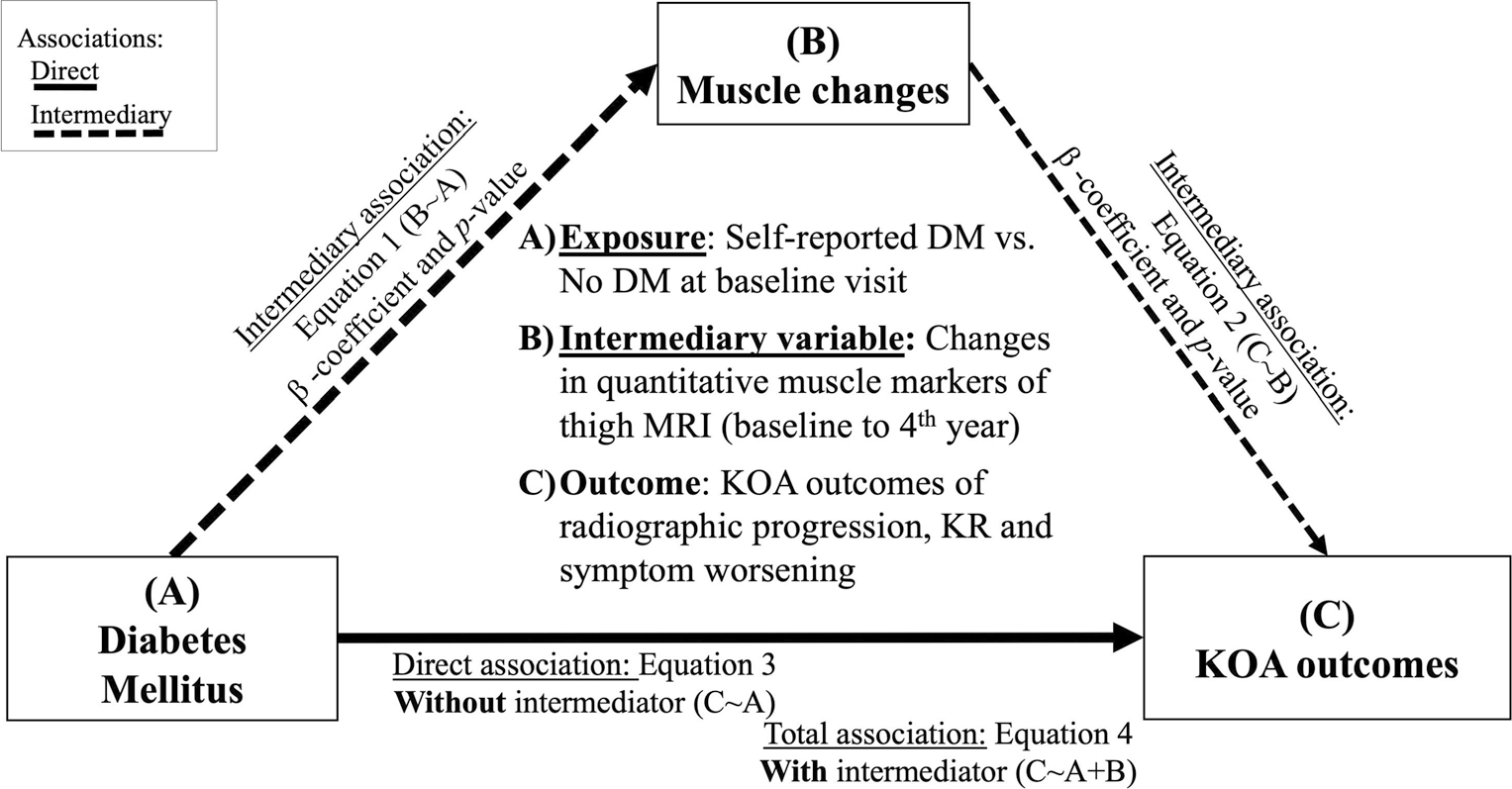
The Osteoarthritis Initiative (OAI) participants with radiographic KOA (Kellgren-Lawrence grade ≥ 2) were included. Thighs and corresponding knees of KOA patients with versus without self-reported DM were matched for potential confounders using propensity score (PS) matching. We developed and used a validated deep learning method for longitudinal thigh segmentation. We assessed the association of DM with 4-year longitudinal muscle degeneration in biomarkers of muscle cross-sectional area (CSA) and contractile percentage (non-fat CSA/total CSA). We further investigated whether DM is associated with 9-year risk of KOA radiographic progression, knee replacement (KR), and symptoms worsening. Finally, we evaluated whether the DM-KOA worsening association is mediated through preceding muscle degeneration.
After PS matching, 698 thighs/knees were included (185:513 with:without DM; average ± SD age:64 ± 8-years; female/male:1.4). Baseline DM was associated with a decreased contractile percent of total thigh muscles and quadriceps (mean difference, 95%CI -0.16%/year, -0.25 to -0.07, and -0.21%/year, -0.33 to -0.08). DM was also associated with an increased risk of worsening KOA-related symptoms (hazard ratio, 95%CI 1.70, 1.18-2.46) but not radiographic progression or KR. The decrease in quadriceps contractile percent partially mediated the increased risk of symptoms worsening in patients with DM.
Baseline DM is associated with thigh muscle degeneration and KOA-related symptoms worsening. As a potentially modifiable risk factor, DM-associated longitudinal thigh muscle degeneration may partially mediate the symptoms worsening in patients with DM and coexisting KOA.
• Diabetes mellitus (DM) is associated with worsening knee osteoarthritis (KOA)-related symptoms. • As a potentially modifiable factor, DM-associated thigh muscle (quadriceps) degeneration partially mediates the worsening of KOA-related symptoms.
我们研究了糖尿病(DM)与膝关节骨关节炎(KOA)患者大腿肌肉退行性变的纵向 MRI 生物标志物之间的关系,并探讨了其在加重 KOA 相关症状中的中介作用。
纳入了骨关节炎倡议(OAI)中存在放射学 KOA(Kellgren-Lawrence 分级≥2)的参与者。使用倾向评分(PS)匹配,对有/无自我报告 DM 的 KOA 患者的大腿及其相应膝关节进行配对,以控制潜在混杂因素。我们开发并使用了一种经过验证的深度学习方法进行纵向大腿分割。我们评估了 DM 与 4 年肌肉横截面积(CSA)和收缩百分比(非脂肪 CSA/总 CSA)的肌肉退行性变的纵向生物标志物之间的相关性。我们进一步研究了 DM 是否与 9 年 KOA 放射学进展、膝关节置换(KR)和症状加重的风险相关。最后,我们评估了 DM-KOA 恶化的相关性是否通过先前的肌肉退行性变介导。
PS 匹配后,共纳入 698 条大腿/膝关节(185 条:513 条有:无 DM;平均±标准差年龄:64±8 岁;女性/男性:1.4)。基线 DM 与大腿肌肉和股四头肌的收缩百分比降低有关(平均差异,95%CI-0.16%/年,-0.25 至-0.07,和-0.21%/年,-0.33 至-0.08)。DM 也与 KOA 相关症状恶化的风险增加相关(风险比,95%CI 1.70,1.18-2.46),但与放射学进展或 KR 无关。股四头肌收缩百分比的降低部分解释了 DM 患者症状恶化的风险增加。
基线 DM 与大腿肌肉退行性变和 KOA 相关症状恶化有关。作为一种潜在可改变的危险因素,DM 相关的纵向大腿肌肉(股四头肌)退行性变可能部分解释了 DM 合并 KOA 患者症状恶化。
糖尿病(DM)与膝骨关节炎(KOA)相关症状恶化有关。
作为一种潜在可改变的因素,DM 相关的大腿肌肉(股四头肌)退化部分解释了 KOA 相关症状的恶化。