Musiimenta Angella, Tumuhimbise Wilson, Atukunda Esther, Mugaba Aaron, Linnemayr Sebastian, Haberer Jessica
Faculty of Computing and Informatics, Mbarara University of Science and Technology, Mbarara, Uganda.
Angels Compassion Research and Development Initiative, Mbarara, Uganda.
JMIR Form Res. 2023 Apr 12;7:e45301. doi: 10.2196/45301.
Although there is an increasing use of digital adherence technologies (DATs), such as real-time monitors and SMS reminders in tuberculosis medication adherence, suboptimal patient engagement with various DATs has been reported. Additionally, financial constraints can limit DAT's utility. The perceived usefulness and the design mechanisms of DATs linked to mobile money financial incentives for tuberculosis medication management remain unclear.
The aim of this study is to describe the perceived usefulness and design mechanisms for a DAT intervention called My Mobile Wallet, which is composed of real-time adherence monitors, SMS reminders, and mobile money incentives to support tuberculosis medication adherence in a low-income setting.
This study used mixed methods approaches among persons with tuberculosis recruited from the Tuberculosis Clinic in the Mbarara Regional Referral Hospital. We purposively sampled 21 persons with tuberculosis aged 18 years and older, who owned cell phones and were able to use SMS text messaging interventions. We also enrolled 9 participants who used DATs in our previous study. We used focus group discussions with the 30 participants to solicit perceptions about the initial version of the My Mobile Wallet intervention, and then iteratively refined subsequent versions of the intervention following a user-centered design approach until the beta version of the intervention that suited their needs was developed. Surveys eliciting information about participants' cell phone use and perceptions of the intervention were also administered. Content analysis was used to inductively analyze qualitative data to derive categories describing the perceived usefulness of the intervention, concerns, and design mechanisms. Stata (version 13; StataCorp) was used to analyze survey data.
Participants expressed the perceived usefulness of the My Mobile Wallet intervention in terms of being reminded to take medication, supported with transport to the clinic, and money to meet other tuberculosis medication-related costs, all of which were perceived to imply care, which could create a sense of connectedness to health care workers. This could consequently cause participants to develop a self-perceived need to prove their commitment to adherence to health care workers who care for them, thereby motivating medication adherence. For fear of unintended tuberculosis status disclosure, 20 (67%) participants suggested using SMS language that is confidential-not easily related to tuberculosis. To reduce the possibilities of using the money for other competing demands, 25 (83%) participants preferred sending the money 1-2 days before the appointment to limit the time lag between receiving the money and visiting the clinic.
DATs complemented with mobile money financial incentives could potentially provide acceptable approaches to remind, support, and motivate patients to adhere to taking their tuberculosis medication.
ClinicalTrials.gov NCT05656287; https://clinicaltrials.gov/ct2/show/NCT05656287.
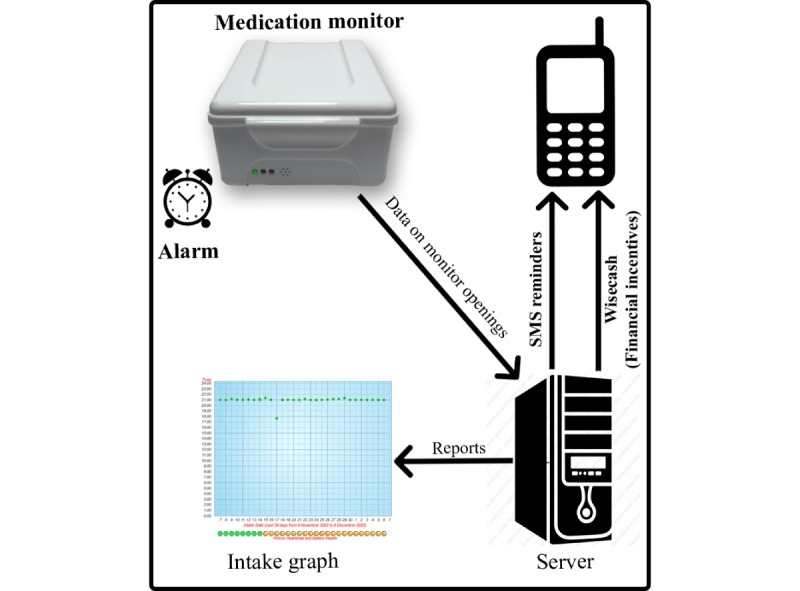
尽管数字依从性技术(DATs)在结核病药物依从性方面的应用越来越广泛,如实时监测器和短信提醒,但已有报道称患者对各种DATs的参与度欠佳。此外,经济限制可能会限制DATs的效用。与移动货币经济激励措施相关的DATs在结核病药物管理中的感知有用性和设计机制仍不明确。
本研究旨在描述一种名为“我的移动钱包”的DAT干预措施的感知有用性和设计机制,该干预措施由实时依从性监测器、短信提醒和移动货币激励措施组成,用于支持低收入环境下的结核病药物依从性。
本研究采用混合方法,研究对象为从姆巴拉拉地区转诊医院结核病诊所招募的结核病患者。我们有目的地抽取了21名18岁及以上的结核病患者,他们拥有手机且能够使用短信文本消息干预。我们还纳入了9名在我们之前的研究中使用过DATs的参与者。我们与30名参与者进行了焦点小组讨论,以征求他们对“我的移动钱包”干预措施初始版本的看法,然后采用以用户为中心的设计方法对干预措施的后续版本进行迭代完善,直到开发出符合他们需求的测试版干预措施。还进行了调查,以获取有关参与者手机使用情况和对干预措施看法的信息。采用内容分析法对定性数据进行归纳分析,以得出描述干预措施感知有用性、关注点和设计机制的类别。使用Stata(版本13;StataCorp)分析调查数据。
参与者表示,“我的移动钱包”干预措施在提醒服药、提供前往诊所的交通支持以及提供支付其他结核病药物相关费用的资金方面具有感知有用性,所有这些都被认为意味着关怀,这可能会让参与者产生与医护人员的联系感。这可能会使参与者产生一种自我认知的需求,即向关心他们的医护人员证明自己坚持服药的决心,从而激发药物依从性。出于对结核病状态意外披露的担忧,20名(67%)参与者建议使用保密的短信语言——不容易与结核病相关联的语言。为了减少将资金用于其他竞争性需求的可能性,25名(83%)参与者更喜欢在预约前1 - 2天汇款,以限制收到钱与前往诊所之间的时间间隔。
辅以移动货币经济激励措施的DATs可能会提供可接受的方法来提醒、支持和激励患者坚持服用结核病药物。
ClinicalTrials.gov NCT05656287;https://clinicaltrials.gov/ct2/show/NCT05656287 。


