Faculty of Arts and Sciences, Department of Psychology, Edge Hill University, Ormskirk, United Kingdom.
Liverpool Centre for Alcohol Research, Liverpool, United Kingdom.
PLoS One. 2023 Apr 12;18(4):e0283233. doi: 10.1371/journal.pone.0283233. eCollection 2023.
Background Previous investigations suggest that the COVID-19 pandemic effects on alcohol consumption were heterogenous and may vary as a function of structural and psychological factors. Research examining mediating or moderating factors implicated in pandemic-occasioned changes in drinking have also tended to use single-study cross-sectional designs and convenience samples.
First, to explore structural (changed employment or unemployment) and psychological (subjective mental health and drinking motives) correlates of consumption reported during the COVID-19 pandemic using a UK nationally representative (quota sampled) dataset. Second, to determine whether population-level differences in drinking during the COVID-19 pandemic (versus pre-pandemic levels) could be attributable to drinking motives.
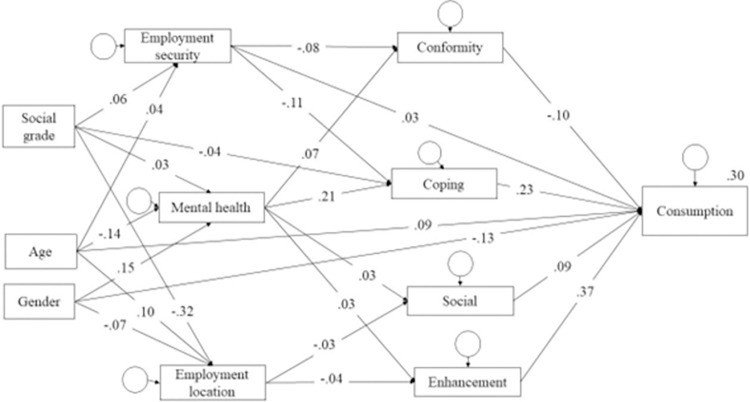
Data collected from samples of UK adults before and during the pandemic were obtained and analysed: Step1 carried out structural equation modelling (SEM) to explore data gathered during a period of social restrictions after the UK's first COVID-19-related lockdown (27 August-15 September, 2020; n = 3,798). It assessed whether drinking motives (enhancement, social, conformity, coping), employment and the perceived impact of the pandemic on subjective mental health may explain between-person differences in self-reported alcohol consumption. Step 2 multigroup SEM evaluated data gathered pre-pandemic (2018; n = 7,902) in concert with the pandemic data from step 1, to test the theory that population-level differences in alcohol consumption are attributable to variances in drinking motives.
Analyses of the 2020 dataset detected both direct and indirect effects of subjective mental health, drinking motives, and employment matters (e.g., having been furloughed) on alcohol use. Findings from a multigroup SEM were consistent with the theory that drinking motives explain not only individual differences in alcohol use at both time points, but also population-level increases in use during the pandemic.
This work highlights socioeconomic and employment considerations when seeking to understand COVID-19-related drinking. It also indicates that drinking motives may be particularly important in explaining the apparent trend of heightened drinking during the pandemic. Limitations related to causal inference are discussed.
使用英国全国代表性(配额抽样)数据集,探讨结构(就业或失业变化)和心理(主观心理健康和饮酒动机)因素与在 COVID-19 大流行期间报告的饮酒量之间的相关性。
确定 COVID-19 大流行期间(与大流行前水平相比)的人群饮酒水平差异是否归因于饮酒动机。