Martínez Natalia, Gragera Teresa, de Lucas María Pilar, Cámara Ana Belén, Ballester Alicia, Anta Berta, Fernández-Medarde Alberto, López-Briones Tania, Ortega Judith, Peña-Jiménez Daniel, Barbáchano Antonio, Montero-Calle Ana, Cordero Víctor, Barderas Rodrigo, Iglesias Teresa, Yunta Mónica, Oliva José Luís, Muñoz Alberto, Santos Eugenio, Zarich Natasha, Rojas-Cabañeros José M
Unidad Funcional de Investigación de Enfermedades Crónicas (UFIEC) and CIBERONC, Instituto de Salud Carlos III, 28220, Majadahonda, Madrid, Spain.
Facultad de Odontología, Universidad Alfonso X el Sabio (UAX), Avenida de la Universidad 1, 28691, Villanueva de la Cañada, Madrid, Spain.
Oncogenesis. 2023 Apr 12;12(1):20. doi: 10.1038/s41389-023-00465-3.
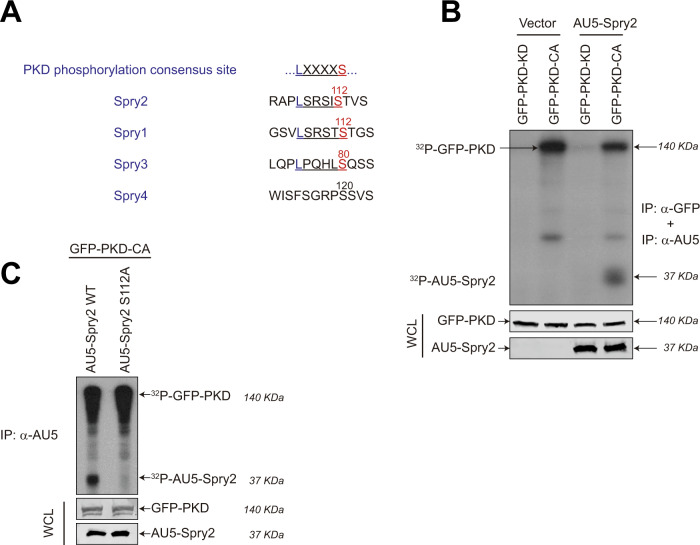
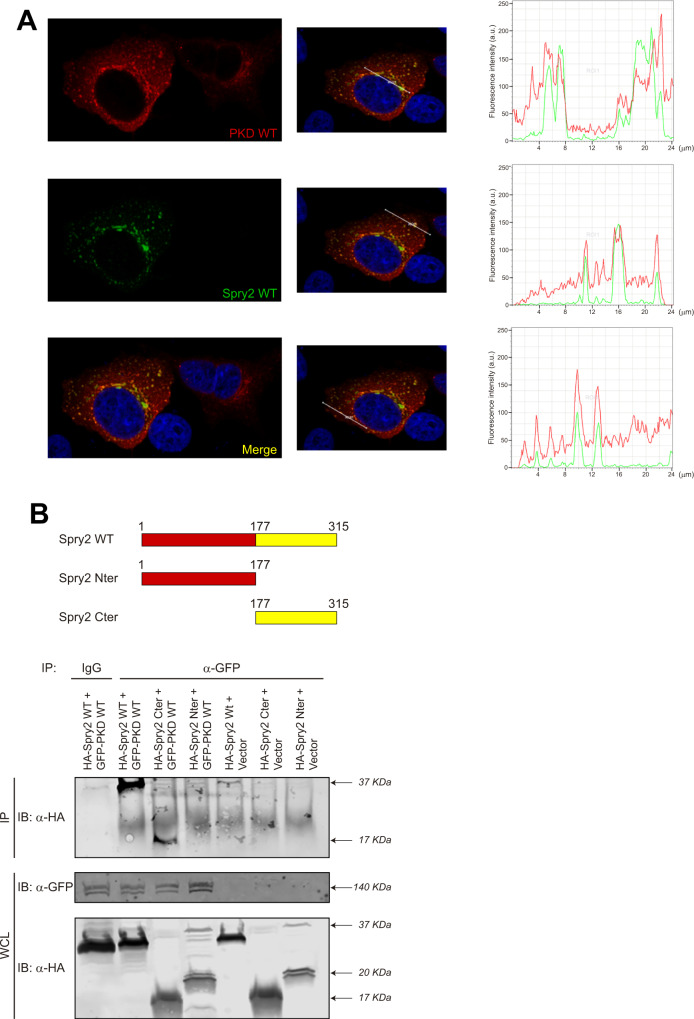
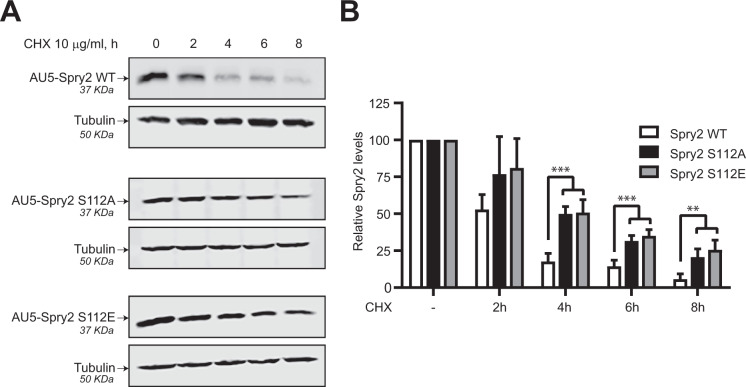
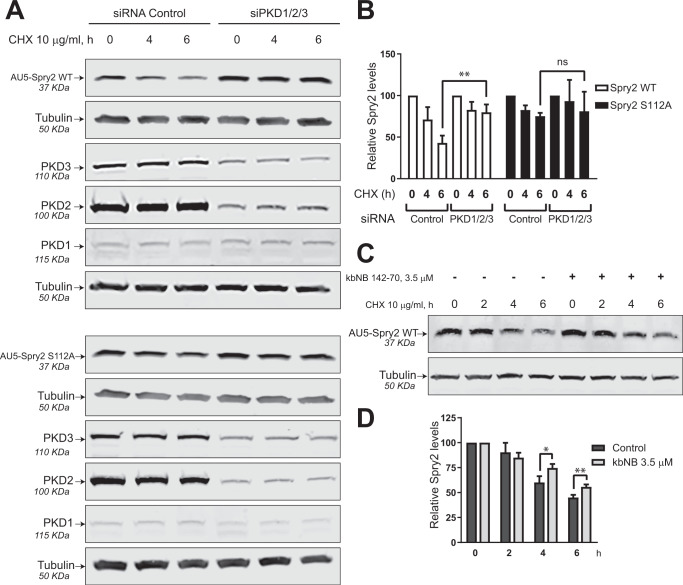
Spry2 is a molecular modulator of tyrosine kinase receptor signaling pathways that has cancer-type-specific effects. Mammalian Spry2 protein undergoes tyrosine and serine phosphorylation in response to growth factor stimulation. Spry2 expression is distinctly altered in various cancer types. Inhibition of the proteasome functionality results in reduced intracellular Spry2 degradation. Using in vitro and in vivo assays, we show that protein kinase D (PKD) phosphorylates Spry2 at serine 112 and interacts in vivo with the C-terminal half of this protein. Importantly, missense mutation of Ser112 decreases the rate of Spry2 intracellular protein degradation. Either knocking down the expression of all three mammalian PKD isoforms or blocking their kinase activity with a specific inhibitor contributes to the stabilization of Spry2 wild-type protein. Downregulation of CSN3, a component of the COP9/Signalosome that binds PKD, significantly increases the half-life of Spry2 wild-type protein but does not affect the stability of a Spry2 after mutating Ser112 to the non-phosphorylatable residue alanine. Our data demonstrate that both PKD and the COP9/Signalosome play a significant role in control of Spry2 intracellular stability and support the consideration of the PKD/COP9 complex as a potential therapeutic target in tumors where Spry2 expression is reduced.
Spry2是酪氨酸激酶受体信号通路的分子调节剂,具有癌症类型特异性效应。哺乳动物Spry2蛋白在生长因子刺激下会发生酪氨酸和丝氨酸磷酸化。Spry2的表达在各种癌症类型中明显改变。蛋白酶体功能的抑制导致细胞内Spry2降解减少。通过体外和体内实验,我们发现蛋白激酶D(PKD)在丝氨酸112处使Spry2磷酸化,并在体内与该蛋白的C端相互作用。重要的是,丝氨酸112的错义突变降低了Spry2细胞内蛋白降解的速率。敲低所有三种哺乳动物PKD亚型的表达或用特异性抑制剂阻断其激酶活性均有助于Spry2野生型蛋白的稳定。COP9信号体的组分CSN3与PKD结合,其下调显著增加了Spry2野生型蛋白的半衰期,但不影响将丝氨酸112突变为不可磷酸化残基丙氨酸后的Spry2的稳定性。我们的数据表明,PKD和COP9信号体在控制Spry2细胞内稳定性方面均发挥重要作用,并支持将PKD/COP9复合物视为Spry2表达降低的肿瘤中的潜在治疗靶点。