Tehran Heart Center, Cardiovascular Diseases Research Institute, Tehran University of Medical Sciences, North Kargar St, Tehran, 1411713138, Iran.
Cardiac Primary Prevention Research Center, Cardiovascular Diseases Research Institute, Tehran University of Medical Sciences, Tehran, Iran.
J Cardiothorac Surg. 2023 Apr 13;18(1):140. doi: 10.1186/s13019-023-02258-6.
Several studies have compared early and late outcomes of on-pump coronary artery bypass grafting (CABG) and off-pump CABG. However, there is still an ongoing debate on this matter, especially in patients with triple-vessel coronary artery disease (3VD).
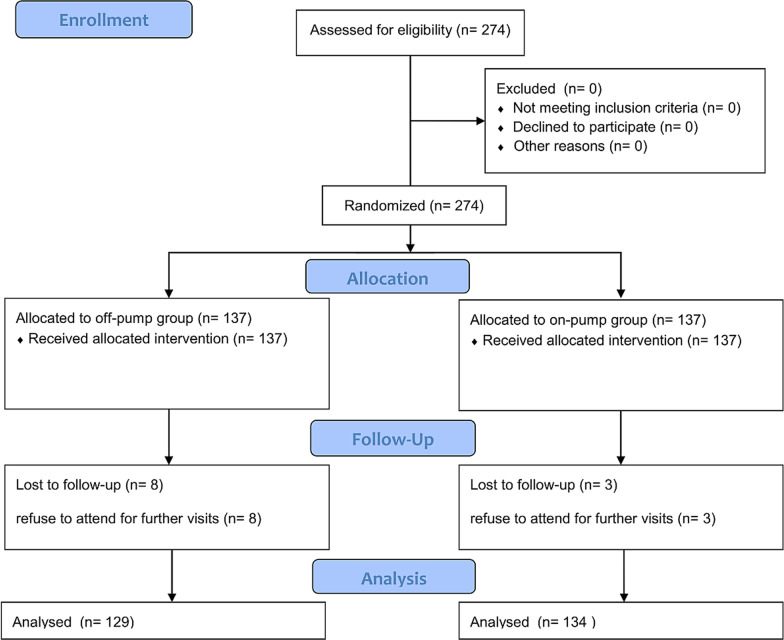
We randomly assigned 274 consecutive patients with 3VD to two equal groups to undergo on-pump CABG or off-pump CABG. The primary outcome was major adverse cardiac and cerebrovascular events (MACCE), including all-cause mortality, acute coronary syndrome, stroke or transient ischemic attack, and the need for repeat revascularization. The secondary outcomes were postoperative infection, ventilation time, ICU admission duration, hospital stay length, and renal failure after surgery.
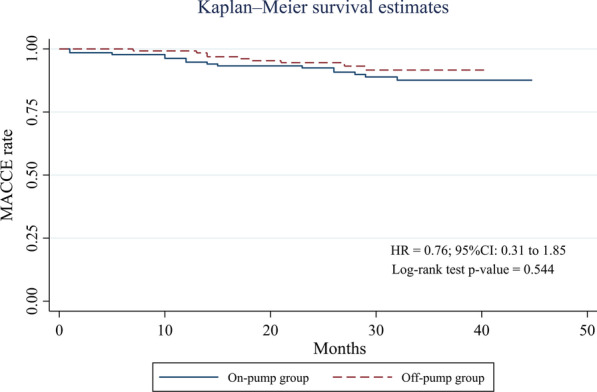
The median follow-up duration was 31.2 months (range 24.6-35.2 months). The mean age of patients was 61.4 ± 9.3 years (range: 38-86), and 207 (78.7%) were men. There were 15 (11.2%) and 9 (7.0%) MACCE occurrences in on-pump and off-pump groups, respectively (P value = 0.23). MACCE components including all-cause death, non-fatal MI, CVA, and revascularization did not significantly differ between on-pump and off-pump groups. We observed no difference in the occurrence of MACCE between off-pump and on-pump groups in multivariable regression analysis (HR = 0.57; 95% CI 0.24-1.32; P value = 0.192). There were no statistical differences in postoperative outcomes between the off-pump and on-pump CABG groups.
Off-pump CABG is an equal option to on-pump CABG for 3VD patients with similar rates of MACCE and postoperative complications incidence when surgery is performed in the same setting by an expert surgeon in both methods. (IRCT20190120042428N1).
已有多项研究比较了体外循环冠状动脉旁路移植术(CABG)与非体外循环 CABG 的早期和晚期结果。然而,对于这一问题仍存在争议,特别是对于三支血管病变(3VD)患者。
我们将 274 例连续的 3VD 患者随机分为两组,分别接受体外循环 CABG 或非体外循环 CABG。主要终点为主要不良心脑血管事件(MACCE),包括全因死亡率、急性冠状动脉综合征、卒中和短暂性脑缺血发作以及需要再次血运重建。次要终点为术后感染、通气时间、重症监护病房(ICU)住院时间、住院时间和术后肾功能衰竭。
中位随访时间为 31.2 个月(范围 24.6-35.2 个月)。患者平均年龄为 61.4±9.3 岁(范围:38-86 岁),207 例(78.7%)为男性。体外循环组和非体外循环组分别有 15 例(11.2%)和 9 例(7.0%)发生 MACCE(P 值=0.23)。体外循环组和非体外循环组在 MACCE 组成部分(包括全因死亡、非致命性心肌梗死、卒中和血运重建)方面无显著差异。多变量回归分析显示,非体外循环组和体外循环组的 MACCE 发生率无差异(HR=0.57;95%CI 0.24-1.32;P 值=0.192)。非体外循环 CABG 组和体外循环 CABG 组在术后结局方面无统计学差异。
在同一术者以相同的技术施行手术时,对于 3VD 患者,非体外循环 CABG 是体外循环 CABG 的等效选择,其 MACCE 发生率和术后并发症发生率相似。(IRCT20190120042428N1)。