Arthur Cecilia, Jylhä Cecilia, de Ståhl Teresita Díaz, Shamikh Alia, Sandgren Johanna, Rosenquist Richard, Nordenskjöld Magnus, Harila Arja, Barbany Gisela, Sandvik Ulrika, Tham Emma
Clinical Genetics, Karolinska University Hospital, 171 76 Stockholm, Sweden.
Department of Molecular Medicine and Surgery, Karolinska Institutet, 171 76 Stockholm, Sweden.
Cancers (Basel). 2023 Mar 25;15(7):1972. doi: 10.3390/cancers15071972.
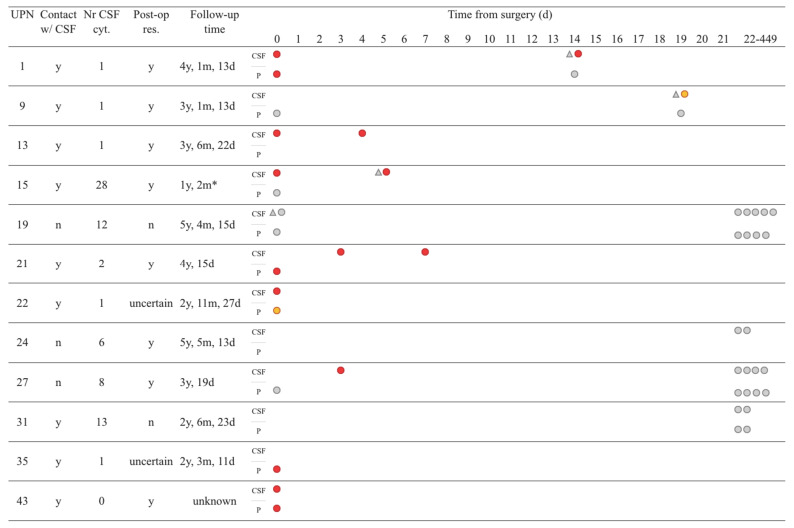
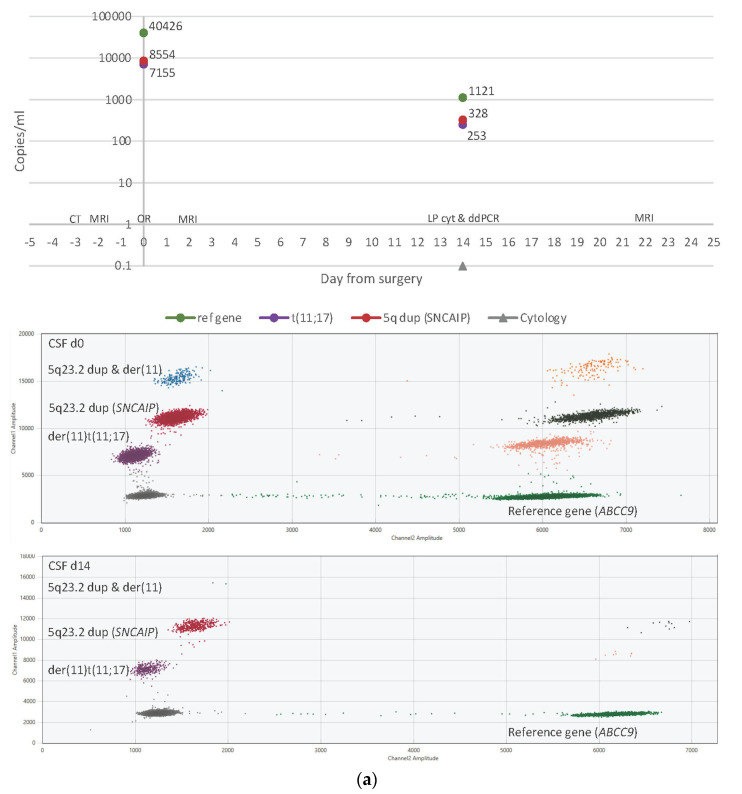
Medulloblastoma is a malignant embryonal tumor of the central nervous system (CNS) that mainly affects infants and children. Prognosis is highly variable, and molecular biomarkers for measurable residual disease (MRD) detection are lacking. Analysis of cell-free DNA (cfDNA) in cerebrospinal fluid (CSF) using broad genomic approaches, such as low-coverage whole-genome sequencing, has shown promising prognostic value. However, more sensitive methods are needed for MRD analysis. Here, we show the technical feasibility of capturing medulloblastoma-associated structural variants and point mutations simultaneously in cfDNA using multiplexed droplet digital PCR (ddPCR). Assay sensitivity was assessed with a dilution series of tumor in normal genomic DNA, and the limit of detection was below 100 pg of input DNA for all assays. False positive rates were zero for structural variant assays. Liquid biopsies (CSF and plasma, n = 47) were analyzed from 12 children with medulloblastoma, all with negative CSF cytology. MRD was detected in 75% (9/12) of patients overall. In CSF samples taken before or within 21 days of surgery, MRD was detected in 88% (7/8) of patients with localized disease and in one patient with the metastasized disease. Our results suggest that this approach could expand the utility of ddPCR and complement broader analyses of cfDNA for MRD detection.
髓母细胞瘤是一种中枢神经系统(CNS)的恶性胚胎性肿瘤,主要影响婴幼儿。其预后差异很大,且缺乏用于检测可测量残留疾病(MRD)的分子生物标志物。使用低覆盖度全基因组测序等广泛的基因组方法分析脑脊液(CSF)中的游离DNA(cfDNA)已显示出有前景的预后价值。然而,MRD分析需要更灵敏的方法。在此,我们展示了使用多重液滴数字PCR(ddPCR)在cfDNA中同时捕获髓母细胞瘤相关结构变异和点突变的技术可行性。用肿瘤在正常基因组DNA中的稀释系列评估检测灵敏度,所有检测的检测限均低于100 pg输入DNA。结构变异检测的假阳性率为零。对12例髓母细胞瘤患儿进行了液体活检(脑脊液和血浆,n = 47),所有患儿脑脊液细胞学检查均为阴性。总体上,75%(9/12)的患者检测到MRD。在手术前或手术21天内采集的脑脊液样本中,88%(7/8)的局限性疾病患者和1例转移性疾病患者检测到MRD。我们的结果表明,这种方法可以扩展ddPCR的应用,并补充对cfDNA进行更广泛的MRD检测分析。