Department of Life Sciences, School of Sciences, European University Cyprus, Nicosia 2404, Cyprus.
Cancer Genetics, Genomics and Systems Biology Group, Basic and Translational Cancer Research Center (BTCRC), Nicosia 1516, Cyprus.
Int J Mol Sci. 2023 Mar 31;24(7):6577. doi: 10.3390/ijms24076577.
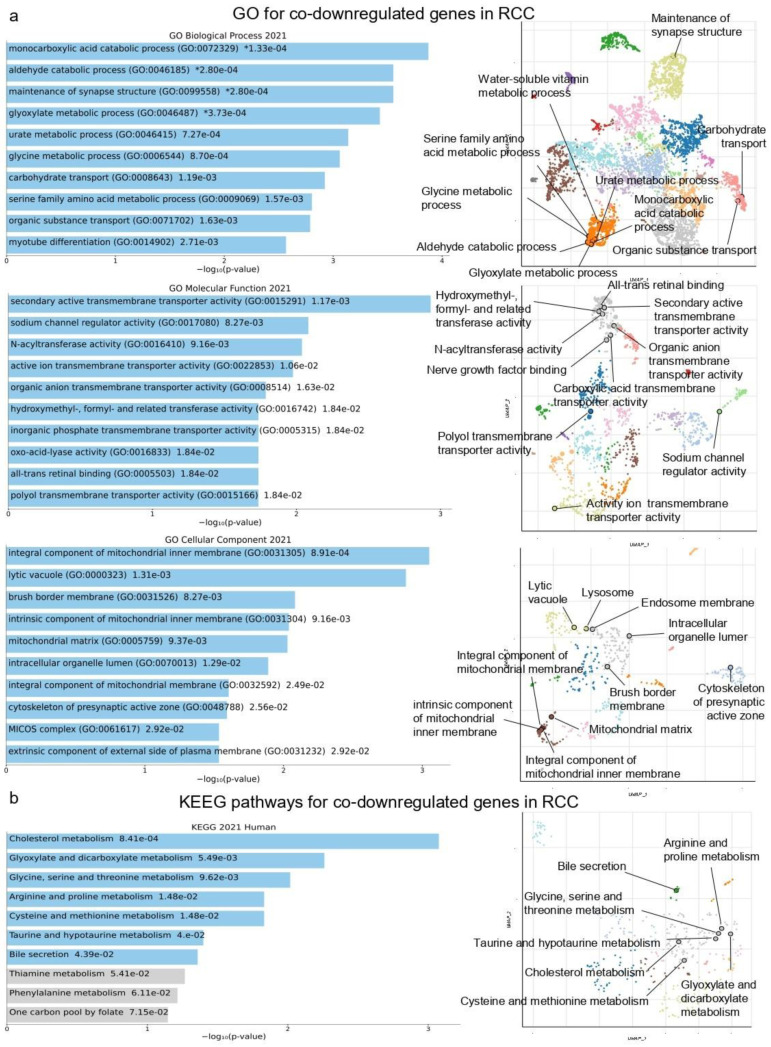
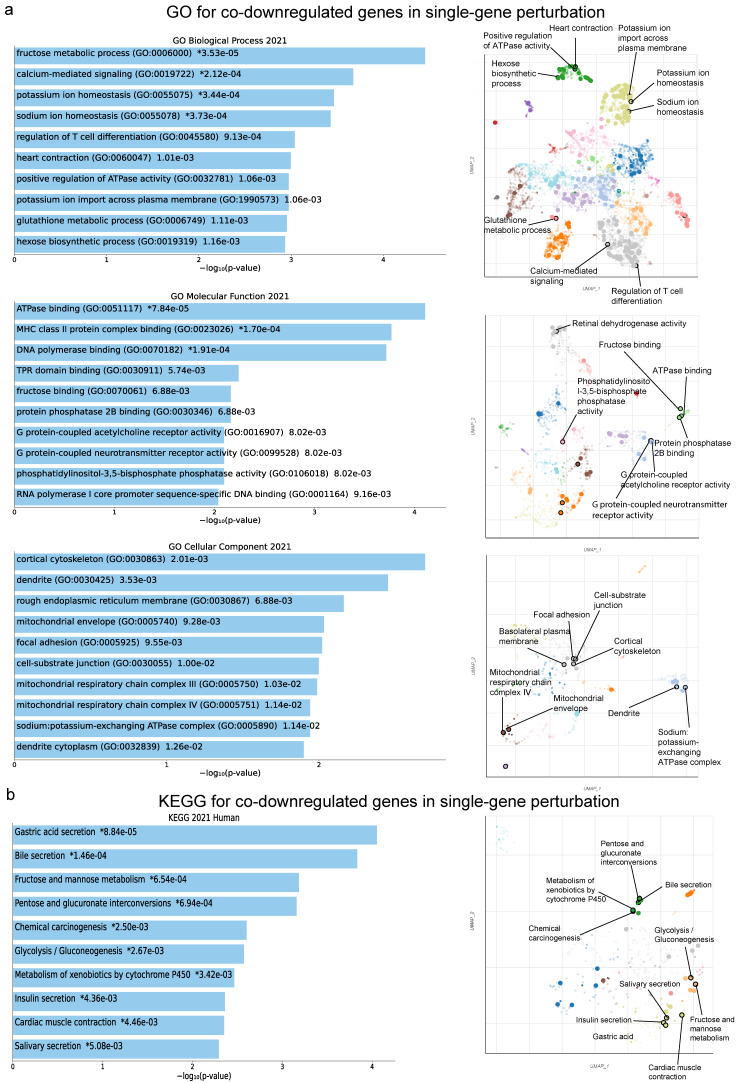
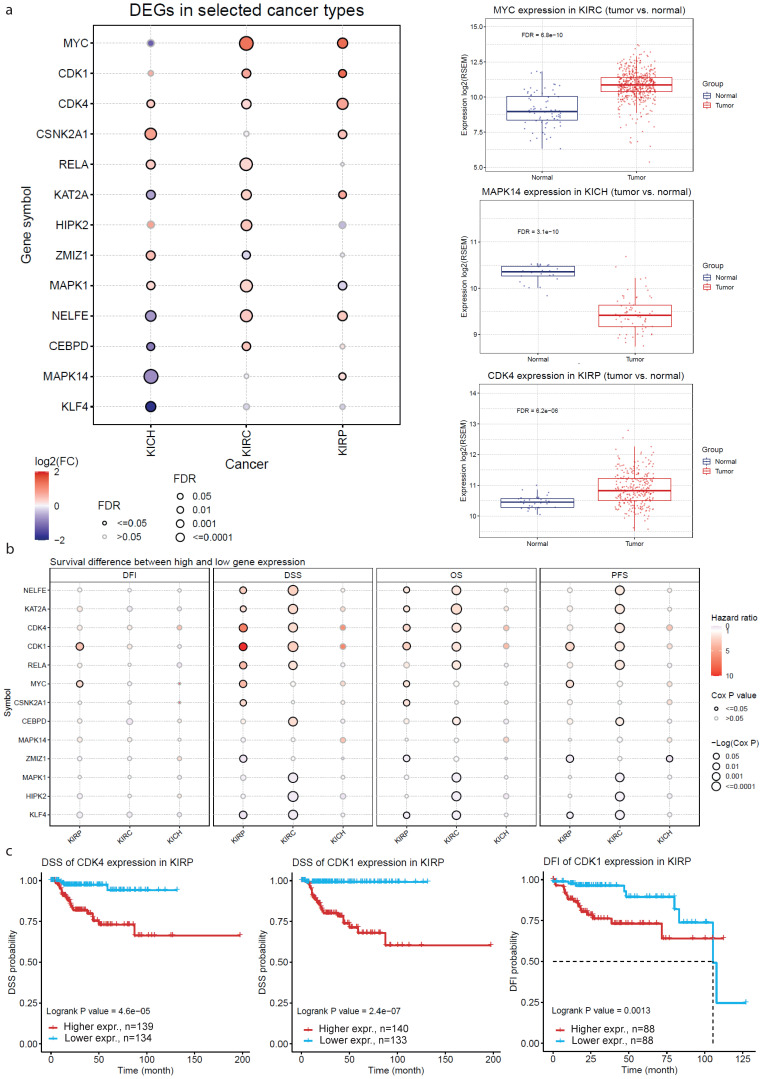
There are several studies on the deregulated gene expression profiles in kidney cancer, with varying results depending on the tumor histology and other parameters. None of these, however, have identified the networks that the co-deregulated genes (co-DEGs), across different studies, create. Here, we reanalyzed 10 Gene Expression Omnibus (GEO) studies to detect and annotate co-deregulated signatures across different subtypes of kidney cancer or in single-gene perturbation experiments in kidney cancer cells and/or tissue. Using a systems biology approach, we aimed to decipher the networks they form along with their upstream regulators. Differential expression and upstream regulators, including transcription factors [MYC proto-oncogene (MYC), CCAAT enhancer binding protein delta (CEBPD), RELA proto-oncogene, NF-kB subunit (RELA), zinc finger MIZ-type containing 1 (ZMIZ1), negative elongation factor complex member E (NELFE) and Kruppel-like factor 4 (KLF4)] and protein kinases [Casein kinase 2 alpha 1 (CSNK2A1), mitogen-activated protein kinases 1 (MAPK1) and 14 (MAPK14), Sirtuin 1 (SIRT1), Cyclin dependent kinases 1 (CDK1) and 4 (CDK4), Homeodomain interacting protein kinase 2 (HIPK2) and Extracellular signal-regulated kinases 1 and 2 (ERK1/2)], were computed using the Characteristic Direction, as well as GEO2Enrichr and X2K, respectively, and further subjected to GO and KEGG pathways enrichment analyses. Furthermore, using CMap, DrugMatrix and the LINCS L1000 chemical perturbation databases, we highlight putative repurposing drugs, including Etoposide, Haloperidol, BW-B70C, Triamterene, Chlorphenesin, BRD-K79459005 and β-Estradiol 3-benzoate, among others, that may reverse the expression of the identified co-DEGs in kidney cancers. Of these, the cytotoxic effects of Etoposide, Catecholamine, Cyclosporin A, BW-B70C and Lasalocid sodium were validated in vitro. Overall, we identified critical co-DEGs across different subtypes in kidney cancer, and our results provide an innovative framework for their potential use in the future.
有几项关于肾癌基因表达谱失调的研究,但由于肿瘤组织学和其他参数的不同,结果也各不相同。然而,这些研究都没有确定不同研究中共同失调基因(co-DEGs)所形成的网络。在这里,我们重新分析了 10 个基因表达综合数据库(GEO)研究,以检测和注释不同亚型肾癌或肾癌细胞和/或组织中单基因扰动实验中的共同失调特征。我们使用系统生物学方法,旨在破译它们形成的网络及其上游调节剂。差异表达和上游调节剂,包括转录因子[原癌基因 MYC(MYC)、CCAAT 增强子结合蛋白 delta(CEBPD)、RELA 原癌基因、NF-kB 亚单位(RELA)、锌指 MIZ 型包含 1(ZMIZ1)、负延伸因子复合物成员 E(NELFE)和 Kruppel 样因子 4(KLF4)]和蛋白激酶[酪蛋白激酶 2α1(CSNK2A1)、丝裂原激活蛋白激酶 1(MAPK1)和 14(MAPK14)、Sirtuin 1(SIRT1)、细胞周期蛋白依赖性激酶 1(CDK1)和 4(CDK4)、同源结构域相互作用蛋白激酶 2(HIPK2)和细胞外信号调节激酶 1 和 2(ERK1/2)],分别使用特征方向、GEO2Enrichr 和 X2K 进行计算,并进一步进行 GO 和 KEGG 途径富集分析。此外,我们使用 CMap、DrugMatrix 和 LINCS L1000 化学扰动数据库,突出显示可能具有重新用途的药物,包括依托泊苷、氟哌啶醇、BW-B70C、阿米洛利、氯苯那敏、BRD-K79459005 和 β-雌二醇 3-苯甲酸酯等,这些药物可能逆转肾癌中鉴定的共同失调基因的表达。其中,依托泊苷、儿茶酚胺、环孢素 A、BW-B70C 和拉沙洛西钠的细胞毒性作用在体外得到了验证。总的来说,我们在不同亚型的肾癌中确定了关键的共同失调基因,我们的结果为它们在未来的潜在应用提供了一个创新的框架。