Welch Mitchell, Sibanda Terence Zimazile, De Souza Vilela Jessica, Kolakshyapati Manisha, Schneider Derek, Ruhnke Isabelle
School of Science & Technology, University of New England, Armidale, NSW 2351, Australia.
Precision Agriculture Research Group, University of New England, Armidale, NSW 2351, Australia.
Animals (Basel). 2023 Mar 30;13(7):1202. doi: 10.3390/ani13071202.
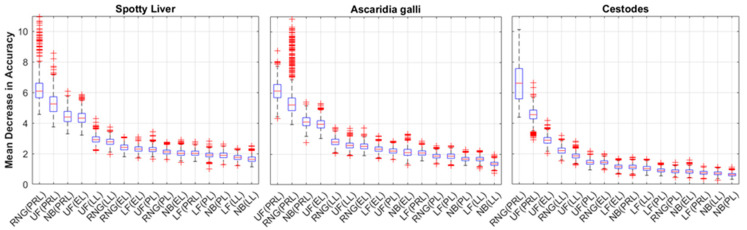
Maintaining the health and welfare of laying hens is key to achieving peak productivity and has become significant for assuring consumer confidence in the industry. Free-range egg production systems represent diverse environments, with a range of challenges that undermine flock performance not experienced in more conventional production systems. These challenges can include increased exposure to parasites and bacterial or viral infection, along with injuries and plumage damage resulting from increased freedom of movement and interaction with flock-mates. The ability to forecast the incidence of these health challenges across the production lifecycle for individual laying hens could result in an opportunity to make significant economic savings. By delivering the opportunity to reduce mortality rates and increase egg laying rates, the implementation of flock monitoring systems can be a viable solution. This study investigates the use of Radio Frequency Identification technologies (RFID) and machine learning to identify production system usage patterns and to forecast the health status for individual hens. Analysis of the underpinning data is presented that focuses on identifying correlations and structure that are significant for explaining the performance of predictive models that are trained on these challenging, highly unbalanced, datasets. A machine learning workflow was developed that incorporates data resampling to overcome the dataset imbalance and the identification/refinement of important data features. The results demonstrate promising performance, with an average 28% of Spotty Liver Disease, 33% round worm, and 33% of tape worm infections correctly predicted at the end of production. The analysis showed that monitoring hens during the early stages of egg production shows similar performance to models trained with data obtained at later periods of egg production. Future work could improve on these initial predictions by incorporating additional data streams to create a more complete view of flock health.
维持蛋鸡的健康和福利是实现最高生产效率的关键,对于确保消费者对该行业的信心也变得至关重要。散养蛋鸡生产系统代表了多样化的环境,存在一系列挑战,这些挑战会削弱鸡群的生产性能,而在更传统的生产系统中则不会遇到这些问题。这些挑战可能包括更多地接触寄生虫、细菌或病毒感染,以及由于活动自由度增加和与同伴互动而导致的受伤和羽毛损伤。能够预测个体蛋鸡在整个生产生命周期中这些健康挑战的发生率,可能会带来显著的经济节约机会。通过提供降低死亡率和提高产蛋率的机会,实施鸡群监测系统可能是一个可行的解决方案。本研究调查了使用射频识别技术(RFID)和机器学习来识别生产系统使用模式并预测个体母鸡的健康状况。文中呈现了对基础数据的分析,重点是识别对于解释在这些具有挑战性、高度不平衡的数据集上训练的预测模型性能具有重要意义的相关性和结构。开发了一种机器学习工作流程,该流程结合了数据重采样以克服数据集不平衡问题,并识别/优化重要的数据特征。结果显示出有前景的性能,在生产结束时,平均正确预测出28%的斑点肝病、33%的蛔虫感染和33%的绦虫感染。分析表明,在产蛋早期监测母鸡与使用产蛋后期获得的数据训练的模型表现相似。未来的工作可以通过纳入更多数据流以更全面地了解鸡群健康状况来改进这些初步预测。