Shaikh Sofia D, Sun Natalie, Canakis Andrew, Park William Y, Weber Horst Christian
Department of Medicine, Chobanian & Avedisian School of Medicine, Boston University, Boston, MA 02118, USA.
Division of Gastroenterology and Hepatology, University of Maryland School of Medicine, Baltimore, MD 21201, USA.
J Clin Med. 2023 Mar 28;12(7):2558. doi: 10.3390/jcm12072558.
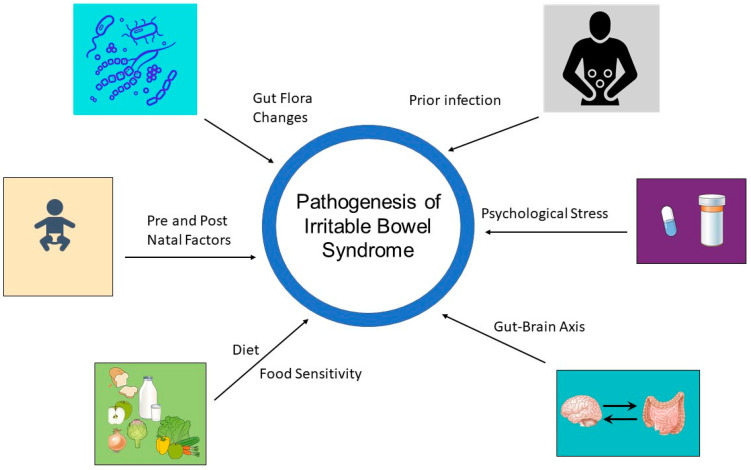
Irritable Bowel Syndrome (IBS) is a functional disorder of the gastrointestinal tract characterized by abdominal pain and altered bowel habits. It has a prevalence of 10 to 25% in the United States and has a high disease burden, as evidenced by reduced quality of life, decreased work productivity and increased healthcare utilization and costs. IBS has been associated with several intra-intestinal and extra-intestinal conditions, including psychiatric comorbidities. Although the pathophysiology of IBS has not been fully elucidated, it involves dysregulation of communication between the brain and gut (brain-gut axis) which is associated with alterations in intestinal motility, gut permeability, visceral hypersensitivity and gut microbiota composition. The purpose of this article is to review the role the gut microbiota plays in the pathophysiology of IBS, understand factors that affect the gut microbiome and explore the microbiome as a target of treatment.
肠易激综合征(IBS)是一种胃肠道功能紊乱疾病,其特征为腹痛和排便习惯改变。在美国,其患病率为10%至25%,疾病负担较重,表现为生活质量下降、工作效率降低以及医疗保健利用率和成本增加。IBS与多种肠内和肠外疾病相关,包括精神共病。尽管IBS的病理生理学尚未完全阐明,但它涉及大脑与肠道之间沟通的失调(脑-肠轴),这与肠道动力、肠道通透性、内脏超敏反应和肠道微生物群组成的改变有关。本文的目的是综述肠道微生物群在IBS病理生理学中的作用,了解影响肠道微生物组的因素,并探索将微生物组作为治疗靶点。