Faculty of Defence Science and Technology, National Defence University of Malaysia, Sungai Besi Camp, Kuala Lumpur 57000, Malaysia.
Faculty of Engineering, National Defence University of Malaysia, Sungai Besi Camp, Kuala Lumpur 57000, Malaysia.
Molecules. 2023 Mar 24;28(7):2920. doi: 10.3390/molecules28072920.
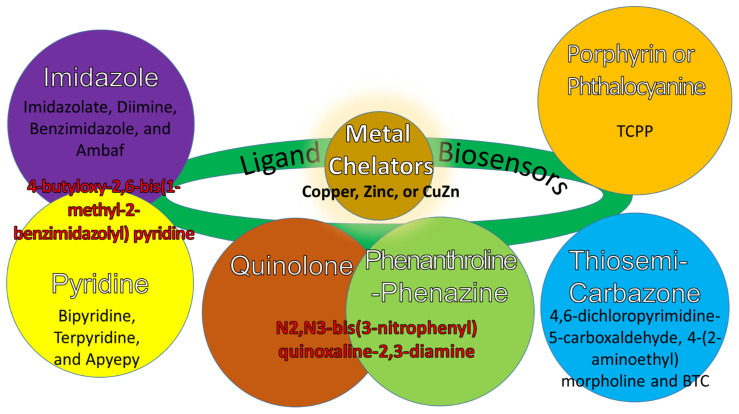
Due to its built-up chemoresistance after prolonged usage, the demand for replacing platinum in metal-based drugs (MBD) is rising. The first MBD approved by the FDA for cancer therapy was cisplatin in 1978. Even after nearly four and a half decades of trials, there has been no significant improvement in osteosarcoma (OS) therapy. In fact, many MBD have been developed, but the chemoresistance problem raised by platinum remains unresolved. This motivates us to elucidate the possibilities of the copper and zinc (CuZn) combination to replace platinum in MBD. Thus, the anti-chemoresistance properties of CuZn and their physiological functions for OS therapy are highlighted. Herein, we summarise their chelators, main organic solvents, and ligand functions in their structures that are involved in anti-chemoresistance properties. Through this review, it is rational to discuss their ligands' roles as biosensors in drug delivery systems. Hereafter, an in-depth understanding of their redox and photoactive function relationships is provided. The disadvantage is that the other functions of biosensors cannot be elaborated on here. As a result, this review is being developed, which is expected to intensify OS drugs with higher cure rates. Nonetheless, this advancement intends to solve the major chemoresistance obstacle towards clinical efficacy.
由于长期使用后产生的固有化疗耐药性,在金属基药物(MBD)中替代铂的需求正在上升。1978 年,FDA 批准的第一种用于癌症治疗的 MBD 是顺铂。即使经过近四分之一个世纪的试验,骨肉瘤(OS)的治疗也没有显著改善。事实上,已经开发出许多 MBD,但铂引起的化疗耐药性问题仍未得到解决。这促使我们阐明铜和锌(CuZn)组合替代 MBD 中铂的可能性。因此,强调了 CuZn 的抗化疗耐药性特性及其用于 OS 治疗的生理功能。在此,我们总结了它们的螯合剂、主要有机溶剂和结构中涉及抗化疗耐药性特性的配体功能。通过本次综述,可以合理地讨论其作为药物输送系统中生物传感器的配体作用。此后,提供了对其氧化还原和光活性功能关系的深入理解。缺点是生物传感器的其他功能无法在此处详细阐述。因此,正在开发这篇综述,预计将提高具有更高治愈率的 OS 药物。尽管如此,这一进展旨在解决临床疗效方面的主要化疗耐药性障碍。